

Quick answer: The best low profile GPU for small PCs in late 2026 is the RTX 5060 low profile, because it delivers 8GB of GDDR7 memory and DLSS 4 in a 69mm half height card. If your power supply has no spare 8 pin connector, the RTX 3050 6GB low profile is the strongest card that runs on slot power alone.
A slim office PC can be a great gaming machine, but only if the graphics card fits. A standard graphics card is too tall for a Dell OptiPlex SFF, an HP EliteDesk, a Lenovo ThinkCentre, or a slim living room case. The bracket slot in those cases is cut for a half height card, and no amount of force will change that. Buy the wrong card and you own a part that cannot go in the case.
This guide fixes that problem before you spend money. It explains what low profile really means, which cards run on slot power alone and which ones need an 8 pin cable, and which of the seven cards worth buying in late 2026 fits your case, your power supply, and your CPU. Every card here was checked against current manufacturer specs and late 2026 listings, and the price notes are a snapshot dated November 10, 2026, because prices in this market move fast.
What Makes a GPU Low Profile
A low profile graphics card is defined by its height. The PCIe specification caps a low profile card at 68.9mm, about 2.73 inches, which is roughly half the height of a standard full height card. A full 2026 list of every low profile card on the market uses the same 69mm figure for every model. That number is not a suggestion. The expansion slot opening in a slim case is cut to exactly that clearance, so a full height card physically cannot seat in the bracket cutout and the side panel will not close.
Height is the first check, but it is not the only one. Length matters too. Most low profile cards run 150mm to 182mm long, and some slim cases cap length well below that. Thickness matters as well. A low profile card can still be one slot thick or two slots thick. The single slot Sapphire Pulse RX 6400, for example, takes up one expansion slot, while most low profile gaming cards, including the RTX 5060 low profile, are dual slot designs that cover the slot below them. If your case has a Wi-Fi card or a capture card in the next slot, a dual slot GPU will block it.
Most low profile cards ship with two brackets in the box, a full height bracket fitted at the factory and a low profile bracket in the bag. Swap the bracket before you install the card. It takes two small screws and two minutes, and forgetting it is the most common first timer mistake in this category.
Do not confuse low profile with the other small card labels you will see in stores. A mini ITX card is short, but it is full height, so it will not fit a slim case. SFF-Ready is NVIDIA’s label for short full height cards, and it starts at the RTX 5070 tier, which means no RTX 5060 can carry the label. Low profile is its own thing: short bracket, 69mm height, built for slim cases and repurposed office PCs.
Slot Power Versus an 8 Pin Connector
The single most important number in this guide is 75 watts. A PCIe x16 slot can deliver up to 75W to a card. Any card rated at 75W or below can run on slot power alone, with no cable from the power supply. Any card rated above 75W needs an extra power connector, usually a single 8 pin plug.
This split decides your whole purchase, because most slim prebuilt PCs have power supplies with no spare PCIe connector at all. A Dell OptiPlex or HP EliteDesk power supply often has no 8 pin cable to give, and the unit itself may be rated at only 240W to 300W. If that describes your PC, your choices are limited to the slot powered cards, and that is fine. The slot powered list is short, but it holds the best value picks in this guide.
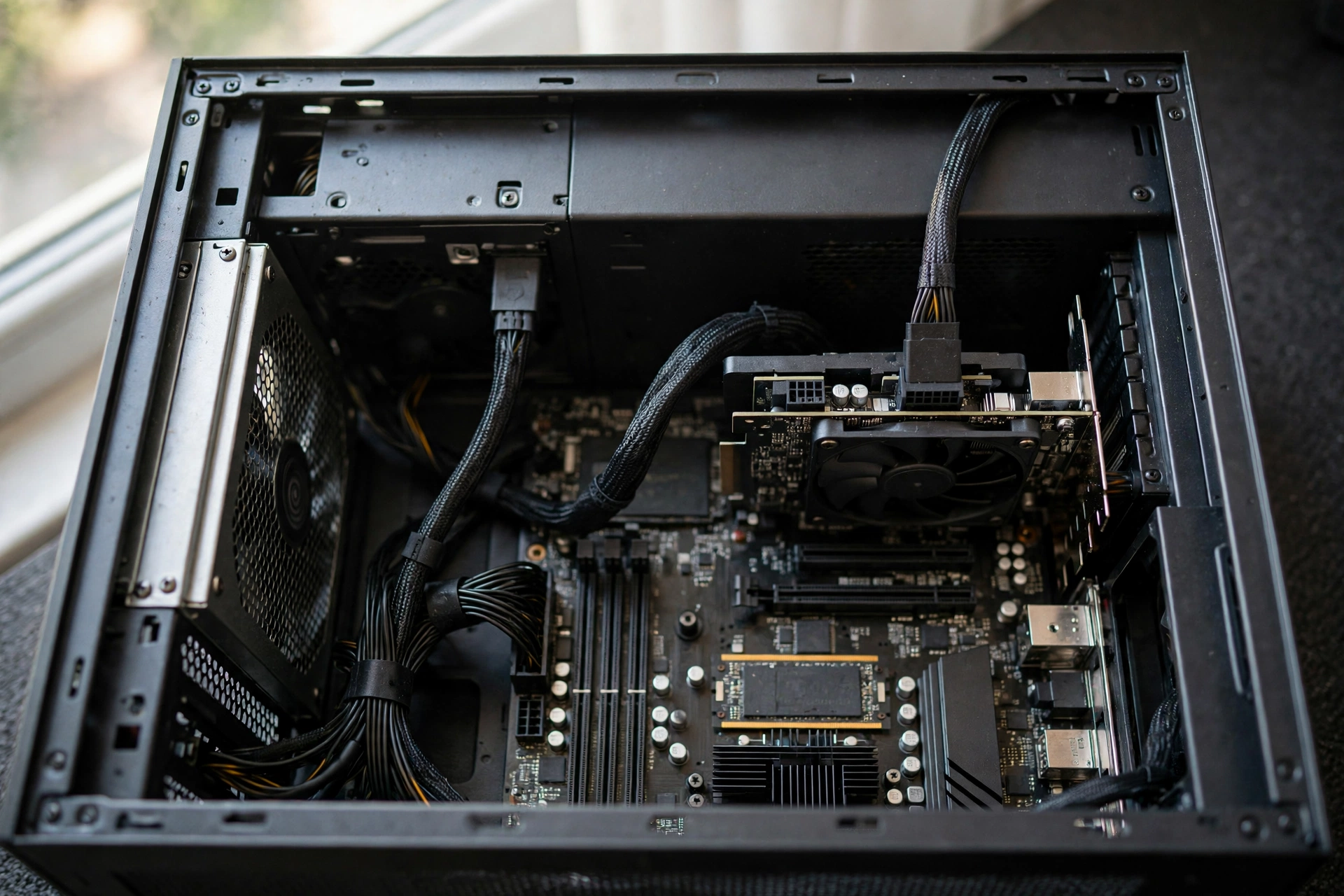
These are the slot powered low profile cards worth buying in late 2026:
- RX 6400 low profile, 53W. No cable needed, and the most forgiving fit in the category.
- Intel Arc A380 low profile, 75W. No cable needed, right at the slot limit.
- RTX 3050 6GB low profile, 70W. No cable needed, and the fastest slot powered gaming card you can buy.
- GTX 1650 low profile, 75W. No cable needed, an older card that still works for light gaming.
- GT 1030 low profile, 30W. No cable needed, but only for video playback and very light use.
Everything faster needs a cable. The RTX 5060 low profile draws 145W, the RTX 5050 low profile draws 130W, the RTX 4060 low profile draws 115W, and the RX 9060 XT low profile draws 140W. All of them need a single 8 pin connector and a power supply that can actually deliver it. Before you buy any of these, open the case and look for a spare 8 pin cable, and check the wattage printed on the power supply label. If you are unsure how to read that label, our guide on how to check what PSU you have walks through it step by step.
One more warning on power. A cheap adapter that turns two Molex plugs or a SATA power plug into an 8 pin connector is not a safe fix for a missing cable. Those adapters can melt under sustained load, and a slim prebuilt power supply was never built to feed a 145W card. If your power supply has no 8 pin cable, buy a slot powered card, or replace the power supply with a proper unit first.
Best Low Profile GPU Picks for Late 2026
Seven cards earn a place in this guide. They are ranked by what they do for a small form factor PC, not by raw speed alone, because fit, power, and thermals matter as much as frames in a case this small.
1. RTX 5060 Low Profile: Best Overall
The RTX 5060 low profile is the best low profile GPU you can buy in late 2026, and it is the first low profile card that feels like a real modern gaming card rather than a compromise. Gigabyte, Zotac, ASUS, and Maxsun all sell versions, all around 182mm long and 69mm tall, all dual slot, all with a single 8 pin connector.
The specs explain why it leads the list. TechPowerUp’s RTX 5060 specification page lists a Blackwell GPU with 3,840 CUDA cores, 8GB of GDDR7 memory on a 128-bit bus, and a 145W board power rating. It supports DLSS 4 with Multi Frame Generation, which matters a lot in a small case, because upscaling and frame generation let the card hit smooth frame rates without pushing more heat through a tiny cooler. Independent testing of the Zotac low profile version found it performs on par with full height RTX 5060 cards, with noise under load as the main trade off for the small cooler.
This is a 1080p high settings card that can stretch to 1440p with DLSS in most modern games. NVIDIA recommends a 550W system power supply, and you need a spare 8 pin connector. The catch is availability and price. Low profile versions carry a clear premium over the standard card’s $299 launch price, and US stock has been thin in late 2026, with no stable US listing found in early November. If you can find one near its launch price, buy it. If the markup is large, the RTX 5050 low profile below is the sensible step down.
2. RTX 5050 Low Profile: Best Budget Blackwell Card
The RTX 5050 low profile is the cheapest way into NVIDIA’s current generation in a slim case. The Gigabyte version measures 182mm long, uses 8GB of GDDR6 memory, 2,560 CUDA cores, and a 130W board power rating, and it needs a single 8 pin connector. It launched at a $249 MSRP, and Newegg listed the Gigabyte low profile model at $259.99 in July 2025, though it was out of stock at the time.
Expect 1080p medium to high settings in modern games, with DLSS 4 closing the gap in supported titles. It is not as fast as the RTX 5060 low profile, but it costs less and it is easier to find in stock in the UK and Europe, where it has been listed around £379.99. That UK price shows the low profile markup clearly, so check US listings before you decide the 5050 is the cheap option. It is the right pick when the RTX 5060 low profile is out of stock or overpriced, and you have an 8 pin connector to spare.
3. RTX 4060 Low Profile: Best Previous Generation Value
The RTX 4060 low profile is last generation’s card in this size, and it is still a good buy when it costs clearly less than the RTX 5060 low profile. The Gigabyte version is 182mm long, carries 8GB of GDDR6 memory, and draws 115W through a single 8 pin connector. It supports DLSS 3 frame generation, which keeps it competitive at 1080p high settings in most games.
The 4060 low profile makes sense in one situation: you find it at a real discount against the 5060 low profile. If the two cards cost nearly the same, take the 5060 low profile for the newer architecture, the GDDR7 memory, and DLSS 4. If the 4060 low profile is meaningfully cheaper, it is the same gaming experience in most titles for less money, and its lower 115W draw runs a little cooler in a cramped case.
4. RTX 3050 6GB Low Profile: Best Slot Powered Gaming Card
The RTX 3050 6GB low profile is the most important card in this guide for owners of slim prebuilt PCs, because it is the fastest low profile card that needs no power cable at all. The MSI and Gigabyte versions are about 181mm long, carry 6GB of GDDR6 memory, and draw just 70W from the PCIe slot. Drop it into a Dell OptiPlex or HP EliteDesk with a free x16 slot and a 300W power supply, and it works.
It handles 1080p medium to high settings in most games, supports DLSS and light ray tracing, and runs cool enough that its small fans stay quiet. It is also the card to buy when you are unsure about your power supply, because there is no cable to forget and no connector to hunt for. The only real limit is the 6GB of memory, which is fine at 1080p but tight if you push texture settings to ultra. For more on how much memory matters at this resolution, see our guide on whether 8GB of VRAM is enough.
5. RX 6400 Low Profile: Best Cheap Card
The RX 6400 low profile is the cheapest low profile card that still plays real games, and it is the easiest fit in the category. It carries 4GB of GDDR6 memory, draws only 53W from the slot, and needs no power cable. The Sapphire Pulse version is a true single slot card at 170mm long, which fits cases where even a dual slot low profile card will not.
It is an esports and light gaming card. Expect smooth frame rates in Valorant, League of Legends, CS2, and Fortnite at 1080p, and playable medium settings in older AAA games. Modern AAA titles at high settings will push past its 4GB of memory and its narrow PCIe 4.0 x4 link, so keep expectations honest. One technical note matters here: the x4 link means it loses more performance than usual on older PCIe 3.0 motherboards, so it is at its best in a system with a PCIe 4.0 slot. For the price, usually around $109 to $170 depending on the model, it is the right card for reviving an old office PC on a tight budget.
6. Intel Arc A380 Low Profile: Best for Media and Light Gaming
The Intel Arc A380 low profile is the odd one out, and it earns its place for one reason: media. It carries 6GB of GDDR6 memory, draws 75W from the slot with no cable needed, and its AV1 encode support makes it a strong pick for a home theater PC or a small streaming box. It also plays esports titles and lighter games well at 1080p.
Two things to check before buying it. First, Arc cards perform best with Resizable BAR enabled in the BIOS, and some older prebuilt motherboards do not support it, so confirm your system has it before you order. Second, Intel’s drivers have improved a lot since the Arc launch, but older DirectX 9 and DirectX 11 games can still run slower than on NVIDIA or AMD cards. If your library is mostly modern DirectX 12 games and media apps, the A380 is a good value at around $100 to $129. If you play a lot of older titles, the RX 6400 or RTX 3050 low profile is the safer pick.
7. RX 9060 XT Low Profile and RX 9050 Low Profile: The Watch List
Two AMD cards could change this category, but neither one is a safe buy yet, so they sit on the watch list rather than in the rankings. Vastarmor showed a low profile RX 9060 XT at CES 2026 with 16GB of GDDR6 memory, a 140W power rating, and a 172mm long triple fan cooler, all in a true 69mm half height design. It is the first low profile card with 16GB of memory, which would make it the best 1440p option in this size by a wide margin. The problem is availability. Vastarmor sells mainly in China, the estimated price is around $430, and no US release has been confirmed.
PowerColor is reportedly preparing a low profile RX 9050 with 8GB of GDDR6 memory and a 92W board power rating that needs an 8 pin connector, but the card has only leaked in a product listing, PowerColor has not confirmed it, and it may end up as an OEM only part. Do not plan a build around either card. Buy what is in stock today, and treat these two as cards to revisit in a few months.
If your work is CAD, video editing, or 3D rendering rather than gaming, one more card deserves a mention. The NVIDIA RTX A2000 is a single slot low profile workstation card with 12GB of memory and a 70W draw, and it needs no power cable. It costs more than the gaming cards here, but for professional apps in a tiny case it has no real rival.
Low Profile GPU Comparison Table
| Card | VRAM | Board Power | Power Connector | Slots | Length | Best For |
|---|---|---|---|---|---|---|
| RTX 5060 low profile | 8GB GDDR7 | 145W | 1x 8 pin | 2 | 182mm | Best overall, 1080p high and 1440p with DLSS |
| RTX 5050 low profile | 8GB GDDR6 | 130W | 1x 8 pin | 2 | 182mm | Budget Blackwell, 1080p medium to high |
| RTX 4060 low profile | 8GB GDDR6 | 115W | 1x 8 pin | 2 | 182mm | Previous generation value when discounted |
| RTX 3050 6GB low profile | 6GB GDDR6 | 70W | None, slot powered | 2 | 181mm | Best slot powered gaming card |
| RX 6400 low profile | 4GB GDDR6 | 53W | None, slot powered | 1 or 2 | 170mm | Cheapest real gaming card, tightest fit |
| Intel Arc A380 low profile | 6GB GDDR6 | 75W | None, slot powered | 2 | 170mm | Media PC, AV1 encode, light gaming |
| RX 9060 XT low profile | 16GB GDDR6 | 140W | Likely 1x 8 pin | 2 | 172mm | Watch list, China only so far |
Street Prices on November 10, 2026
Prices below are a snapshot dated November 10, 2026, taken from early November 2026 hardware roundups and listings, including PCGuide’s low profile roundup, which lists prices correct as of November 5, 2026. Treat them as a guide, not a quote, because low profile cards go in and out of stock and their prices move with the wider GPU market. Check the current listing before you buy, and be suspicious of any deal that looks far below these numbers.
| Card | Street Price, November 10, 2026 | Notes |
|---|---|---|
| RTX 5060 low profile | No stable US price, premium over the $299 launch price | Thin US stock in early November 2026 |
| RTX 5050 low profile | Around $260 in the US, £379.99 in the UK | $249 MSRP, Newegg listed $259.99 in July 2025 |
| RTX 4060 low profile | Varies, buy only at a clear discount to the 5060 low profile | Older stock, check listings |
| RTX 3050 6GB low profile | Around $170 to $220 | Best value when found near the low end |
| RX 6400 low profile | Around $109 to $170 | Sapphire single slot version near the low end |
| Intel Arc A380 low profile | Around $100 to $129 | Often the cheapest 6GB card in the list |
| RX 9060 XT low profile | Around $430 estimated | Vastarmor, China only, no US release confirmed |
The wider market explains why these prices look high. NVIDIA said on October 16 that the RTX 5090 has not been discontinued, but admitted supply is constrained, and the card has been missing from NVIDIA’s own US store since mid October, with the RTX 5080 following it out by the end of the month. Street prices for high end cards have climbed far above launch prices, and that pressure pushes buyers down the stack, which keeps midrange and low profile cards expensive too. If you need a card now, buy the card that fits your case and power supply at a price you can accept, and do not wait for a market-wide price drop that no one can promise. For a broader look at what your money buys at this budget, see our guide to the best GPU under 300 dollars.
Thermals in a Small Case What Actually Gets Hot
A low profile card has a small cooler by definition. Two or three tiny fans, a short heatsink, and very little room for air to move. That means heat and noise are the real limits in a small form factor build, more than raw speed. A 145W RTX 5060 low profile in a slim case with one exhaust fan will run hotter and louder than the same chip in a mid tower, and the card will slow itself down to protect itself if temperatures climb too high.
Airflow is the fix, and it is mostly about the case, not the card. Keep the intake clear, keep cables out of the fan path, and give the hot air somewhere to go. A slim case with a vented side panel over the GPU will run noticeably cooler than a sealed box. Clean the dust filters regularly, because a thin layer of dust on a small heatsink hurts more than it does on a big one. If the card still runs hot, a small undervolt through MSI Afterburner can cut a few degrees with no real performance loss, and a custom fan curve that ramps up earlier is better than letting the fans scream at full speed late.
The system around the card matters too. Small form factor PCs pack the CPU, the GPU, and the power supply into a tiny box, so heat from one part warms all the others. That is why the same thermal logic applies to the whole system, and our guide to mini PC bottlenecks and thermals covers the system level view, including CPU cooling and case airflow, so this guide does not repeat it here.
One practical tip: test the card with the case closed, not open. An open case on a bench gives the cooler fresh air it will never get in real use, and temperatures can rise 5 to 10 degrees once the side panel goes back on. Run a game for 20 minutes with the panel closed, watch the temperature, and listen to the fans. That is the number that matters.
Which CPU to Pair With Each Card
A low profile GPU does not need a flagship CPU. In fact, pairing a big CPU with a small card wastes money and adds heat to a case that cannot afford it. The goal is a CPU that keeps up with the card at 1080p without bottlenecking it, and no more.
| Card | CPU to Pair | Why It Fits |
|---|---|---|
| RTX 5060 low profile | Ryzen 5 7600 or Core i5-12400F | Fast enough for 1080p high and 1440p with DLSS, runs cool |
| RTX 5050 and RTX 4060 low profile | Ryzen 5 5600 or Core i5-12400F | Plenty for 1080p, cheap and widely available |
| RTX 3050 6GB low profile | Ryzen 5 5500 or Core i3-12100F | Matches the card, keeps the budget build balanced |
| RX 6400 low profile | Ryzen 5 3600 or Core i5-10400F | Fine for esports, and these CPUs are cheap used |
| Intel Arc A380 low profile | Core i3-12100F or Ryzen 5 5500 | Needs Resizable BAR, so pair with a board that supports it |
Do not pair an RTX 5060 low profile with a ten year old dual core CPU and expect smooth gaming. At 1080p the CPU does a lot of the work, and a weak processor will hold the card back no matter how good the GPU is. For a deeper look at the best match for the top card, see our guide to the best CPU for RTX 5060.
Memory deserves a note here too. The October 2026 Steam hardware survey puts the RTX 3060 back on top at 3.62 percent of surveyed systems, and 16GB of system RAM is again the most common configuration at 41.42 percent, with 8GB of video memory the most common amount at 26.92 percent. That tells you what most PC gamers actually run: a midrange card, 16GB of RAM, and 1080p. Plan your build to match that, with 16GB of system RAM as the target. RAM prices have been climbing fast in late 2026 as memory supply tightens, so buy the RAM with the build rather than planning to add it later at a higher price.
How to Check Fit Before You Buy
Five minutes with a tape measure saves a return shipment. Work through this checklist before you order any low profile card.
- Measure the bracket height. If your case takes half height cards, the slot opening is about 69mm tall. A full height card will not fit, no matter how short it is.
- Measure the length. Open the case and measure from the rear bracket to the first obstruction, usually a drive cage or the front panel. Most low profile cards are 170mm to 182mm long, and some slim cases stop at 170mm.
- Count the slots. A dual slot card covers the expansion slot below it. Check that nothing you need lives in that slot.
- Check the power supply. Look for a spare 6 pin or 8 pin PCIe cable, and read the wattage on the power supply label. No spare cable means a slot powered card only.
- Check the BIOS. Older prebuilt PCs sometimes need a BIOS update to boot a newer card, and some need the CSM or legacy boot setting changed. Check the manufacturer’s support page for your exact model before you buy.
- Check the display outputs. Low profile cards often have two DisplayPort outputs and one HDMI, and some use mini DisplayPort. Make sure your monitor cable matches, or budget for an adapter.
Mistakes That Waste Money
- Buying a full height card for a slim case. The most expensive mistake in this category. Check the bracket height first, every time.
- Buying a card that needs an 8 pin connector when the power supply has none. The card will not run without it, and a cheap Molex to 8 pin adapter is not a safe fix.
- Buying a GT 710, GT 610, or GT 1030 for gaming. These cards are for video playback and extra monitors, not modern games. A GT 1030 will run esports titles at low settings, but that is its ceiling.
- Ignoring the 4GB memory limit. The RX 6400 is a fine card for the price, but its 4GB of memory will struggle with high texture settings in modern games. If you play AAA titles, step up to a 6GB or 8GB card. For more on this, see our guide on whether full VRAM causes stuttering.
- Buying a used card without testing it. Low profile cards from office PCs are often fine, but a used card can hide worn fans or a history of overheating. Test before you pay when you can, and read our complete guide to checking GPU health before buying used if the deal is from a stranger.
- Forgetting the low profile bracket. The card ships with a full height bracket fitted. Swap it before installation, or the card will not line up with the case.
Frequently Asked Questions
What is the best low profile graphics card right now?
The RTX 5060 low profile is the best low profile graphics card right now, because it brings current generation performance, 8GB of GDDR7 memory, and DLSS 4 into a 69mm half height card. If your power supply has no spare 8 pin connector, the RTX 3050 6GB low profile is the best slot powered option.
What small graphic card should I buy for my compact PC?
Start with your power supply. If it has a spare 8 pin connector, buy the RTX 5060 low profile for the best performance or the RTX 5050 low profile to save money. If it has no spare connector, buy the RTX 3050 6GB low profile for gaming or the RX 6400 low profile for the lowest price. Measure the case length first in all cases.
Can I add a graphics card to a PC that only has integrated graphics?
Yes, in most cases. If your desktop PC has a free PCIe x16 slot and a low profile bracket opening, you can add a low profile card. Check that the power supply can handle the card, and pick a slot powered card like the RTX 3050 6GB low profile or the RX 6400 low profile if your power supply has no spare PCIe cable. Laptops cannot take an internal graphics card upgrade.
What power supply does an RTX 5060 low profile card need?
NVIDIA recommends a 550W system power supply for the RTX 5060, and the low profile versions need a single 8 pin PCIe connector. The card itself draws 145W, so a quality 450W to 550W unit with a spare 8 pin cable is enough in a typical build. Check the wattage and the cable before you buy.
Do all low profile GPUs run without a power connector?
No. Only cards rated at 75W or below run on slot power alone. That includes the RX 6400, the RTX 3050 6GB low profile, the Intel Arc A380 low profile, and the GTX 1650 low profile. Faster cards like the RTX 5060 low profile at 145W and the RTX 5050 low profile at 130W need a single 8 pin connector.
Can a low profile GPU play modern games?
Yes, the current generation ones can. The RTX 5060 low profile plays modern games at 1080p high settings and can stretch to 1440p with DLSS. The RTX 3050 6GB low profile handles 1080p medium to high settings. Older or cheaper cards like the RX 6400 and the GT 1030 are limited to esports titles and lighter games, so match the card to the games you actually play.
Key Takeaways
- Low profile means a 69mm half height bracket. Measure your case before you buy anything.
- The 75W slot power limit splits the market. Cards at 75W or below need no cable, and anything faster needs a single 8 pin connector.
- The RTX 5060 low profile is the best low profile GPU for most buyers in late 2026, with the RTX 5050 low profile as the budget step down.
- The RTX 3050 6GB low profile is the best slot powered gaming card, and the right pick for slim prebuilt PCs with no spare power cable.
- The RX 6400 low profile is the cheapest card that still plays real games, and the single slot version fits the tightest cases.
- Pair the card with a sensible CPU, 16GB of system RAM, and a power supply that has the cable the card needs.
- Prices move fast in late 2026, so treat the November 10, 2026 snapshot in this guide as a guide and check current listings before you buy.
Conclusion
The best low profile GPU is not the fastest card on the market. It is the fastest card that fits your case, runs on your power supply, and stays cool in a box with almost no airflow. For most small form factor PCs in late 2026, that card is the RTX 5060 low profile, with the RTX 3050 6GB low profile as the answer when your power supply has no spare cable, and the RX 6400 low profile as the answer when the budget is tight.
Measure twice, check the power cable once, and buy the card that matches the system you actually own. A slim PC with the right low profile card is a capable 1080p gaming machine, and it takes up no more desk space than the office PC it started as.

Leave a Reply