

An amd ryzen gaming pc build rewards balance more than any single expensive part. A strong graphics card paired with a weak processor will stall in CPU heavy scenes, while a flagship processor paired with a weak graphics card will leave gaming performance on the table at higher resolutions. The goal of this guide is to help you pick a Ryzen processor, a platform, memory, power supply, and graphics card that work together, so your money goes where it actually improves frame rates and smoothness.
This is one guide for the whole Ryzen build cluster, not a set of near identical articles for every chip. The same questions come up again and again: should you stay on AM4 or move to AM5, is a Ryzen 5 enough, when does a Ryzen 7 make sense, and how much RAM and power supply do you really need. Answering those questions together keeps the advice consistent, because a CPU choice changes the motherboard, the memory type, and the sensible upgrade path in one move.
Why Ryzen Builds Are Trending Again
Ryzen builds are back in the spotlight for practical reasons, not because of one launch. Many gamers already own AM4 boards and DDR4 memory, so a Ryzen 5000 series upgrade is a cheap way to extend a PC. At the same time, AM5 is now a mature platform with a longer future, so new builders have a clear reason to choose it. That split, between upgrading what you own and building fresh, is exactly why Ryzen dominates so many build discussions right now.
The October 2026 Steam Hardware Survey adds useful context. It puts the GeForce RTX 3060 back on top at 3.62 percent of surveyed systems, just ahead of the RTX 5070 at 3.56 percent, and it returns 16GB to the top of the system memory chart at 41.42 percent. Those figures describe surveyed Steam users, not the whole PC market, and Valve’s survey is voluntary, so treat them as a snapshot rather than a census. Still, the message for builders is clear: the typical gaming PC is still a midrange machine, not a flagship. A Ryzen 5 or Ryzen 7 paired with a midrange card matches what most players actually run.
November 2026 reports also matter for timing, and they must be labeled carefully. Reports in early November 2026 describe further RTX 50 series price rises from board partners, with larger reported increases on high end cards and smaller reported increases on mainstream cards. NVIDIA has not announced an equivalent worldwide change to official suggested prices in that reporting, so these are market reports, not official price changes. The practical lesson is simple: if your budget is tight, a proven midrange card and a balanced Ryzen CPU often beat stretching for a high end card whose street price has moved well above its launch price. Check current retail prices on the day you buy, because they move fast.
For the step by step assembly side, our complete build walkthrough covers the physical process in detail. This guide focuses on the decisions you make before you order parts, while that walkthrough covers putting them together. If you want a full parts list approach first, start with the decisions here, then follow the assembly steps there.
AM4 vs AM5 The Decision That Shapes Everything
AM4 and AM5 are not interchangeable. AM4 uses DDR4 memory, while AM5 uses DDR5 memory only. A CPU, motherboard, and memory kit must all belong to the same platform, so choosing a platform is really choosing three parts at once. That is why this decision deserves more thought than any single specification comparison.
AM4 makes sense in two situations. First, you already own an AM4 motherboard and DDR4 memory, and you want a drop in CPU upgrade. Second, you are building on a tight budget and the total cost of an AM4 board, a Ryzen 5000 series CPU, and DDR4 memory is clearly lower than the AM5 equivalent in your market. The Ryzen 5 5500 and Ryzen 5 5600X remain sensible AM4 gaming chips, and the Ryzen 7 5700X and 5800X3D class options give AM4 owners a strong final upgrade without replacing the whole platform.
AM5 makes sense when you are starting from scratch, when you want the longest upgrade path, or when you plan to keep the motherboard through more than one CPU generation. AMD has extended AM5 support in its platform announcements, and AM5 brings DDR5 and PCIe 5.0 support to the platform. AMD’s original platform details are in AMD’s Ryzen 7000 series launch announcement. The trade off is cost: you pay for a new board and DDR5 memory, and in a period of high memory prices that trade off is real. Do not let a future upgrade promise override a present budget problem. A balanced AM4 build you can afford now beats an unbalanced AM5 build with a weak graphics card.
Choosing Between Ryzen 5 and Ryzen 7
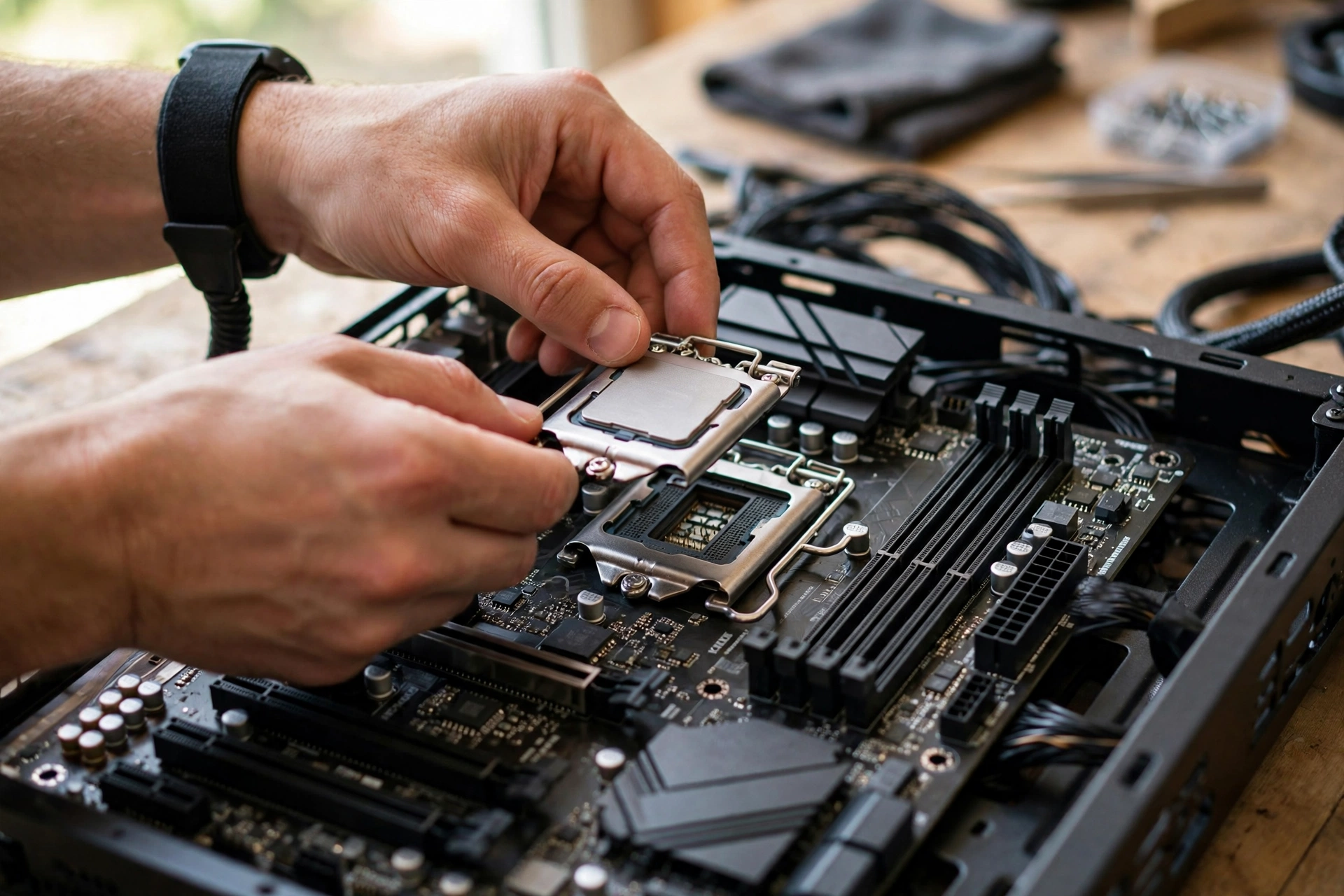
Ryzen 5 and Ryzen 7 are not a simple good versus better ranking. They are different tools for different workloads, and the right one depends on your resolution, your graphics card, and whether you stream, record, or multitask while gaming.
The Ryzen 5 5500 is an entry level AM4 option for budget 1080p builds. It has 6 cores and 12 threads, which is enough for most current games when paired with a modest graphics card, but it leaves less headroom for background tasks and for very CPU heavy titles. Choose it when the budget is the constraint and the graphics card is also modest, because a stronger CPU would not help a weak GPU at 1080p high settings in most games.
The Ryzen 5 5600X is the classic balanced AM4 gaming chip. AMD lists it as a 6 core, 12 thread AM4 processor with DDR4 support up to 3200 MT/s, a 65W TDP, and boost clocks up to 4.6 GHz. Those are manufacturer specifications, and they explain why the chip became so popular: it is efficient, it runs cool enough for a modest cooler, and it pairs well with midrange graphics cards. If you are upgrading an existing AM4 system, the 5600X is often the sweet spot between cost and gaming smoothness. You can confirm the official specifications on AMD’s Ryzen 5 5600X page.
Ryzen 7 builds make sense when you need more cores or more headroom. An 8 core Ryzen 7 helps if you stream while gaming, run Discord, a browser, and recording software at the same time, or play CPU heavy simulation and strategy titles. It also helps if you plan to upgrade to a much faster graphics card later, because the extra cores give the new card more room to work at 1080p and 1440p. For pure gaming at 4K with a midrange card, the difference between a Ryzen 5 and a Ryzen 7 is often small, because the graphics card becomes the limit first. That is the whole point of bottleneck thinking: buy the CPU for the resolution and card you will actually use, not for a theoretical maximum.
If you already have a build and you are unsure whether the CPU or the GPU is holding you back, measure before you spend. Our guide to finding a bottleneck walks through the checks that separate a CPU limit from a GPU limit, and it is worth reading before you replace a part that was never the problem.
What Each Budget Should Actually Buy
The table below groups builds by purpose rather than by exact price, because street prices change quickly and a price quoted today can be wrong next week. Use the tier as a template, then shop current prices in your region and adjust one tier up or down if a part is on sale.
| Tier | CPU | GPU pairing | Best for |
|---|---|---|---|
| Entry 1080p | Ryzen 5 5500 | Modest midrange card | Esports and 1080p gaming on a tight budget |
| Balanced 1080p and 1440p | Ryzen 5 5600X | Midrange card | Smooth 1080p high refresh and entry 1440p gaming |
| Strong 1440p | Ryzen 7 5700X class or AM5 Ryzen 7 | Strong midrange card | High refresh 1440p plus streaming and multitasking |
| High end 1440p and 4K | AM5 Ryzen 7 | High end card | Demanding titles at high settings and a longer upgrade path |
The balanced tier is where most builders should land, because the Ryzen 5 5600X leaves enough CPU headroom for a midrange card without wasting money on cores that gaming alone will not use. If your total budget is tight, our budget build guide shows how to allocate it without creating a new bottleneck. Avoid mixing tiers by more than one step, such as a high end card on an entry CPU, unless a planned upgrade in a few months explains the mix.
CPU and GPU Balance by Resolution
Resolution changes which part matters most. At 1080p, the CPU works harder relative to the GPU, because frames are cheaper to render and the processor must prepare more of them per second. At 1440p, the load shifts toward the GPU. At 4K, the GPU dominates in most titles, and even a midrange CPU can keep up if the card is strong enough. This is why the same CPU and GPU pair can look balanced at 4K and CPU limited at 1080p.
| Resolution | CPU guidance | GPU pairing | Notes |
|---|---|---|---|
| 1080p | Ryzen 5 is usually enough, Ryzen 7 for high refresh or streaming | Midrange card matched to your refresh rate | CPU limits show up first here, especially at high refresh rates |
| 1440p | Ryzen 5 for most games, Ryzen 7 for CPU heavy titles and multitasking | Strong midrange card | The most balanced resolution for a Ryzen 5 or Ryzen 7 build |
| 4K | Ryzen 5 can work, Ryzen 7 for headroom and future GPU upgrades | High end card | GPU is usually the limit, so do not overspend on the CPU alone |
Match your monitor to your build, not just your parts list to each other. A 1080p 60Hz monitor does not need the same CPU as a 1080p 240Hz monitor, because the high refresh target demands far more frames per second from the processor. Similarly, a 1440p 165Hz monitor is a different target from a 1440p 60Hz monitor. Write down your monitor resolution and refresh rate before you pick a CPU, and treat that target as part of the specification.
VRAM deserves its own check at every resolution. A card with too little VRAM will stutter in texture heavy games even if its raw speed looks fine on paper, and that stutter is easy to mistake for a CPU problem. Our check on whether 8GB of VRAM is enough explains where that limit appears and which settings expose it first, so read it before settling on a card with a small memory buffer.
RAM Capacity and EXPO
Memory is where Ryzen builds most often go wrong in quiet ways. The wrong type will not fit at all, the wrong capacity will cause stutter, and a kit running at the wrong speed will leave performance unused. All three problems are avoidable with a short checklist.
First, type follows platform. AM4 takes DDR4 only, and AM5 takes DDR5 only. There is no adapter that fixes a mismatch, so confirm the board and memory type together. Second, capacity: 16GB remains the most common configuration in the October 2026 Steam survey at 41.42 percent, but 32GB is the safer choice for a new build that will also stream, record, or keep many applications open. A 16GB build is workable for gaming alone, while a 32GB build removes memory capacity from the list of things you have to worry about. Third, configuration: two matched sticks in dual channel mode beat a single stick in almost every gaming case, so buy a kit, not two separate sticks bought months apart.
Speed and timings need care on both platforms. On AM4, DDR4-3600 is a widely used sweet spot for Ryzen 5000 series builds, even though AMD’s official specification for the 5600X lists DDR4 up to 3200 MT/s. Kits above the official specification run through overclocking profiles, so check your motherboard’s memory support list before buying an aggressive kit. On AM5, DDR5-6000 is a widely used sweet spot, and AMD EXPO profiles provide the one click way to run a DDR5 kit at its rated speed. AMD describes EXPO as its extended profiles technology for AM5, designed to give users preconfigured DDR5 overclocking profiles. You can read AMD’s own explanation on AMD’s EXPO technology page.
Enable the profile after building. A DDR5 kit installed without EXPO enabled will often run at a much lower base speed, and the builder may never notice. Enter the BIOS, enable EXPO on AM5 or the equivalent memory profile on AM4, save, and then confirm the reported speed in the BIOS or in your operating system. If the system fails to boot after enabling a profile, reset the BIOS, update it, and try a more conservative kit from the board maker’s support list rather than forcing unstable settings.
Our RAM guide covers how much memory gaming really needs in more depth, including where 16GB starts to struggle and where 32GB is simply peace of mind. Use it to settle the capacity question, then use this guide’s platform rules to settle the type and speed question.
PSU and Cooling The Hidden Bottlenecks
A power supply and a cooler rarely appear in frame rate charts, which is exactly why they cause so many build problems. A weak power supply can shut a PC down under load, cause crashes that look like driver problems, and limit future GPU upgrades. A weak cooler lets a CPU throttle, which looks like a sudden frame rate drop in long sessions rather than a steady low frame rate.
Size the power supply for the graphics card you plan to own, not just the one you buy today, if an upgrade is part of your plan. Check the card maker’s recommended wattage, leave headroom above it, and buy a reputable unit with the right connectors for your card. A cheap unit that meets the wattage number on paper but uses poor components is not a bargain, because it protects every other part in the build. If you are choosing between a slightly faster card and a better power supply on a tight budget, choose the power supply first when your current unit is old, unbranded, or already close to its limit.
Cooling follows a similar logic. The Ryzen 5 5600X ships with a stock cooler and a 65W TDP, so a modest tower cooler is usually plenty and often quieter. Higher core Ryzen 7 chips and hot cases need more attention, especially in small cases with restricted airflow. Watch temperatures under a sustained gaming load, not just at idle, and check that case fans actually move air through the case rather than recirculating hot air around the graphics card. If temperatures climb steadily over a long session and frame rates fall with them, cooling is the bottleneck, even though no benchmark chart will label it as one.
Upgrade Paths That Actually Make Sense
A good Ryzen build plan includes the second purchase, not just the first. The cheapest upgrade path is almost always the one that reuses the most parts, which is why AM4 owners should think twice before abandoning a working board and DDR4 kit.
If you own an AM4 board and DDR4 memory, the sensible path is a CPU upgrade within AM4, then a graphics card upgrade when prices and your monitor justify it. A Ryzen 5 5500 owner can move to a Ryzen 5 5600X or a Ryzen 7 class chip, depending on whether gaming smoothness or multitasking is the goal. A Ryzen 5 5600X owner should usually upgrade the graphics card next, not the CPU, unless streaming or CPU heavy work has become the new limit. Jumping to AM5 from a working AM4 system means replacing the CPU, board, and memory together, so it should wait until you need at least two of those three replaced anyway.
When the upgrade question is CPU versus GPU, do not guess. Our guide on whether to upgrade the CPU or GPU first walks through the symptoms that point each way, and it pairs well with the bottleneck checks earlier in this guide. In general, upgrade the part that is actually at its limit in the games you play, at the resolution and settings you use, not the part that looks oldest on paper.
Common Ryzen Build Mistakes
The first mistake is pairing a fast card with a slow CPU at 1080p high refresh and then blaming the card. At high refresh rates the CPU must prepare frames quickly, and no graphics setting fixes a processor that cannot keep up. Lowering settings can even make a CPU limit more visible, because the GPU finishes frames faster and waits on the CPU more often.
Putting the Finished Build Together
Once the parts are chosen, the build itself rewards patience more than speed. Install the CPU carefully, align it with the socket marker, and never force it. Install memory in the slots your motherboard manual recommends for two sticks, usually the second and fourth slots from the CPU, because the wrong slots can disable dual channel mode. Mount the cooler evenly, connect its fan, and confirm that it clears the memory and the case side panel before closing up.
Frequently Asked Questions
Which motherboard and processor should I buy for a gaming PC?
This is a real question asked on Quora, close to its original wording. The short answer is to pick the processor first, then a motherboard that matches its socket and your needs. For a Ryzen build, that means an AM4 board with DDR4 for a Ryzen 5000 series chip, or an AM5 board with DDR5 for a Ryzen 7000 or 9000 series chip. Spend on solid power delivery and the features you will use, such as enough M.2 slots and rear USB ports, rather than on extreme overclocking features you will never touch. A midrange B550 board suits most AM4 builds, and a midrange B650 board suits most AM5 builds.
Should I stay on AM4 or jump to AM5?
This is the recurring question asked on r/buildapc, where builders ask it in many forms. Stay on AM4 if you already own a working AM4 board and DDR4 memory, especially if a CPU upgrade alone solves your problem. Jump to AM5 if you are building from scratch, if your board and memory both need replacing anyway, or if you want the longest platform future and you can afford the board plus DDR5 memory without weakening your graphics card choice. If the AM5 move forces you down a graphics card tier, stay on AM4 and keep the better card.
Does an 8 core AMD Ryzen offer any benefits for a typical user over a 4 core Ryzen in common PC tasks and gaming?
This is a real question asked on Quora, close to its original wording. For a typical user, the jump from 4 cores to 8 cores helps most with multitasking, streaming, and newer games that use more threads, while older or lightly threaded games may show little difference. In this guide’s terms, that is the Ryzen 7 argument: more cores help when you do more than just play one game at a time, or when you want headroom for a future graphics card upgrade. If you only play one game at a time on a modest card, a modern 6 core Ryzen 5 is usually the better value, and the money saved belongs in the graphics card or in 32GB of memory.
Is a Ryzen 5 enough for gaming in 2027?
For most gamers, yes, provided the graphics card and monitor match. A Ryzen 5 5600X class chip handles 1080p and 1440p gaming well with a midrange card, and it leaves room for background applications. It becomes a limit mainly at high refresh 1080p, in CPU heavy simulation and strategy titles, or when paired with a much faster graphics card than the tier table recommends. If any of those apply to you, step up to a Ryzen 7 rather than forcing a Ryzen 5 to do a job it was not chosen for.
Should I buy DDR4 or DDR5 for a new Ryzen build?
Buy the memory type your platform requires, because there is no choice once the platform is set. AM4 means DDR4 and AM5 means DDR5. For a new build with no parts to reuse, DDR5 on AM5 is the forward looking choice. For an upgrade to an existing AM4 system, DDR4 is the correct and cheaper choice, and reusing a good DDR4 kit is one of the best savings in PC building.
Conclusion
A successful amd ryzen gaming pc build is a balanced system, not a showcase part. Choose AM4 when you already own the platform or when the total system cost clearly favors it, and choose AM5 when you are building fresh and you value the longer upgrade path. Pick a Ryzen 5 for balanced 1080p and 1440p gaming, pick a Ryzen 7 when streaming, multitasking, or a future graphics card upgrade demands more headroom, and match the graphics card to your monitor’s resolution and refresh rate. Buy matched dual channel memory, enable its profile, size the power supply for the card you will own next, and keep airflow in mind from the first boot. Do those things, and your Ryzen build will spend its budget on frame rates you can feel, instead of on a bottleneck you could have avoided.

Leave a Reply