

Quick verdict: One question settles the RTX 5070 vs RX 9070 XT debate: ray tracing or VRAM. If you play ray-traced games, stream with NVENC, or depend on DLSS 4 Multi Frame Generation, buy the RTX 5070. If you play raster-first games at 1440p and want the most memory headroom, buy the RX 9070 XT. In November 2026 both cards sell for nearly the same street price, around $1,010 to $1,035 new, so the choice comes down to features, not money.
This is the most common graphics card question of late 2026, and it is also one of the most confusing. The two cards launched within a day of each other in early 2025, at nearly the same price, and they target the exact same gamer: someone building or upgrading a 1440p PC. One has more memory. The other has better ray tracing and better upscaling. One uses less power. The other wins raw speed. Every comparison seems to crown a different winner, because the winner depends on what you play.
This guide cuts through that confusion. It compares the real specifications from Nvidia and AMD, the 1440p performance as independent reviewers report it, the ray tracing gap, the 12GB versus 16GB VRAM question, DLSS 4 against FSR 4, power and PSU needs, and the actual November 2026 street prices. By the end, you will know which card fits your games, your monitor, and your budget.
RTX 5070 vs RX 9070 XT at a Glance
Both cards launched in March 2025, one day apart, and both aim at 1440p gaming. But they are built very differently. Nvidia’s card uses the Blackwell architecture with faster GDDR7 memory on a narrower bus. AMD’s card uses the RDNA 4 architecture with more memory on a wider bus. Here are the official numbers, from Nvidia and AMD’s official RX 9070 XT specifications.
| Specification | RTX 5070 | RX 9070 XT |
|---|---|---|
| Architecture | Nvidia Blackwell, GB205 | AMD RDNA 4, Navi 48 |
| Cores | 6,144 CUDA cores | 4,096 stream processors, 64 compute units |
| Video memory | 12GB GDDR7 | 16GB GDDR6 |
| Memory bus | 192-bit | 256-bit |
| Memory bandwidth | 672 GB/s | Up to 640 GB/s |
| Boost clock | Up to 2,512 MHz | Up to 2,970 MHz |
| Board power | 250W total graphics power | 304W typical board power |
| Minimum PSU | 650W | 750W |
| Launch price (MSRP) | $549 | $599 |
| Launched | March 5, 2025 | March 6, 2025 |
Do not compare the core counts directly. Nvidia’s CUDA cores and AMD’s stream processors are not the same thing, and 6,144 of one is not automatically faster than 4,096 of the other. The numbers that matter in this table are the memory, the power, and the price. The RX 9070 XT gives you 4GB more video memory and a wider bus. The RTX 5070 gives you faster memory, lower power draw, and a lower launch price. The rest of this guide shows how those differences play out in real games.
If you want the wider family picture, our RX 9070 vs RTX 5070 comparison covers the non-XT AMD card against the same Nvidia card, and our RTX 4070 Super vs RTX 5070 guide shows what the previous generation offers at this price level.
Where the RX 9070 XT Pulls Ahead
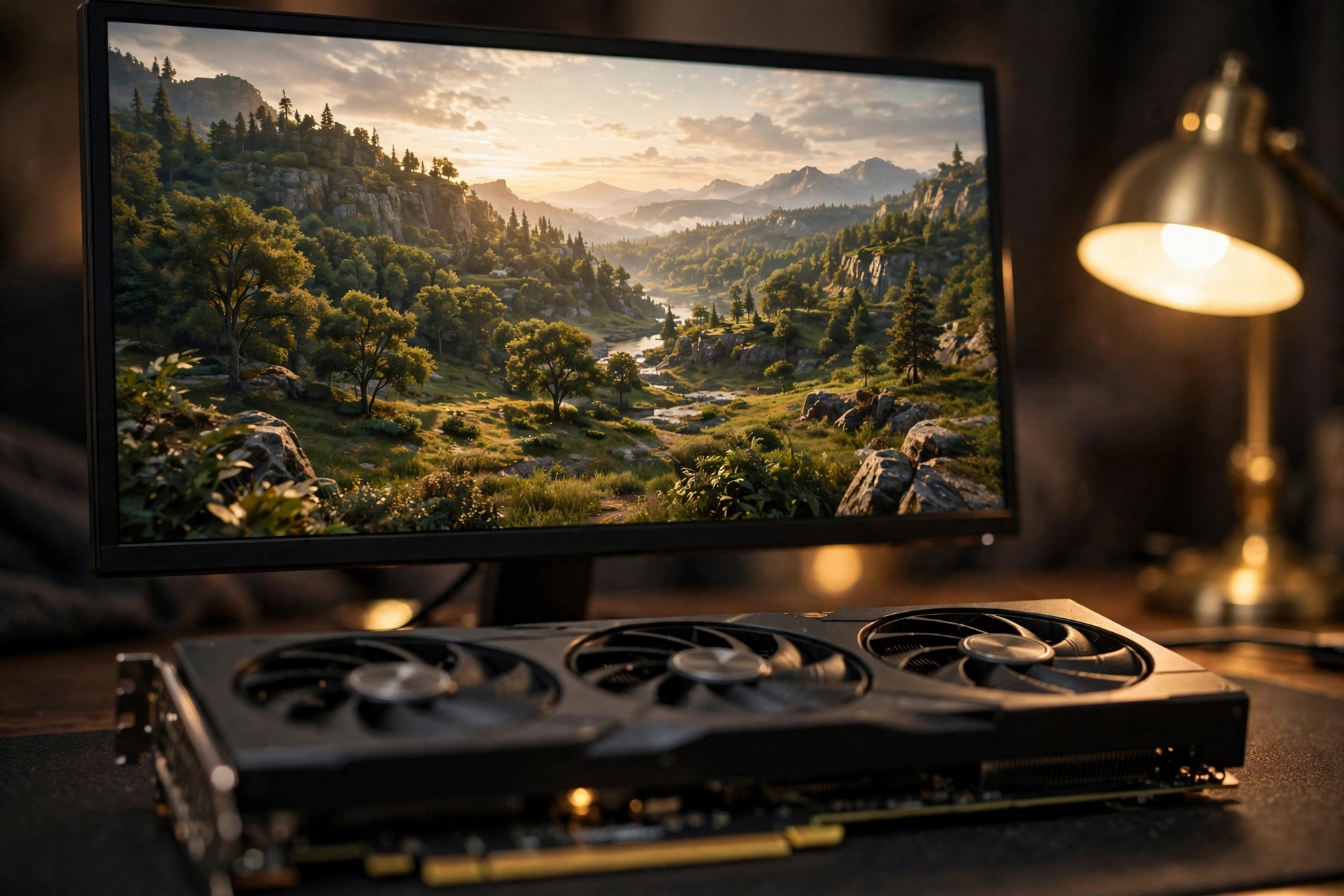
At pure rasterization, meaning traditional rendering with no ray tracing and no upscaling, the RX 9070 XT is the faster card at 1440p. The comparisons agree on the direction, even if they disagree on the exact size of the lead. Hardware Unboxed’s 30-game average put the RX 9070 XT roughly 11 percent above the RTX 5070 at 1440p native. TechPowerUp’s launch-review summary put the RTX 5070 at about 82 percent of the RX 9070 XT at 1440p, which works out to a lead of around 20 percent for the AMD card. A 30-game comparison from PCBuildHelper found the RX 9070 XT averaging 106 frames per second against 89 for the RTX 5070 at 1440p on high settings, again about a 20 percent lead. NanoReview’s game average showed a 19 percent lead at 1440p.
A sensible planning number is a lead of about 10 to 20 percent for the RX 9070 XT at 1440p in raster-heavy games, with the exact figure depending on the titles you play. The lead grows at 4K, where the extra memory and wider bus help more, and it shrinks at 1080p, where both cards are fast enough that the CPU often becomes the limit instead.
What does that lead feel like in practice? In a demanding single-player game at 1440p ultra settings, the RX 9070 XT is the card more likely to hold 60 frames per second without help. The RTX 5070 will often need DLSS upscaling to reach the same smoothness in the same scene. In competitive shooters at high refresh rates, both cards are fast, and the difference matters less, because you will probably lower settings for frame rate anyway.
Two cautions belong here. First, these are averages across many games. In any single game, the order can flip. Some games favor Nvidia’s architecture, and some favor AMD’s. Check the games you actually play, not the average. Second, driver updates move the numbers. Both companies have improved performance since launch, and a comparison from March 2025 is not the same as one from November 2026. Use recent comparisons when you can.
Ray Tracing Where the RTX 5070 Fights Back
Turn on ray tracing and the order reverses. The RTX 5070 is clearly the stronger ray tracing card, and the gap is bigger than the raster gap in the other direction. TechPowerUp’s data, as summarized in 2026 comparisons, puts the RTX 5070 about 25 to 35 percent ahead of the RX 9070 XT in ray-traced workloads at 1440p. In fully ray-traced games such as Cyberpunk 2077 and Alan Wake 2, the Nvidia card pulls clearly ahead.
This matters more than it used to, because ray tracing is no longer a niche feature. Big 2026 releases use ray-traced lighting, shadows, and reflections as core parts of their look, not as optional extras. Path tracing, the heaviest form of ray tracing, widens the gap further, and it is the one area where the RTX 5070 wins by a margin that no amount of VRAM can close.
That said, context matters. The RX 9070 XT is not bad at ray tracing. AMD’s RDNA 4 architecture improved ray tracing a lot over the previous generation, and the card handles ray tracing at 1440p in most games. It simply does it slower than the RTX 5070. If you play ray-traced games occasionally, the RX 9070 XT is fine. If ray tracing is the main reason you are upgrading, or if you play path-traced games, the RTX 5070 is the right card.
The honest way to decide is to count your games. Open your library and sort it. If most of your hours go to raster-first games such as competitive shooters, strategy games, and open world games without heavy ray tracing, the RX 9070 XT’s raster lead matters more. If most of your hours go to ray-traced showcases, the RTX 5070’s ray tracing lead matters more. The card that wins is the one that wins in your games.
The Memory Gap That Matters
The memory gap is the simplest difference between these cards, and for many buyers it is the deciding one. The RTX 5070 has 12GB of GDDR7 memory. The RX 9070 XT has 16GB of GDDR6 memory. That is 4GB more, or one third more, on the AMD card.
Video memory holds textures, geometry, and frame buffers. When it runs out, the game has to shuffle data back and forth to system RAM, and that causes stutter, texture pop-in, and sudden frame drops. Our guide on what happens when video memory runs out explains the symptoms in detail, and our guide on whether 8GB of VRAM is enough shows how quickly modern games fill a small buffer.
At 1080p, 12GB is comfortable. At 1440p with high or ultra textures, 12GB is enough today, but the margin is thin, and it is getting thinner every year. At 4K, 12GB is already tight in the most demanding games. The 16GB on the RX 9070 XT gives you room that the RTX 5070 does not have, and that room matters more the longer you keep the card.
There is one nuance. The RTX 5070’s GDDR7 memory is faster: 672 GB/s of bandwidth against 640 GB/s on the RX 9070 XT. Faster memory moves data quicker, which helps in some workloads. But bandwidth is not capacity. When a game needs more than 12GB of textures, faster memory does not save you. Capacity is the wall, and the RX 9070 XT’s wall is further away.
Think about how long you keep a graphics card. If you upgrade every two years, 12GB will probably carry you through. If you keep a card for four or five years, 16GB is the safer bet. Games only get heavier, and the card you buy today has to run the games of 2028 and 2029, not just the games of 2026.
DLSS 4 vs FSR 4 in 2026
Upscaling is now part of the buying decision, not an afterthought. Both cards have AI upscaling, but the two systems are not equal.
DLSS 4 is Nvidia’s system, and its headline feature is Multi Frame Generation. It can generate up to three extra frames for every real frame, which can double or triple your displayed frame rate in supported games. It only works on RTX 50 series cards, and it needs game support, but where it works, it is the single biggest frame rate advantage either card has. DLSS 4 also includes improved upscaling quality, and it works in a large and growing list of games.
FSR 4 is AMD’s answer, and it is the company’s first AI-powered upscaler. It runs on RDNA 4 cards, including the RX 9070 XT, and its image quality is much closer to DLSS than AMD’s older FSR versions were. FSR 4 is a strong upscaler. What it does not have is a direct equivalent to DLSS 4 Multi Frame Generation in the same form. AMD has frame generation technology, but it does not multiply frames the way DLSS 4 does.
What this means in practice: in a game that supports both systems, the RTX 5070 can use Multi Frame Generation to reach frame rates the RX 9070 XT cannot match, even though the AMD card is faster in raw rendering. In a game that supports neither, the RX 9070 XT’s raw speed wins. In a game that supports only FSR, the two cards are closer, because the RX 9070 XT gets good upscaling too.
Check the games you play. If your favorite games support DLSS 4, the RTX 5070 gains a real advantage. If they support FSR 4 or neither, the RX 9070 XT’s raster lead and extra VRAM matter more. Upscaling support is a library question, not a spec sheet question.
Power, Heat, and PSU What Your Build Needs
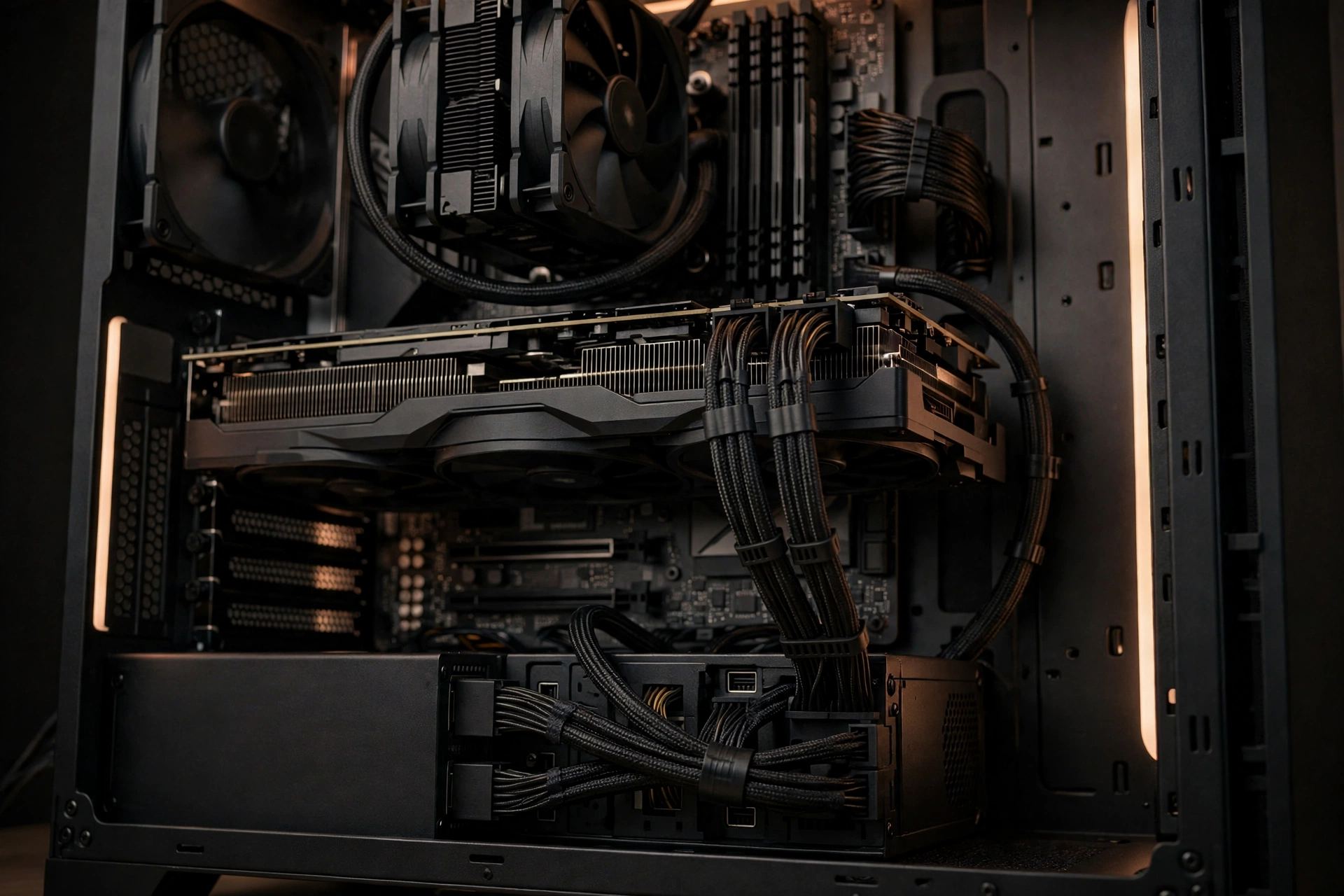
The two cards also differ in what they ask from your power supply. The RTX 5070 has a total graphics power of 250W, and Nvidia recommends a 650W system power supply. The RX 9070 XT has a typical board power of 304W, and AMD recommends a minimum 750W power supply. That is a 54W gap in board power and a 100W gap in the PSU recommendation.
In a real build, that gap means three things. First, the RX 9070 XT needs a stronger PSU, and if your current unit is 650W, it is fine for the RTX 5070 but short for the RX 9070 XT. Second, the RX 9070 XT produces more heat, so it needs better case airflow. Third, the running cost is slightly higher, though the difference on an electricity bill is small for most gamers.
Transient power spikes deserve a mention, because they cause crashes that people blame on drivers or games. Modern graphics cards can spike well above their rated power draw for a fraction of a second. A good quality PSU with headroom handles those spikes. A cheap PSU at its limit does not. If you are buying either card, buy a good PSU with at least 100W of headroom above the recommendation, and make sure it is a reputable unit, not the cheapest one on the shelf.
If you need help picking a unit, our guide to the best 750W PSUs for gaming covers the wattage the RX 9070 XT needs, and it explains the 80 Plus ratings and the ATX 3.1 standard in plain language.
Which GPU to Buy at Current Prices
This is where the comparison changed completely in 2026. At launch, the RTX 5070 cost $549 and the RX 9070 XT cost $599, a $50 gap in AMD’s favor on value. In November 2026, that gap is gone, because street prices for both cards have climbed far above their launch prices.
| Card | Launch MSRP | November 2026 Street Price (New) | Used Price |
|---|---|---|---|
| RTX 5070 | $549 | About $1,011 | About $715 |
| RX 9070 XT | $599 | About $1,035 | About $875 |
The street prices above come from VideoCardPrices on November 10, 2026, which lists the RX 9070 XT at $1,034.99 new and the RTX 5070 at $1,010.92 new. The two cards sit within about 2 percent of each other, so at current prices the decision should come down to features, not money. The used prices from the same source are $875 for the RX 9070 XT and $715 for the RTX 5070 on eBay.
Prices are still moving. WCCFTech reported on November 3, 2026 that manufacturers confirmed further price increases across the RTX 50 series in November, with the RTX 5070 rising by $90 to $135 at the factory level, and the RX 9070 XT approaching the $1,000 mark. AMD’s own product page marked the RX 9070 XT as not available for purchase on October 30, 2026, which tells you something about supply. Treat every price in this section as a snapshot from early November 2026, and check live listings before you buy.
So which GPU should you buy at current prices? If the prices are nearly equal, buy on features. Ray tracing, DLSS 4, streaming, and lower power point to the RTX 5070. Raster speed and 16GB of VRAM point to the RX 9070 XT. Neither card is a bargain at these prices, and neither is a bad buy. The mistake is buying on the launch MSRP, which no longer exists, or waiting for a price drop that the market is not offering.
If you are considering a used card to save money, be careful. A used RTX 5070 at around $715 is a real saving, but only if the card is healthy. Read our guide on how to check a used graphics card before you buy it first. A card that ran hot for years is not a bargain at any price.
Which Card Fits Which Gamer?
| Your Situation | Buy This | Why |
|---|---|---|
| 1440p raster-first AAA games | RX 9070 XT | About 10 to 20 percent faster, 16GB VRAM |
| Ray-traced and path-traced games | RTX 5070 | 25 to 35 percent faster in ray tracing |
| Streaming with NVENC | RTX 5070 | Nvidia encoder and broadcast features |
| Content creation and CUDA apps | RTX 5070 | CUDA support, better app compatibility |
| Long-term card, 4 to 5 years | RX 9070 XT | 16GB VRAM ages better |
| Small case or weak airflow | RTX 5070 | 250W vs 304W, less heat |
| 650W PSU, no upgrade planned | RTX 5070 | 650W is enough for the 5070, not the 9070 XT |
| 4K gaming | RX 9070 XT | Extra VRAM and raster speed help at 4K |
| High refresh competitive gaming | Either | Both are fast; pick on price and features |
The pattern is clear. The RX 9070 XT is the better pure gaming card for raster workloads and the better long-term card because of its memory. The RTX 5070 is the better all-round card because of ray tracing, DLSS 4, streaming, and creation apps. Neither card is wrong. The wrong choice is buying the card that wins in benchmarks for games you never play.
Bottleneck Check Will Your CPU Hold Either Card Back?
A graphics card comparison is only half the story. Either of these cards can be held back by a weak CPU, and at 1080p the CPU matters even more than the GPU. At 1440p, the graphics card does most of the work, so the CPU matters less, but a very old processor will still cost you frames.
As a rule of thumb, pair either card with a modern 6-core or 8-core CPU. A Ryzen 5 7600X, Ryzen 7 7800X3D, Ryzen 7 9800X3D, Core i5-13600K, or Core i7-14700K will all feed these cards well at 1440p. Our guide to the best CPU for the RTX 5070 goes through the pairings in detail, and our check on whether a Ryzen 7 7700X bottlenecks the RTX 5070 answers that specific pairing question.
Two specific warnings. First, if you have an old 4-core CPU, upgrade it before you buy either card. You will not see what the card can do. Second, if you play competitive games at high refresh rates, the CPU matters more than the graphics card, because frame rates are so high that the processor becomes the limit. In that case, spend the money on the CPU first.
One interesting finding from recent testing is worth knowing. In a budget PC scaling test, the RX 9060 XT beat the RTX 5070 when both were paired with a slow CPU, because Nvidia’s driver overhead costs more CPU time. The same effect applies here in a smaller way: with a slow CPU, the RX 9070 XT’s lead grows, because AMD’s cards lean less on the processor. With a fast CPU, the gap narrows to the pure hardware difference. Either way, the CPU you pair with the card changes the result.
Common Mistakes to Avoid
Buying on launch MSRP. The RTX 5070 launched at $549 and the RX 9070 XT at $599. Neither card sells for that price in November 2026. Both are around $1,010 to $1,035 new. Judge the cards on what they cost today, not what they cost in March 2025.
Ignoring VRAM. Twelve gigabytes is enough today at 1440p, but the margin is thin. If you keep cards for years, 16GB is the safer choice. Do not buy the card with less memory and then wonder why textures stutter in two years.
Buying a card your PSU cannot feed. The RX 9070 XT needs a 750W PSU. The RTX 5070 needs 650W. A cheap or aging PSU at its limit causes crashes that look like driver problems. Check your unit before you buy.
Judging by one benchmark. Averages hide the truth. The RX 9070 XT wins raster averages and the RTX 5070 wins ray tracing averages. Check the games you play, not the headline number.
Paying a scalper price without checking used cards. A healthy used RTX 5070 at around $715 is a big saving over a new one at around $1,011. Test before you pay, and walk away from any seller who will not let you test.
Forgetting upscaling support. DLSS 4 Multi Frame Generation only works in supported games on RTX 50 series cards. FSR 4 only works on RDNA 4 cards. Check your library before you count on either feature.
Frequently Asked Questions
Is the RX 9070 XT faster than the RTX 5070?
Yes, in traditional rasterization at 1440p. Independent comparisons put the RX 9070 XT about 10 to 20 percent ahead of the RTX 5070 at 1440p without ray tracing or upscaling. The RTX 5070 is faster in ray tracing, by about 25 to 35 percent. Which card is faster for you depends on the games you play.
Is 12GB VRAM enough on the RTX 5070?
Yes for 1080p and for 1440p today, with a thin margin. At 1440p with high textures, 12GB is enough right now, but it is getting tight, and it is already tight at 4K in demanding games. The RX 9070 XT’s 16GB gives you more headroom, and that matters more the longer you keep the card.
Does the RTX 5070 or RX 9070 XT use more power?
The RX 9070 XT uses more power. Its typical board power is 304W against 250W for the RTX 5070, and AMD recommends a minimum 750W power supply against 650W for the RTX 5070. The RX 9070 XT also produces more heat, so it needs better case airflow.
Which is better for ray tracing?
The RTX 5070 is clearly better for ray tracing. It is about 25 to 35 percent faster in ray-traced workloads at 1440p, and the gap grows in fully path-traced games such as Cyberpunk 2077 and Alan Wake 2. The RX 9070 XT handles ray tracing well, but it is slower at it.
What PSU do I need for each card?
Nvidia recommends a 650W system power supply for the RTX 5070. AMD recommends a minimum 750W power supply for the RX 9070 XT. Buy a good quality unit with at least 100W of headroom above the recommendation, and check that your PSU is not old or low quality before you install a new card.
Should I buy now or wait?
Prices in November 2026 are well above launch prices for both cards, and manufacturers confirmed further increases during the month. If you need a card now, buy on features, because the two cards cost nearly the same. If you can wait, waiting may help, but there is no sign of a price drop coming soon. Do not buy on the launch MSRP, because that price no longer exists.
- The RX 9070 XT is about 10 to 20 percent faster at 1440p rasterization, and it has 16GB of VRAM against 12GB.
- The RTX 5070 is about 25 to 35 percent faster in ray tracing, and it has DLSS 4 Multi Frame Generation.
- The RTX 5070 uses less power at 250W and needs a 650W PSU. The RX 9070 XT uses 304W and needs a 750W PSU.
- In November 2026, both cards cost nearly the same new, around $1,010 to $1,035, so buy on features, not price.
- DLSS 4 and FSR 4 both matter, but only in games that support them. Check your library first.
- Pair either card with a modern 6-core or 8-core CPU, or the processor becomes the bottleneck.
Conclusion
The RTX 5070 vs RX 9070 XT question has no single winner, and that is the honest answer. The RX 9070 XT wins raw speed and memory. The RTX 5070 wins ray tracing, upscaling, streaming, and power efficiency. At November 2026 prices, they cost nearly the same, so the money does not decide it. Your games decide it.
Count your library. If ray tracing, DLSS 4, and streaming fill your hours, buy the RTX 5070. If raster-first AAA games at 1440p fill your hours, and you want the card to last four or five years, buy the RX 9070 XT. Either way, check your CPU and your power supply first, because a great graphics card in an unbalanced PC is money wasted. Buy the card that fits your PC and your games, not the card that wins a benchmark chart for games you never play.

Leave a Reply