

Quick answer: The Ryzen AI Halo Developer Platform, launched October 12, 2026, is a compact desktop powered by the 16-core Ryzen AI Max+ PRO 495 with up to 192GB of unified LPDDR5x memory (160GB allocatable as VRAM). It can run 300-billion-parameter AI models locally at 4-bit quantization. The Linux version costs $7,299.99 at Micro Center.
The most important spec in AI hardware right now is not teraflops. It is gigabytes. A graphics card with 24GB of VRAM simply cannot load a 70-billion-parameter language model, no matter how fast its cores are. Memory capacity is the hard wall, and the Ryzen AI Halo Developer Platform just raised that wall dramatically on the desktop.
On October 12, 2026, AMD launched the next Ryzen AI Halo Developer Platform: a mini-PC-sized system built around the Ryzen AI Max+ PRO 495 processor with up to 192GB of unified memory shared between the CPU, integrated GPU, and NPU. Up to 160GB of that pool can be assigned as graphics memory. For comparison, the most expensive consumer graphics card you can buy tops out at 32GB of VRAM.
This article covers what the platform is, the full specifications, what unified memory actually changes for AI workloads, how the integrated GPU compares to a discrete graphics card, who should buy one, how it stacks up against NVIDIA’s DGX Spark and Apple’s Mac Studio, and what PC builders should learn from it.
If you want the deeper technical background on why unified memory changes the bottleneck picture, our unified memory gaming PC analysis covers the architecture in detail. This article focuses on the product itself and what it means for you.
Table of Contents
- What Is the Ryzen AI Halo Developer Platform?
- Full Specifications: What Is Inside the Box
- What 192GB of Unified Memory Actually Means
- Integrated GPU vs Discrete GPU for Local AI
- Who Should Buy It, and Who Should Skip It
- Halo vs DGX Spark vs Mac Studio
- What This Means for PC Builders
- Frequently Asked Questions
- Key Takeaways
What Is the Ryzen AI Halo Developer Platform?
The Ryzen AI Halo Developer Platform is a compact, ready-to-run desktop system AMD sells to AI developers, researchers, and creators who want to build and run large AI models locally instead of renting cloud GPUs. The new version, announced October 12, 2026, upgrades the formula introduced earlier in 2026 with the first-generation Halo (built on the Ryzen AI Max+ 395 with 128GB of memory and a $3,999 price).
The pitch is simple: one small, quiet box on your desk that can hold and run AI models far too large for any consumer graphics card. AMD positions it for local agent workflows, image and video generation, music tools, 3D applications, and large language model experimentation, with what it calls serious local AI performance in a compact, quiet system (AMD).
Availability details from the launch: the Linux configuration is orderable now through Micro Center at $7,299.99, in-store pickup only with no shipping offered. A Windows version incorporating Microsoft’s Project Zenith is described as coming soon, with no firm date. (Guru3D)
The platform also includes the Ryzen AI Developer Center, a software hub with preloaded applications and models, guided AI Playbooks for common workflows, and validated software configurations (ROCm, drivers, frameworks) tested together so developers are not assembling a fragile DIY software stack.
Full Specifications: What Is Inside the Box
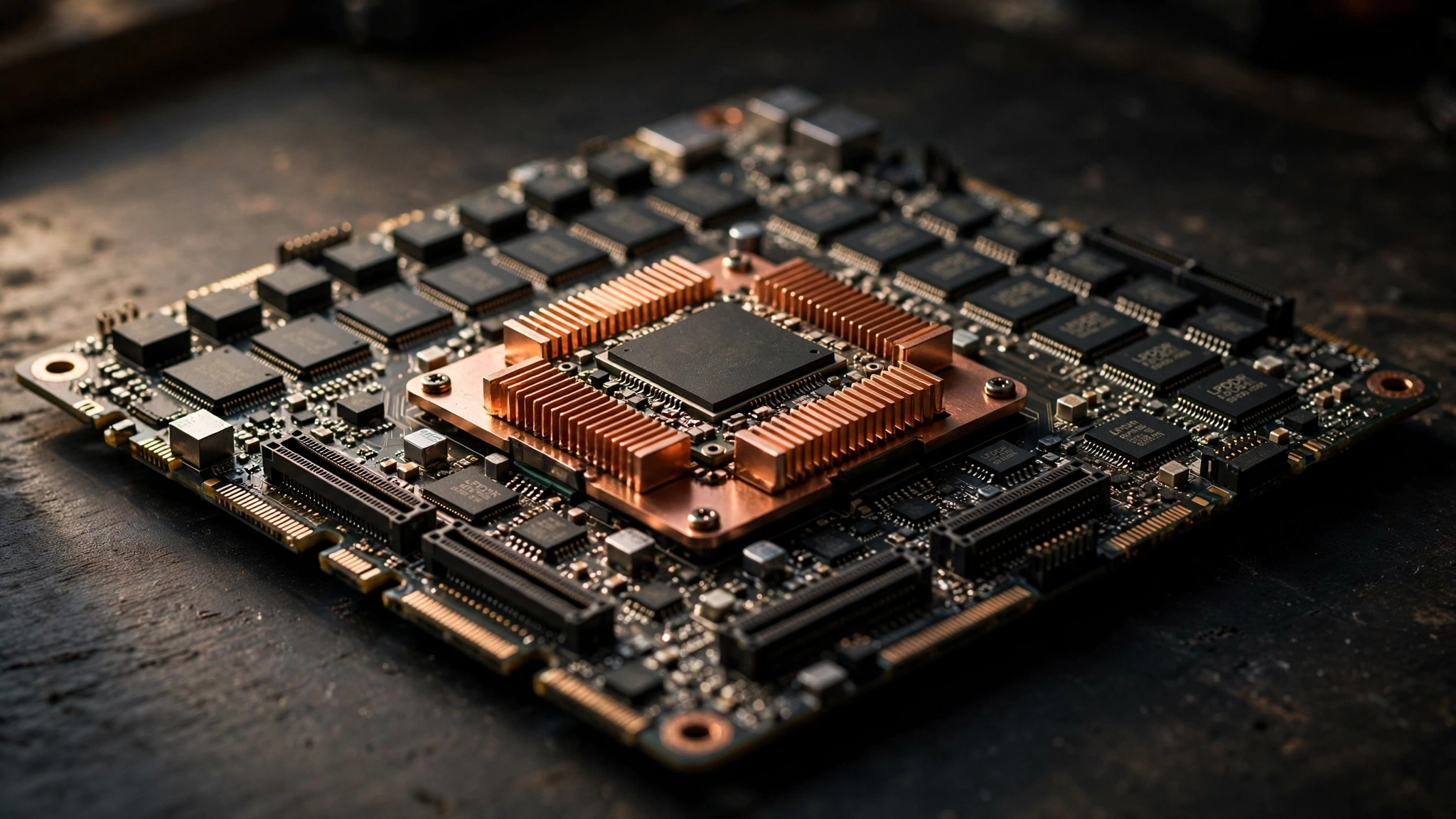
Here is everything AMD has published about the hardware:
| Component | Specification |
|---|---|
| Processor | AMD Ryzen AI Max+ PRO 495, 16x Zen 5 cores / 32 threads |
| Clocks | 3.1 GHz base, up to 5.2 GHz boost |
| Cache | 16MB L2 + 64MB L3 (80MB total) |
| Process | TSMC 4nm FinFET |
| Integrated GPU | Radeon 8065S, 40 RDNA 3.5 compute units at up to 3,000 MHz |
| NPU | XDNA 2, up to 55 TOPS (132 TOPS combined CPU+GPU+NPU) |
| AI compute | Up to 61 TFLOPS FP16 |
| Memory | Up to 192GB LPDDR5x-8533 unified, 273 GB/s bandwidth |
| Max GPU-allocatable memory | Up to 160GB as VRAM |
| Storage | 2TB M.2 SSD |
| Networking | 10GbE Ethernet, Wi-Fi 7, Bluetooth 5.4 |
| Expansion | PCIe 4.0, HDMI 2.1b, multiple USB-C ports |
| Platform TDP | 120W (processor configurable 45W to 120W) |
| Size / weight | 150 x 150 x 45.4 mm, under 1.2 kg |
| OS | Linux (shipping); Windows 11 with Project Zenith (coming soon) |
| Price | $7,299.99 (Linux, Micro Center, in-store pickup only) |
Two things stand out immediately. First, the memory: 192GB at 273 GB/s in a box smaller than a hardcover book. Second, the power: 120W total platform TDP, which is less than a single mid-range discrete GPU draws under load.
For context on the generational jump: the previous Halo used the Ryzen AI Max+ 395 with 128GB of LPDDR5X-8000 at 256 GB/s and was rated for models up to 200 billion parameters. The new platform raises memory by 50 percent and bandwidth to 273 GB/s, extending the ceiling to 300-billion-parameter models and beyond.
What 192GB of Unified Memory Actually Means
To understand why this matters, you need to understand the wall that every local AI enthusiast hits: VRAM capacity.
A language model’s weights must fit in memory to run. A 70-billion-parameter model at 4-bit quantization needs roughly 40GB. A 300-billion-parameter model at 4-bit needs roughly 150GB just for the weights, before counting the operating system, the application, and the KV cache (the working memory the model uses while generating). No consumer graphics card on earth has 150GB of VRAM. The RTX 5090 has 32GB. Even the $8,000+ RTX PRO 6000 Blackwell has 96GB.
Unified memory changes the equation. In the Halo platform, the CPU, GPU, and NPU all draw from the same 192GB pool of LPDDR5x. Up to 160GB can be explicitly reserved as GPU-addressable memory. So a 300B model at 4-bit quantization, needing around 150GB, fits with room to spare. AMD calls it the first x86 client processor capable of running a model at that scale locally. (Tech Insider)
But here is the honest technical nuance, and it is the same lesson this site teaches about every bottleneck: capacity is not speed. Fitting a model in memory and running it fast are two different problems. The Halo’s 273 GB/s of memory bandwidth is far below what a discrete GPU offers (an RTX 5090 pushes over 1,700 GB/s). In AI inference, token generation speed is largely bound by how fast weights can stream from memory to the compute units. So the Halo can hold enormous models that no consumer GPU can touch, but it will generate tokens more slowly than a smaller model on a fast discrete card.
Real-world community data on the previous 128GB generation illustrates the tradeoff: testers reported around 31 to 45 tokens per second running GPT-OSS 120B class models on Strix Halo hardware, and roughly 12 tokens per second on dense 70B models where bandwidth becomes the binding constraint. The 192GB platform should improve on capacity, but the bandwidth physics do not change. Think of it this way: unified memory removes the capacity bottleneck and replaces it with a bandwidth bottleneck. That is still a huge win, because a slow model that runs beats a fast model that cannot load at all.
This connects to a broader 2026 trend: memory is the new battleground. Our RAM bottleneck guide covers how system memory limits gaming PCs; in AI, the same principle applies at 10x the scale.
Integrated GPU vs Discrete GPU for Local AI
The Radeon 8065S inside the PRO 495 is, by integrated graphics standards, a monster: 40 RDNA 3.5 compute units at up to 3,000 MHz, with up to 61 TFLOPS of FP16 AI compute across the whole chip. For gaming, it is roughly in the territory of a modest discrete card. For AI, the comparison with discrete GPUs splits cleanly along one line: capacity versus speed.
Where the Halo iGPU wins: any model too large for discrete VRAM. A 120B model, a 300B model at 4-bit, multiple large agents running concurrently with separate KV caches. No consumer discrete GPU can even attempt these. The Halo’s 160GB of allocatable graphics memory is in a different universe from the 16 to 32GB on gaming cards.
Where a discrete GPU wins: everything that fits. A 7B, 13B, or 32B model runs dramatically faster on an RTX 5090 or RX 9070 XT because of vastly higher memory bandwidth and mature CUDA or ROCm software stacks. If your models fit in 24GB, a discrete GPU is the better tool, full stop.
The software wrinkle: NVIDIA’s CUDA ecosystem remains the default for AI development, and much tooling assumes it. AMD’s ROCm stack has improved substantially, and the Halo ships with validated configurations to smooth the path, but buyers should expect more setup friction than the CUDA world, especially for exotic workflows. Community reports on the first-generation Halo note that ROCm, Vulkan, DirectML, PyTorch, llama.cpp, LM Studio, Ollama, and ComfyUI are different paths, and support in one does not guarantee a smooth experience in another.
AMD published its own September 2026 testing comparing the PRO 495 against Intel’s Core Ultra X9 388H and Apple’s M5 Pro across generative AI workloads in ComfyUI, reporting higher relative throughput for the AMD system. Treat vendor benchmarks as directional, not gospel: AMD chose the workloads, the configurations, and the software versions. Independent testing will be the real verdict.
The practical takeaway for builders: match the hardware to the model size, the same way you match a CPU and GPU to a resolution. Big models need the Halo’s memory. Small models want a discrete GPU’s speed. Our CPU vs GPU bottleneck guide is the same decision framework applied to gaming.
Who Should Buy It, and Who Should Skip It

Buy it if you are: an AI developer or researcher who regularly works with 70B to 300B parameter models locally; a small team running multi-agent workflows with large context windows; anyone with a hard “no cloud” requirement for sensitive data who needs big models offline; a creator doing heavy local image, video, or 3D generation who has outgrown 24GB of VRAM.
Skip it if you are: a gamer (this is not a gaming machine, and $7,300 buys an absurd gaming PC); someone whose models fit in 24 to 32GB of VRAM (a discrete GPU will be faster and cheaper); anyone expecting plug-and-play simplicity (this is a developer platform, and the software stack needs attention); anyone on a budget (the previous-generation 128GB Strix Halo mini PCs from third parties, often $2,959 to $3,649, cover the 70B to 120B range for far less money).
Consider the middle path: third-party Strix Halo mini PCs based on the previous-generation Ryzen AI Max+ 395 with 128GB remain the value pick for pure local inference per dollar, handling models up to around 120B parameters. The new Halo platform is for people who specifically need the jump to 192GB and 300B-class models.
One more consideration: at $7,299.99 with in-store pickup only and no shipping, plus the well-documented 2026 memory price inflation that has pushed DRAM costs up across the industry, the price reflects real component costs more than AMD margin-stacking. Whether it is worth it depends entirely on whether you need what only it can do.
Halo vs DGX Spark vs Mac Studio
The Halo does not compete in a vacuum. Its two natural rivals:
NVIDIA DGX Spark: NVIDIA’s compact AI box, with a 64GB model at $4,999 and a 128GB Founders Edition at $6,950. The Spark brings the CUDA software moat and strong per-model performance, but even the 128GB version holds less than the Halo’s 192GB, and the 64GB model cannot load the 120B-class models the platform is famous for benchmarking. Choose Spark if you live in CUDA and your models fit; choose Halo if capacity is the priority.
Apple Mac Studio (M5 Ultra): Apple’s unified-memory desktop, configurable to very large memory capacities with excellent bandwidth and a silent operation. The Mac Studio is the polished, premium alternative, but it costs more at high memory tiers and lives outside the x86 and CUDA software worlds. Community testing has shown strong token rates on Apple silicon for models that fit.
| System | Max Memory | Strength | Weakness | Price (approx.) |
|---|---|---|---|---|
| Ryzen AI Halo (PRO 495) | 192GB unified | Capacity per dollar; x86 software compatibility | Bandwidth-limited speed; ROCm setup friction | $7,300 |
| NVIDIA DGX Spark 128GB | 128GB unified | CUDA ecosystem; strong per-model speed | Less capacity; higher price per GB | $6,950 |
| Mac Studio (M5 Ultra) | Very large (configurable) | Bandwidth; polish; silent | Price; outside x86/CUDA worlds | Higher at max configs |
Prices are approximate late-2026 figures and move with the volatile memory market; verify before buying.
What This Means for PC Builders
You are probably not spending $7,300 on a developer mini PC. Here is what to take away anyway.
1. VRAM capacity is becoming the spec that matters. For years, GPU shoppers compared core counts and clock speeds. For AI workloads, the first question is now “does the model fit?” This same logic is creeping into gaming: our best RAM for gaming guide shows how memory capacity decisions now shape build planning.
2. Bandwidth is the next bottleneck after capacity. The Halo story is a perfect illustration of bottleneck whack-a-mole: solve capacity, and bandwidth becomes the limit. Solve bandwidth, and compute becomes the limit. There is always a slowest part. The skill is identifying which one binds your specific workload.
3. The APU is growing up. A few years ago, integrated graphics meant “good enough for office work.” The 8065S with 40 compute units and 160GB of addressable memory is a different species. For builders, this signals that future APUs may cover use cases that used to require discrete cards.
4. Buy for your workload, not the spec sheet. The Halo is simultaneously the best and worst $7,300 computer depending on what you run. Big local models: unbeatable. Gaming: terrible value. This is the universal rule, from mini PCs to full gaming rigs.
Frequently Asked Questions
What is the Ryzen AI Halo Developer Platform?
It is a compact desktop system from AMD for local AI development, powered by the 16-core Ryzen AI Max+ PRO 495 processor with up to 192GB of unified LPDDR5x memory. The new version launched October 12, 2026, with the Linux configuration priced at $7,299.99 through Micro Center.
How much VRAM can the Ryzen AI Halo allocate to the GPU?
Up to 160GB of the 192GB unified memory pool can be explicitly reserved as GPU-addressable VRAM, leaving the remainder for system RAM, the OS, and other processes. This is roughly five to ten times the VRAM of high-end consumer graphics cards.
Can it really run a 300-billion-parameter LLM?
Yes, at 4-bit (INT4) quantization, where the model’s weights need roughly 150GB of memory. At higher precision like FP16, a 300B model would need far more memory than the 192GB pool holds. AMD describes it as the first x86 client processor capable of running a model at that scale locally.
Is a Strix Halo mini PC worth buying for local AI?
For large local LLM inference, yes, with caveats. Community testing on the previous 128GB generation shows it handles 70B to 120B class models that ordinary consumer GPUs cannot load, at 31 to 45 tokens per second for 120B-class models. It is better for model fit than maximum speed: a discrete NVIDIA card remains faster for models that fit in its VRAM, and the ROCm software stack needs more setup effort than CUDA. (Based on r/LocalLLaMA community reports and third-party roundups.)
How much memory do I need to run a 70B model locally?
About 40GB at 4-bit quantization, or 70GB at 8-bit, plus room for context and the operating system. That rules out 24GB and 32GB graphics cards and makes 48GB cards, 96GB workstation cards, 128GB Strix Halo systems, and the 192GB Halo platform the realistic entry points.
Is it cheaper to run an LLM locally or in the cloud?
It depends on usage. For sporadic use, paying per token via a cloud API is usually cheaper and simpler. For heavy daily use, sensitive data that cannot leave your premises, or very large models run constantly, local hardware can pay for itself. The Halo’s $7,300 price only makes sense for serious, sustained local workloads.
Key Takeaways
- The Ryzen AI Halo Developer Platform (launched Oct 12, 2026) pairs a 16-core Zen 5 chip with 192GB of unified LPDDR5x memory, 160GB allocatable as VRAM.
- It can run 300B-parameter models locally at 4-bit quantization, something no consumer GPU can do.
- The tradeoff is bandwidth: 273 GB/s means slower token generation than a discrete GPU on models that fit in VRAM.
- At $7,299.99, it is a developer tool, not a gaming PC; third-party 128GB Strix Halo mini PCs remain the value pick for smaller models.
- The lesson for builders: capacity is the new VRAM wall, bandwidth is the bottleneck behind it, and hardware must always match the workload.
Conclusion
The Ryzen AI Halo Developer Platform is not for everyone, and AMD knows it. It is for the developer staring at a 300-billion-parameter model and a 24GB graphics card, doing math that does not work. For that person, 192GB of unified memory in a 1.2-kilogram box is not an incremental upgrade. It is the difference between possible and impossible.
For the rest of us, it is a preview of where client computing is headed: memory capacity as the headline spec, heterogeneous chips that blend CPU, GPU, and NPU, and a growing class of workloads where the right question is not “how fast?” but “does it fit?” That is a bottleneck story, and it is our favorite kind.
*Note: “Ryzen AI Halo Developer Platform” is a breaking-news keyword from AMD’s October 12, 2026 launch. It may have little or no search volume yet. Specifications and pricing in this article come from AMD’s announcement and launch coverage; independent benchmark verification was not available at publication time, and AMD’s own performance claims should be treated as vendor data until third parties test them.*

Leave a Reply