

This guide breaks down the intel nova lake bllc leak 2027 in plain terms, separates what Intel has actually confirmed from what leakers are only claiming, and answers the question most PC gamers are asking right now: should you wait for Nova Lake, or buy a proven gaming CPU today? The short answer is that waiting makes sense only if your current PC still plays your games well, because the most exciting numbers in this story are still unconfirmed leak claims, not Intel announcements, and Intel has not given a retail launch date, a product list, or prices.
What Intel Actually Confirmed
On its third quarter 2026 earnings call on October 29, 2026, Intel chief executive Lip-Bu Tan confirmed two things that are now on the record. First, Nova Lake will be Intel’s first client product built on the enhanced Intel 18A-P process. Second, Nova Lake is tracking ahead of schedule, with design wins expected to reach about twice the number Panther Lake achieved at launch. Intel also said it will share more details at CES in January 2027, with the show running from January 6 to January 9.
Intel chief financial officer David Zinsner added the strategic context. He said Intel has had a gap, in his words a hole, in its portfolio for high end desktop chips, and that Nova Lake fills that gap. That is a significant admission, because AMD’s X3D processors have owned the gaming CPU conversation for several years. Intel is now publicly positioning Nova Lake as its answer at the high end, rather than leaving that segment to a later or quieter release.
What Intel did not confirm is just as important. Intel has not published a Nova Lake launch date, a model list, core counts, clock speeds, cache sizes, power ratings, or prices. A CES briefing is not the same as a retail launch, and being ahead of an internal development schedule does not by itself mean chips will be on store shelves earlier. Treat CES 2027 as the next disclosure milestone, not as a date you can already plan a build around.
For background on the earlier Nova Lake reporting, including the leaked model names and the BFC branding discussion, see our earlier coverage in brief: our previous article covered the reported Core Ultra 9 4970K BFC model and what the big cache branding could mean for gamers, and the new leak discussed below builds on that same story rather than replacing it. You can read that earlier report here: Intel Nova Lake BFC Leak: What the Reported 4970K Means for Gamers.
What the New Leak Claims and Why It Needs
The new claims come from leaker Haze2K1, who posted on October 29, 2026 about what the post described as circulating chatter and reported presentation material. According to that leak, Nova Lake could deliver about 20 percent higher gaming performance overall compared with the previous Arrow Lake generation. The same leak broke that figure down further, claiming raw single thread performance up about 8 percent without bLLC and up about 17 percent with bLLC, plus about 15 percent from Intel APX, which is a reported instruction set extension that doubles general purpose registers.
Every one of those numbers must be read as unconfirmed. The leak does not provide a complete benchmark breakdown, and independent outlets covering it have noted the same gaps: no confirmed game list, no confirmed test system, no confirmed memory configuration, and no confirmed power limits. Without those details, a 20 percent figure cannot be compared fairly with anything you can buy today. It could be an average across many games, a best case result, an internal projection, or a mix of all three. The honest description is that a leaker reports about 20 percent, not that Nova Lake delivers 20 percent.
Other reports make the picture even murkier, which is itself useful information. Some coverage of reported internal estimates has described higher figures for a bLLC configuration compared with the Core Ultra 9 285K, while other coverage has stressed that non bLLC Nova Lake gaming performance could be quite similar to Arrow Lake. Those two ideas can both be partly true if the big cache models are doing most of the work, but they cannot both be used as a single clean headline. When leaks disagree, the right move for a buyer is to wait for a consistent, testable claim, not to pick the most exciting number and plan around it.
The cache figures follow the same pattern. Earlier leaks reported up to 144MB of bLLC on a single tile configuration, with a dual tile configuration reported at up to 288MB. Those figures come from different leak sources and different reported SKU tables that have changed over time, and the highest figure appears tied to a large dual tile part that may arrive later and may not be a mainstream gaming chip. For a normal gaming build, the single tile figure is the one to watch, and even that figure is still only reported, not confirmed by Intel.
What bLLC Is, and Why Gamers Care About Cache
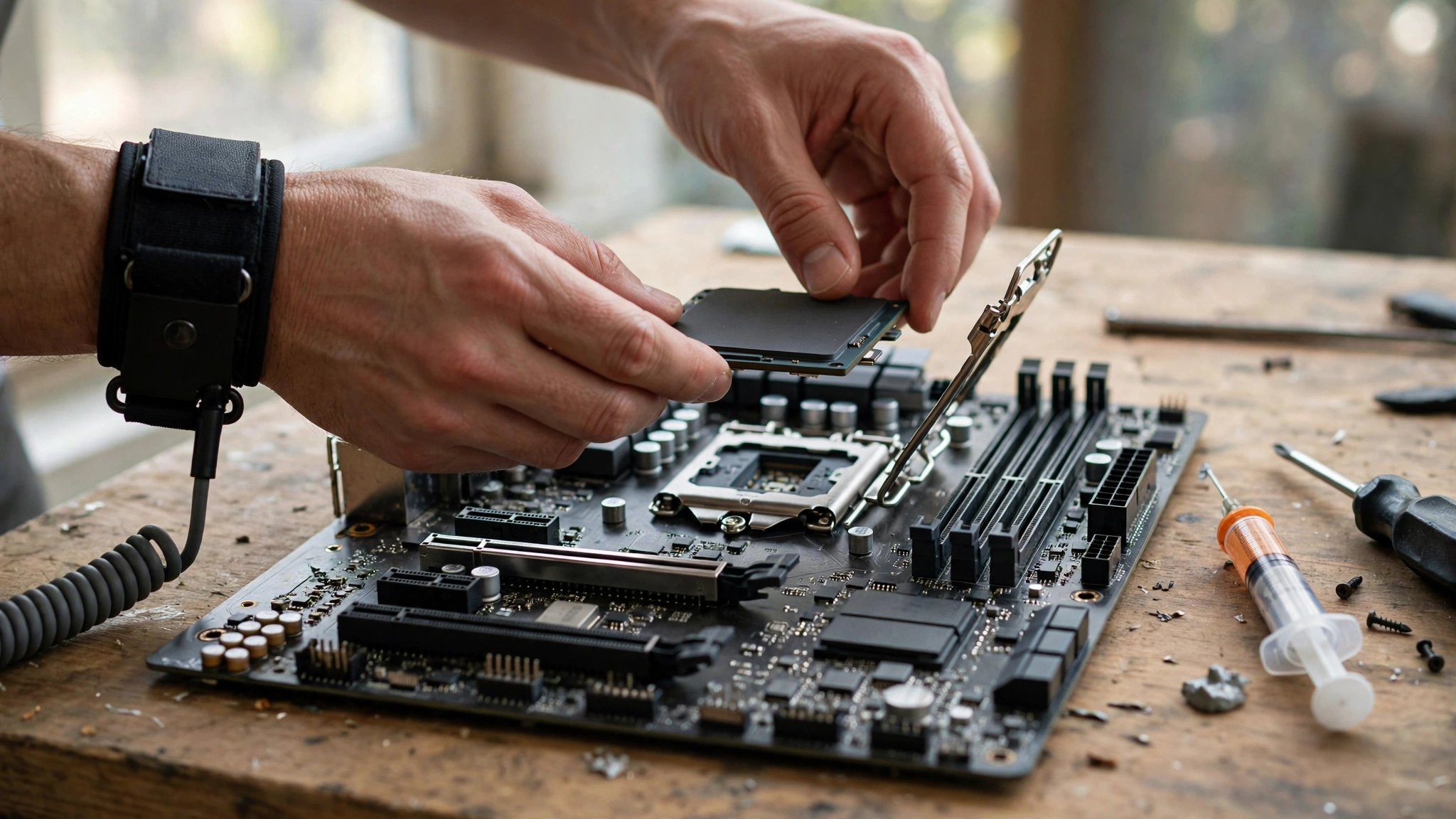
bLLC stands for big last level cache. In simple terms, cache is fast memory built into or very close to the processor, and it holds data the cores are likely to need next. When the data a game needs is already in cache, the CPU does not have to wait for a slower trip out to system RAM. When it is not in cache, the CPU stalls, and that stall can show up as lower frame rates, worse low frame rates, or stutter in busy scenes.
AMD’s version of this idea is 3D V-Cache, used in its X3D processors. AMD stacks extra cache silicon onto the processor, which is why X3D chips have become the default gaming recommendation for many builders. Intel’s reported bLLC approach is different in engineering terms: reports describe a large cache placed flat inside the compute tile rather than stacked on top of it. The goal is similar, keeping more game data close to the cores, but the implementation is not the same, and that difference is why cache size alone cannot settle the contest.
Cache helps most in games and settings where the CPU is the limiting factor. That typically means competitive games at high refresh rates, simulation heavy games, large open world games with many characters and systems running at once, and any game played at 1080p with a powerful graphics card. In those cases, the CPU has to prepare frames quickly, and a cache miss costs time the player can feel. At 4K with high graphics settings, the graphics card usually becomes the limit first, and a bigger CPU cache makes a smaller difference, because the GPU is setting the pace.
There are limits to what cache can do, and buyers should keep them in mind. Cache latency matters as much as cache size, because slow cache can waste some of the benefit of having more of it. Clock speeds, core design, memory speed, and how a game schedules work across cores also matter. A chip with a huge cache but lower clocks or awkward core scheduling could still lose to a better balanced chip in some games. That is why reviewers test many games at several resolutions instead of trusting one cache number.
The Bottleneck Angle Where a Faster CPU Actually Helps
A bottleneck is simply whichever part is holding back performance in a given game at given settings. If your CPU cannot prepare frames fast enough, your graphics card waits, and you get a CPU bottleneck. If your graphics card cannot render frames fast enough, your CPU waits, and you get a GPU bottleneck. Most real gaming PCs move between the two depending on the game, the resolution, and the settings, which is why a single bottleneck percentage can mislead if it is read without context.
To understand the difference in practical terms, start with this explainer: CPU Bottleneck vs GPU Bottleneck: Which One Is Slowing Your PC. The key idea for this story is resolution. At 1080p, the graphics card finishes each frame relatively quickly, so the CPU is more likely to be the limit, and a faster or better cached CPU can show a clear gain. At 1440p, the balance shifts, and at 4K, the graphics card usually dominates, so even a large CPU upgrade may show little change in average frame rate. Low frame rates, sometimes called 1 percent lows, are a separate and often more important measure than the average, because they describe smoothness: a CPU that keeps lows steadier will feel better even when the average looks similar.
That resolution logic is also why the reported Nova Lake gaming claim needs careful reading. If the reported 20 percent figure came mostly from CPU limited testing, such as 1080p with a top tier graphics card, it would not mean every gamer at every resolution should expect 20 percent more performance. A 4K gamer with a midrange card might see far less, because the graphics card was already the limit, while a competitive 1080p player chasing high refresh rates is exactly the kind of gamer who could benefit most, if the leak proves accurate.
If you do have a clear CPU bottleneck today, try the no cost fixes first, such as closing background tasks, updating drivers, and checking thermals. This practical guide covers the steps: How to Fix a CPU Bottleneck Without Buying a New PC. Trying those steps first gives you a cleaner baseline for judging whether the CPU really is the problem.

Confirmed, Reported, and Unknown The Honest Scorecard
Read the middle column as interesting but unproven, and the right column as the reason not to order anything yet.
| Topic | Confirmed by Intel | Reported by leaks, unconfirmed | Still unknown |
|---|---|---|---|
| Next disclosure | More details at CES in January 2027 | CES as unveiling, phased launch after | Retail launch date and availability |
| Gaming performance | No figure published | About 20 percent overall in one leak, higher bLLC figures in other reports | Independent benchmark results |
| Single thread gain | No figure published | About 8 percent without bLLC, about 17 percent with bLLC in one leak | Clock speeds and test conditions |
| Cache size | No size published | Up to 144MB single tile, up to 288MB dual tile in reports | Which models get bLLC and at what price |
| Launch order | Desktop focus, high end gap to fill | BFC models earliest, per one leaker | First models, pricing, motherboard cost |
| Platform | New generation, high end desktop focus | Reported LGA 1954 socket and 900 series chipsets | Motherboard prices and upgrade path |
Intel’s own process page is the best primary source for what 18A-P means in process terms, separate from any Nova Lake performance claim: Intel 18A and 18A-P Process Technology. Intel describes 18A-P as delivering over 9 percent higher performance at the same power, or more than 18 percent lower power at the same performance, compared with base 18A. Those are process level comparisons, not a promise that a finished Nova Lake gaming CPU will be faster by those amounts in your games.
On the AMD side, the current gaming benchmark is a real, shipping product with published specifications. AMD lists the Ryzen 7 9800X3D with 8 cores, 16 threads, up to 5.2 GHz boost clock, 96MB of L3 cache, and a 120W default TDP on the AM5 socket: AMD Ryzen 7 9800X3D Specifications. That is the kind of complete, checkable specification sheet Nova Lake does not have yet. When you compare a shipping chip with a leaked chip, the shipping chip always wins on certainty, even if the leaked chip later wins on speed.
The Wccftech coverage of the earnings call is also worth reading for the exact executive wording and the phased launch discussion: Intel CEO Says Nova Lake Will Fill the High End Client CPU Gap. Note that even that coverage treats a formal launch as phased, with single tile models first and dual tile models later in 2027 according to reports.
What to Buy Today if You Cannot Wait
If your PC is struggling now, waiting for an unconfirmed chip is a real cost in lost gaming time. The proven gaming buy today remains an X3D processor on AM5, with the Ryzen 7 9800X3D as the usual starting point for a pure gaming build. It is a shipping product, it has a large body of independent reviews, and it sits on a platform with a documented upgrade path, which lowers the risk of the purchase.
For a detailed pairing view, including which graphics cards fit well with that CPU, see this guide: Best GPU for Ryzen 7 9800X3D. At 1440p and 4K, the graphics card choice often matters more than squeezing the last few percent from the CPU, so budget balance beats brand loyalty.
If you are building around a midrange card such as an RTX 5070, the CPU decision is different again. You do not need a flagship gaming CPU to feed a midrange card in most games, and overspending on the CPU can starve the graphics card budget where it would have helped more. This pairing guide explains that balance: Best CPU for RTX 5070. Use it as a reality check before letting Nova Lake excitement push you toward a flagship CPU your graphics card cannot use.
Intel buyers have a harder choice today. Current Intel desktop parts are real and available, but the reported Nova Lake platform change means a new Intel build today may not offer the same CPU upgrade path as an AM5 build. That does not make current Intel chips bad, but it does change the value calculation: if you buy Intel now, buy it because the current chip fits your games and budget today, not because you expect a drop in Nova Lake upgrade later. Until Intel confirms the socket, chipset, and compatibility story, no upgrade promise should be assumed.
Two Trending Stories That Change the Timing
Two other hardware stories are moving at the same time, and both are relevant to timing, even though neither changes what Nova Lake itself will do. Treat both as unconfirmed reports, not as announcements.
The first is a reported RTX 5080 24GB model. Reports attributed to Chinese distribution source ChannelGate, covered by several hardware outlets, describe a 24GB RTX 5080 arriving in China as early as December 2026, with January 2027 as the slower end of the window, possibly around CES. The same reports describe the 16GB RTX 5080 being phased out in China in favor of the 24GB model. NVIDIA has not announced this card, a price, or a date, and the report is explicitly China focused, so it does not establish that a US buyer will see the same replacement on the same schedule. The US NVIDIA Marketplace removal of the RTX 5080 reported alongside it is an interesting signal, but a store listing change is not a product announcement either.
For a CPU buyer, the RTX 5080 rumor matters only in one narrow way. If you are planning a high end build that pairs a new CPU with a new flagship class card, the graphics card side of that build is also in flux, and buying both parts in a hurry could lock you into a 16GB card just before a 24GB option appears, or into a high price just before supply changes. That is a reason to slow down a full high end rebuild, not a reason to pick a CPU today. If your graphics card is already strong, the RTX 5080 rumor should not change your CPU decision at all.
The second story is a reported AMD Radeon price increase for November 2026. Reports attributed to ChannelGate and covered by PC Games Hardware, TechPowerUp, and VideoCardz describe AMD raising what it charges board partners for Radeon GPU plus GDDR6 memory kits in November, following an October adjustment, with GDDR6 prices reported up 8 to 10 percent in the third quarter of 2026. AMD has not confirmed a figure, a percentage for the November step, or the affected models, and reports differ on whether this is best described as a further increase or part of a sequence of increases through 2026. Reports also estimate retail effects could appear about three weeks after a partner price change, which would land in the December shopping season, but that timing is an estimate, not a confirmed retail price list.
The practical takeaway is modest and honest. GPU prices are under upward pressure from memory costs, so assuming graphics cards will simply get cheaper while you wait for Nova Lake is risky. That pressure argues for buying a graphics card when you find a fair price, rather than timing the whole build around a CPU that has no date. It does not argue for rushing a CPU purchase, because CPU and GPU prices move on different cycles, and a CPU bought in a panic is still a CPU you may regret when CES details arrive.
Wait or Buy The Decision Table
Use this table as a starting point, then check it against your own PC, games, and budget.
| Your situation | Best move now | Why |
|---|---|---|
| Current PC plays well, you are just curious | Wait for CES 2027 details | Waiting costs nothing if you are already happy |
| Building a new PC this month | Buy X3D on AM5, balance the GPU budget | Shipping product, reviews, and a known platform |
| Playing mostly at 4K with high settings | Buy for the GPU first, CPU second | Graphics card is usually the limit at 4K |
| Playing competitive games at 1080p high refresh | Buy a strong cached CPU now, or wait only if you can tolerate the wait | CPU and cache matter most here, but Nova Lake is still unproven |
| Planning a full high end rebuild | Wait for CES, and watch GPU reports | Both CPU and GPU sides are in flux at the high end |
| On an older Intel platform needing a full rebuild anyway | Compare total platform cost at CES time | A new socket may mean motherboard plus memory, not just a CPU |
Risks, Red Flags What Could Still Change
The biggest risk in this story is not that Nova Lake will be slow. It is that early buyers will pay early adopter prices for a platform whose real performance, thermals, and motherboard costs are still unknown. New sockets usually mean new motherboards at launch prices and early BIOS versions, which is another reason a CES announcement should not automatically trigger a day one purchase.
Finally, be skeptical of any single number that appears without a source system. A gaming percentage without games, resolution, settings, graphics card, memory, and power limits is a marketing style claim, even when it comes from a leaker rather than a vendor. Internal projections are also not independent benchmarks: they are made by the company that wants the product to look good, under conditions it chose. Independent testing exists precisely to replace those projections with measurements you can reproduce.
Frequently Asked Questions
Should I Choose a 9800X3D for Future-Proofing My New Build or Opt for a 9600X Instead?
This is a real question builders ask when they are torn between a proven gaming chip and saving money for a better graphics card. For a pure gaming build that you want to keep for several years, the 9800X3D is the safer long term pick, because its large cache helps in CPU limited games and it sits on AM5, which gives you a later upgrade path without a full rebuild. The cheaper CPU makes sense if you play mostly at 1440p or 4K, where the graphics card matters more, and putting the saved money into a stronger graphics card will help more than the CPU difference.
Should I upgrade now, or wait for the next generation?
Upgrade now if your current CPU is clearly holding back the games you play today, if you have already tried the no cost fixes, and if a proven chip fits your budget and platform. Wait if your current PC still plays your games well, if your upgrade would require a full platform rebuild anyway, or if the only reason to wait is a leak with no date or price. Set a date, not a rumor, as your trigger: if CES 2027 details do not change your plan, buy the proven chip then.
Should I buy now or wait for Nova Lake?
Buy now if you need the performance now, if you are building this month, or if a proven X3D chip fits your budget and your graphics card can use it. Wait for CES details if your current system is fine, if you specifically want Intel’s big cache answer to X3D, or if you are planning a full high end rebuild where both the CPU and the graphics card sides are uncertain. Do not wait on the reported 20 percent figure alone, because it is unconfirmed, it may not apply at your resolution, and it says nothing about price, motherboard cost, or availability. The CES briefing will give you real specifications to compare, and that comparison, not the leak, should make the final call.
Conclusion
The intel nova lake bllc leak 2027 is exciting because it suggests Intel finally has a serious gaming cache story, and Intel’s own October 29 confirmation gives that story a real foundation: Nova Lake is coming, it uses 18A-P, it is ahead of schedule, and more details are due at CES in January 2027. Everything beyond that foundation, including the reported 20 percent gaming figure, the cache sizes, the model list, and the launch order, is still a leak claim that could change before Intel publishes specifications.
That leaves a clear, practical verdict. If your PC is holding you back today, buy a proven gaming CPU now and enjoy it, because a leak is not a product and months of waiting have a real cost. If your PC is already doing the job, wait for CES, compare the real specifications and the total platform cost, and only then decide between Nova Lake, a proven X3D chip, and whatever AMD shows next. Do not buy on a headline number alone: wait for the specification sheet, the independent review, and the street price.

Leave a Reply