
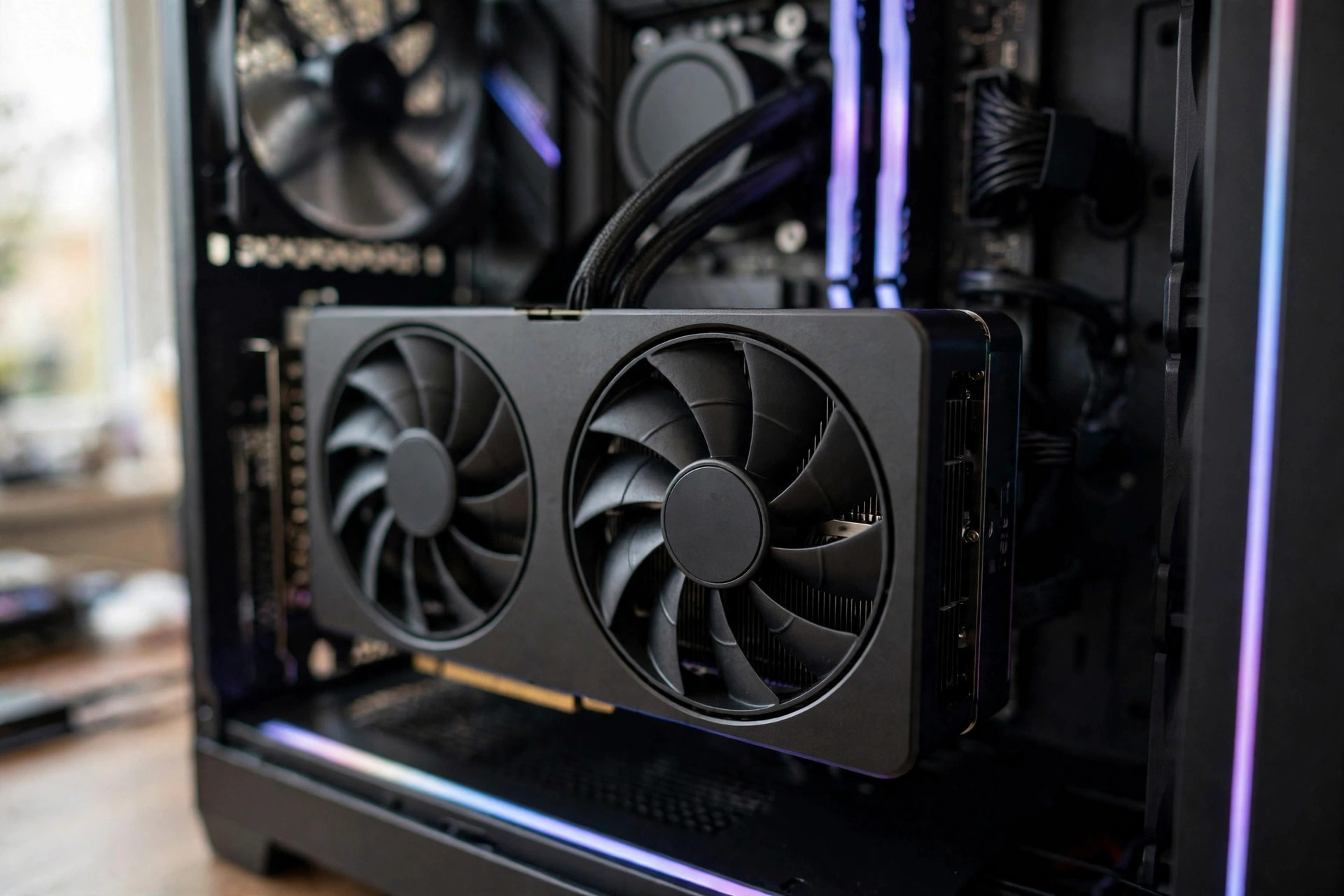
Quick answer: The RTX 4080 is a high end Ada Lovelace graphics card with 16GB of GDDR6X memory, 9,728 CUDA cores, and a 320W power draw. It is a strong 4K card and an excellent 1440p card. It launched at $1,199, and newer cards now offer similar speed for less, so in late 2026 it only makes sense at a clear discount, usually on the used market.
If you type rtx 4080 into a search bar today, you will see a confusing picture. Some listings ask close to the original launch price. Others sell used cards for far less. Newer cards like the RTX 5070 Ti promise similar speed with newer features. So is this card still a smart buy, or is it a trap for shoppers who do not check current prices first?
This guide answers that question with facts. You will find the full specs, real performance at 1080p, 1440p, and 4K, honest comparisons with the RTX 4070 Ti Super, the RX 7900 XTX, and the RTX 5070 Ti, the CPUs that pair well with it, the power supply you need, and what to pay for a used one in late 2026. Every benchmark number here comes from published test suites, and every estimate is labeled as one, because no single frame rate number fits every game and every PC.
RTX 4080 Specs at a Glance
The RTX 4080 is built on NVIDIA’s Ada Lovelace architecture using the AD103 graphics chip. It sits one step below the RTX 4090 in the 40 series lineup, and it was the second fastest gaming card NVIDIA sold when it launched on November 16, 2022. Here are the official specs, taken from NVIDIA’s own product page.
| Specification | RTX 4080 |
|---|---|
| Architecture | Ada Lovelace |
| GPU die | AD103 |
| CUDA cores | 9,728 |
| RT cores | 76 (3rd generation) |
| Tensor cores | 304 (4th generation) |
| Base clock | 2.21 GHz |
| Boost clock | 2.51 GHz |
| Memory | 16GB GDDR6X |
| Memory bus | 256-bit |
| Memory bandwidth | 716.8 GB/s |
| Total graphics power | 320W |
| Average gaming power | 251W |
| Recommended system power | 750W |
| Interface | PCIe 4.0 x16 |
| Display outputs | 3x DisplayPort 1.4a, 1x HDMI 2.1a |
| Maximum resolution | 8K at 60Hz with DSC |
| Launch date | November 16, 2022 |
| Launch MSRP | $1,199 |
The 16GB of GDDR6X memory is the spec that matters most for long term use. It is enough for 4K texture packs in demanding games, and it is the main reason this card still holds up in 2026 while 8GB and 12GB cards from the same era start to struggle. The 256-bit bus and 716.8 GB/s of bandwidth keep that memory fed. For the full official spec sheet, see NVIDIA’s RTX 4080 product page.
One number deserves a second look: average gaming power is 251W, well below the 320W total graphics power rating. That is the figure NVIDIA measured across 22 games at mixed resolutions. Your card will use more in a heavy 4K ray tracing scene and less in a light esports title. Plan your power supply around the 320W figure, not the average.
What the RTX 4080
The RTX 4080 is a 4K capable card with strong ray tracing, DLSS 3 frame generation, and 16GB of memory. It is also a card with a messy launch story, and that story still causes confusion today.
First, NVIDIA announced two versions in September 2022: a 16GB model at $1,199 and a 12GB model at $899. The 12GB model used a different, weaker chip with fewer cores and a narrower memory bus. After heavy criticism, NVIDIA cancelled the 12GB version before it ever reached stores. The card that went on sale is the 16GB model only. If you see a desktop “RTX 4080 12GB” for sale, it is not a real retail product. The laptop version is a different story, and it does have 12GB, which we cover later in this guide.
Second, there is no RTX 4080 Ti. NVIDIA never released one. The 4080 Ti does not exist as a real graphics card, and any listing that uses that name is either a mistake or a scam. Do not pay a premium for a card that was never made.
Third, the RTX 4080 Super arrived in January 2024 as the refresh. It uses the full AD103 chip with 10,240 CUDA cores and launched at $999, which was $200 less than the original 4080. In real games it is only a few percent faster than the standard 4080. Think of it as the same card with a better price, not a new performance class.
Fourth, the original RTX 4080 is no longer in production. NVIDIA retired it from its active lineup after the Super version arrived, and the RTX 50 series is now the current range. You will not find new stock at the old launch price in most stores. That is why the used market, covered later in this guide, is where most 4080 shopping happens now.
RTX 4080 Performance at 1080p
At 1080p, the RTX 4080 is far more card than most monitors need. In published test suites, it averages around 157 frames per second at 1080p Ultra settings across a broad mix of games. That number is a test suite average, not a promise for your favorite game. Competitive shooters will run far above it. Heavy single player games with ray tracing will run below it.
The real story at 1080p is the CPU, not the card. At this resolution the graphics card finishes each frame so fast that the processor becomes the limit. A weak or older CPU will hold the RTX 4080 back, and you will see the card sitting at 60 or 70 percent usage while the CPU runs at full load. That is a CPU bottleneck, and it means you paid for speed you cannot use.
For most 1080p gaming, this card is overkill. A cheaper card will give you the same experience on a 60Hz or 144Hz monitor. The 4080 only earns its place at 1080p if you play competitive games on a 240Hz or faster monitor and you pair it with a very fast CPU. In that narrow case, the extra headroom turns into real frames.
Practical takeaway: if your monitor is 1080p at 60Hz or 144Hz, buy a cheaper card or upgrade your monitor first. The 4080 belongs at higher resolutions.
RTX 4080 at 1440p Its Sweet Spot
The 1440p resolution is where the RTX 4080 feels most at home. In published test suites, it averages around 117 frames per second at 1440p Ultra settings. That is high enough for a 144Hz or 165Hz monitor in most games, and it leaves room for ray tracing in many titles with DLSS turned on.
This is the resolution where the balance is right. The card works hard enough that the CPU stops being the main limit, but the pixel count is low enough that the 16GB of memory and the AD103 chip can stretch their legs. Demanding single player games run smoothly at high settings. Competitive games run at very high frame rates. Ultrawide 1440p monitors, which push about a third more pixels than standard 1440p, are also a good match.
If you own a 1440p high refresh monitor, this card makes sense in a way it never does at 1080p. It is the resolution NVIDIA effectively designed the card around, even though the marketing talked about 4K.
Practical takeaway: 1440p at high refresh rates is the best use of an RTX 4080. If that is your setup, this card will not feel wasted.
RTX 4080 at 4K
At 4K, the RTX 4080 is a genuinely strong card. In published test suites, it averages around 67 frames per second at 4K Ultra settings across a broad mix of games. That average hides a wide range. Lighter games and well optimized titles run far above 60 frames per second. The heaviest games with full ray tracing need DLSS to stay smooth.
The 16GB of memory is what makes 4K workable here. At 4K with high resolution texture packs, games regularly use more than 10GB of video memory. Cards with 8GB or 12GB hit a wall in those scenes and start to stutter, even if their raw speed looks fine on paper. The 4080 has room to spare, which is a big part of why it has aged better than cheaper cards from the same generation.
For demanding games, expect to make small trade offs. Turning one or two settings down from Ultra to High, or switching DLSS to Quality mode, usually buys back a large chunk of performance for a difference you will not notice while playing. Heavy path tracing in games like Cyberpunk 2077 is the exception: at 4K with full path tracing and no upscaling, even this card struggles, and DLSS is not optional.
If you are checking whether your system can run a specific demanding game at 4K, our Battlefield 6 PC requirements guide shows how to read official requirements and match them to your hardware.
Practical takeaway: the RTX 4080 handles 4K well for most games, and DLSS covers the hardest cases. It is not a card that needs excuses at this resolution.
Ray Tracing and DLSS 3
Ray tracing is one of the clearest strengths of the RTX 4080. Its third generation RT cores handle ray traced reflections, shadows, and lighting far better than the previous generation, and far better than competing AMD cards of the same era. In games with heavy ray tracing, the gap between the 4080 and the RX 7900 XTX grows large, and it grows larger still at 4K.
DLSS 3 is the other half of the story. It includes Super Resolution, which renders at a lower resolution and rebuilds the image, Ray Reconstruction, which cleans up ray traced lighting, and Frame Generation, which creates extra frames to smooth motion. In supported games, turning on DLSS 3 can nearly double your frame rate at 4K with ray tracing on.
One honest limit: the RTX 4080 supports DLSS 3 frame generation, but not the Multi Frame Generation feature that arrived with the RTX 50 series. Multi Frame Generation creates several extra frames per real frame, while the 4080 creates one. In practice, the 4080 still plays smoothly in every DLSS supported game. You only miss the newest frame generation trick, not the core upscaling that matters most.
For creators, the same hardware helps outside games. The NVENC encoder is strong for streaming and recording, and CUDA support makes the card useful in video editing, 3D rendering, and AI apps. That is one reason used 4080 cards stay in demand even as newer gaming cards arrive.
Practical takeaway: if ray tracing matters to you, the 4080 is still one of the best value cards for it, as long as the price is right.
RTX 4080 vs RTX 4070 Ti Super
The RTX 4070 Ti Super is the closest card below the 4080, and it is the comparison most buyers should start with. Both cards have 16GB of GDDR6X memory on a 256-bit bus, both support DLSS 3, and both play the same games well. The difference is how much faster the 4080 is, and whether that gap is worth the money.
| Specification | RTX 4080 | RTX 4070 Ti Super |
|---|---|---|
| CUDA cores | 9,728 | 8,448 |
| Boost clock | 2.51 GHz | 2.61 GHz |
| Memory | 16GB GDDR6X | 16GB GDDR6X |
| Memory bandwidth | 716.8 GB/s | 672 GB/s |
| Total graphics power | 320W | 285W |
| Launch MSRP | $1,199 | $799 |
Across more than 100 games, published benchmark comparisons put the RTX 4080 about 16 to 18 percent faster than the 4070 Ti Super on average. The gap varies by game and resolution, and it is largest at 4K with ray tracing. You can see the full per game breakdown in this RTX 4070 Ti Super vs RTX 4080 comparison.
The value question is simple. When the 4070 Ti Super launched at $799, it cost $400 less than the 4080 while giving up less than a fifth of the speed. That made it the better buy for most people. In late 2026, the same logic applies to used prices: if a used 4080 costs only a little more than a used 4070 Ti Super, take the 4080. If the gap is large, the cheaper card is the smarter pick.
Practical takeaway: the 4080 is clearly faster, but the 4070 Ti Super is the value pick unless the price gap is small.
RTX 4080 vs RX 7900 XTX
The RX 7900 XTX is AMD’s flagship from the same era, and it is the strongest AMD alternative to the RTX 4080. It launched at $999 with 24GB of GDDR6 memory on a wide 384-bit bus, giving it 960 GB/s of bandwidth. In pure rasterized games with no ray tracing, the two cards trade blows, and the 7900 XTX wins some titles outright.
The picture changes as soon as ray tracing enters the scene. The 4080 pulls ahead clearly, and the gap grows at 4K. AMD’s FSR upscaling has improved, but it does not match DLSS 3 frame generation in supported games, and it does not close the ray tracing gap. For streaming, the 4080 also has the stronger encoder, and for creative apps, CUDA support gives NVIDIA a real edge.
So which card should you pick? If you play mostly rasterized games at 1440p or 4K, you do not care about ray tracing, and you find the 7900 XTX cheaper, it is a fine card with more memory. If you want ray tracing, DLSS, better streaming quality, or CUDA apps, the 4080 is the better card even though it has less memory. Both cards are discontinued now, so this choice mostly happens on the used market, where condition and price matter more than the brand on the box.
Practical takeaway: the 7900 XTX wins on memory and raw raster value, while the 4080 wins on ray tracing, DLSS, and creator features.
RTX 4080 vs RTX 5070 Ti
The RTX 5070 Ti is the newest rival, and it is the card that makes buying a used 4080 a careful decision. It launched in early 2025 at $749 with 8,960 CUDA cores, 16GB of GDDR7 memory, 896 GB/s of bandwidth, and a 300W power draw. It also brings DLSS 4 with Multi Frame Generation and a newer video encoder.
In published comparisons, the 5070 Ti matches or slightly beats the RTX 4080 Super in rasterized performance across resolutions, which puts it right around the standard 4080 as well. It draws less power doing it. The 4080 still holds an edge in some heavy ray tracing tests, but the gap is small, and the 5070 Ti’s newer frame generation can erase it in supported games.
That leaves one rule for buyers. If you can buy a new RTX 5070 Ti near its $749 launch price, buy it instead of a used 4080. You get a new card, a full warranty, lower power use, and newer features for less money than the 4080 cost new. The used 4080 only wins when it is much cheaper, roughly in the $600 to $750 range depending on your region, and you do not care about Multi Frame Generation.
The same logic applies one step down the ladder. Published GPU hierarchy data puts the RTX 4080 about 22 percent faster than the RTX 5070 at 1440p and about 24 percent faster at 4K in rasterized games. The 5070 is cheaper and newer, but the gap is real. If you are choosing between a used 4080 and a new 5070, the 4080 is faster. If you are choosing between a used 4080 and a new 5070 Ti, the 5070 Ti is the better buy at similar money. For a wider look at how the newest cards stack up against the last flagship, see our RTX 5080 vs RTX 4090 buying guide.
Practical takeaway: the 5070 Ti is the better buy at launch price. The 4080 only wins on the used market at a real discount.
Which CPU Pairs Well With the RTX 4080
A card this fast needs a CPU that can keep up, especially at 1080p and 1440p. At 4K the graphics card does most of the work, so even a midrange CPU is usually fine. At lower resolutions, the CPU matters a lot more.
The best pairings are the fastest gaming CPUs. The Ryzen 7 9800X3D is the top pick, thanks to its large 3D stacked cache, and the Ryzen 7 7800X3D is close behind. On the Intel side, the Core i7-14700K and Core i9-14900K both feed the 4080 without trouble. These are the CPUs to choose if you play competitive games at high refresh rates and you want every frame the card can deliver.
The good value pairings cover most gamers. A Ryzen 7 7700X, a Core i5-14600K, or a Ryzen 7 5700X3D will run the 4080 well at 1440p and 4K, with only small losses at 1080p in CPU heavy games. If you already own one of these, there is no reason to upgrade the CPU just for this card.
The pairings to avoid are older midrange and budget CPUs. An old six core chip from several generations ago, or any quad core, will bottleneck the 4080 hard at 1080p, leaving the card at half usage while the CPU struggles. One bottleneck calculator estimates that an i5-9400F holds back about 59 percent of the card’s performance at 1080p. Treat that figure as a rough estimate, not a precise measurement, but the direction is right: a weak old CPU wastes this card.
Our best GPU for Ryzen 7 9800X3D guide covers that top pairing in detail, and our RTX 4090 with Ryzen 9 3950X bottleneck analysis shows how an older high core count CPU behaves with a card even faster than the 4080. For the full performance ladder of the card above this one, see our RTX 4090 ladder.
Practical takeaway: pair the 4080 with a modern Ryzen 7 or Core i7 class CPU. At 4K you can go cheaper, but at 1080p a slow CPU wastes the card.
Power Supply and Build Requirements
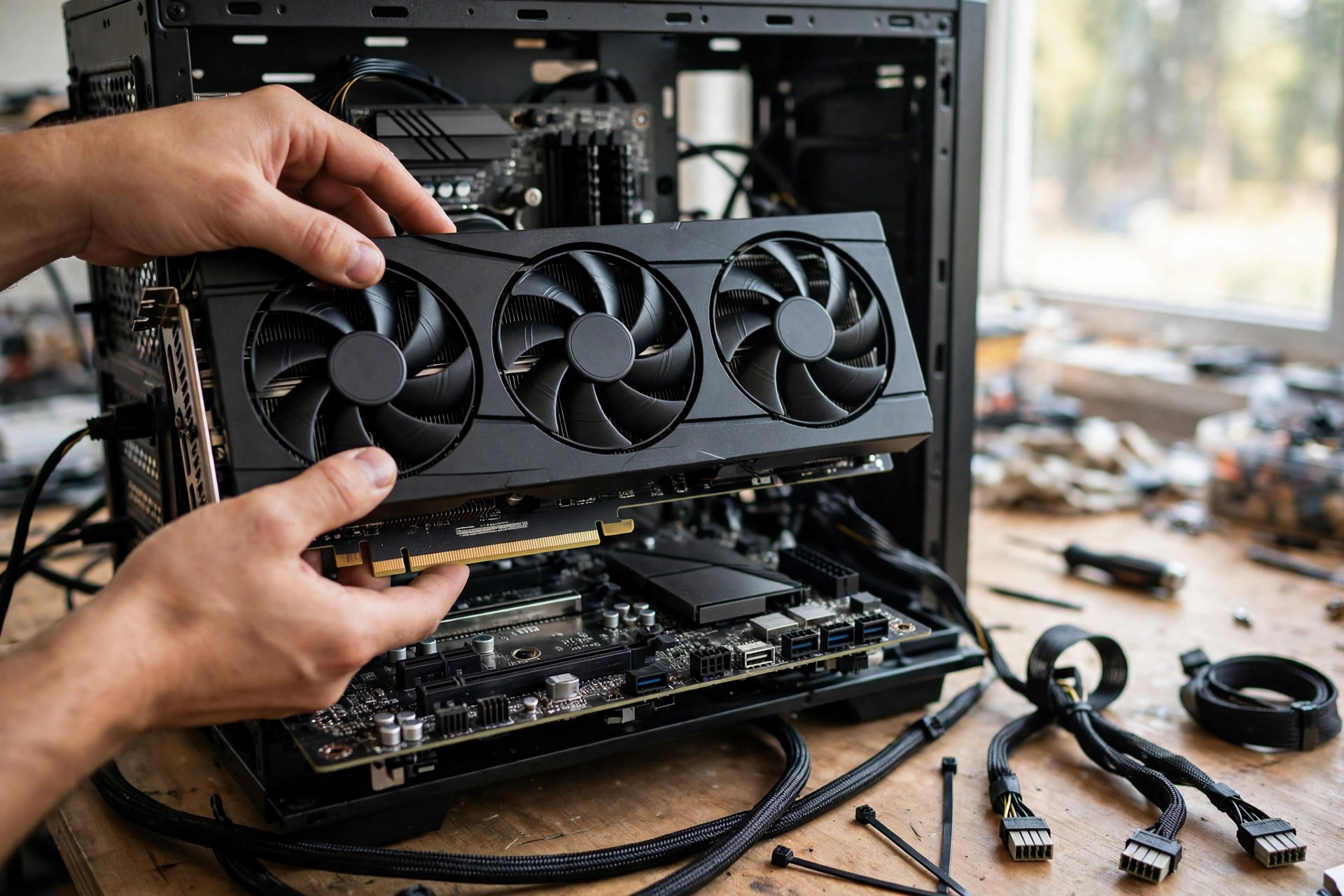
NVIDIA recommends a 750W system power supply for the RTX 4080. That is a safe figure for a typical build with a midrange to high end CPU. If you run a power hungry CPU like a Core i9-14900K, overclock either part, or run many drives and fans, step up to an 850W unit for headroom. A quality 750W Gold rated supply from a trusted brand is enough for most 4080 builds. A cheap no name 750W unit is not, because wattage on the label is not the same as stable power under load.
The card uses the 12VHPWR connector, also called 12V-2×6 on newer supplies. Most cards ship with an adapter that takes three 8-pin PCIe cables. Use three separate cables from the power supply, not daisy chained splitters, and push the connector in fully until it clicks. A loose connector is the most common cause of the melted connector stories you may have read about.
Size is the other thing people forget. The Founders Edition is 310mm long, and partner cards run longer, up to about 340mm or more for the biggest triple fan models. Measure your case before you buy. Check the card’s thickness too: most 4080 models take up three slots or more, which can block the PCIe slot below them.
Cooling is rarely a problem. The 4080 runs cooler and quieter than the 4090, and most partner coolers keep it well under its 90 degree thermal limit. Make sure your case has decent airflow, with at least two intake fans feeding the card fresh air, and you will be fine.
Our PSU tier list ranks power supplies by quality, so you can pick a unit that will run this card safely for years.
Practical takeaway: a good 750W Gold supply, three separate PCIe cables, and a case that fits a 310mm or longer card. Check all three before you buy.
Partner Cards ASUS, MSI, Gigabyte, and More
Every RTX 4080 uses the same AD103 chip, so partner cards differ in cooling, clock speed, size, and price, not in what the card fundamentally is. The differences still matter, especially for noise, temperatures, and whether the card fits your case.
The ASUS ROG Strix RTX 4080 is the flagship partner model. The OC edition pushes the boost clock higher and uses a massive cooler that keeps the card quiet under load. ASUS also sells the TUF Gaming version, which is cheaper, slightly smaller, and still well cooled. Both are good cards, and the Strix is the one to pick if you want the quietest big cooler and you do not mind the size or the price premium.
MSI’s lineup covers both ends. The MSI Suprim X is the premium model with a large cooler and high clocks, while the Ventus 3X is the simpler, cheaper triple fan card. The Suprim X runs cool and quiet. The Ventus runs a little warmer and louder, but it costs less and fits more cases.
Gigabyte offers the Gaming OC, the Eagle, and the Aorus Master. The Gaming OC is the balanced pick with a good cooler and a modest factory overclock. The Aorus Master is the top model with the biggest cooler and an LCD screen on the side. The Eagle is the budget option in the range, and it is the one to look at if you want the cheapest Gigabyte 4080.
Zotac’s Trinity cards and PNY’s Verto cards are usually among the cheapest partner models. They run a little warmer than the big triple fan cards, but they are the same GPU underneath, and they are fine in a case with decent airflow. ASUS also made a special Noctua Edition with fans from the cooling brand Noctua, built for quiet operation above all else.
White builds get their own options. The Gigabyte Aero, the white ASUS ROG Strix, and the Zotac Trinity OC White Edition are all white RTX 4080 cards that match a white themed build. They cost more than the black versions of the same cards, so only pay the premium if the color matters to you.
Practical takeaway: buy the cooler and the size that fit your case and your noise tolerance. The chip is the same in every partner card.
RTX 4080 Mobile The Laptop Version
The RTX 4080 Mobile is a different card that shares the name, and buyers mix the two up often. It uses the smaller AD104 chip with 7,424 CUDA cores, 12GB of GDDR6 memory on a 192-bit bus, and 432 GB/s of bandwidth. Its total graphics power ranges from 60W to 150W depending on the laptop, plus extra dynamic boost power in some models.
That means a laptop RTX 4080 performs roughly like a desktop RTX 4070 Ti, not like a desktop RTX 4080. It is still a strong laptop GPU, and it plays modern games well at 1080p and 1440p, with DLSS 3 support included. But it is not the same card as the desktop version, and it should not be priced like one.
If you are shopping for a gaming laptop, check the TGP figure in the laptop’s spec sheet before you buy. A 150W RTX 4080 laptop will run noticeably faster than a 60W one with the same name on the box. The gap between the fastest and slowest versions of this chip is large enough to change which games run smoothly at high settings. For the full spec table, see the RTX 4080 Mobile specs on TechPowerUp.
Practical takeaway: the laptop RTX 4080 is a good chip, but it is a step below the desktop card. Always check the laptop’s TGP before buying.
RTX 4080 Price in Late 2026 and the Used Market
The RTX 4080 price story in late 2026 is simple to explain and hard to shop. The card is discontinued, new stock is scarce, and remaining new listings often ask more than the card is worth. The real market is the used market, where an RTX 4080 for sale can be a good deal or a bad one depending on the price.
Used price trackers reported very different numbers during 2026. Mid-year snapshots put typical used prices for the standard 4080 under $800, while November listings showed asking prices closer to $1,000 to $1,200 in some regions. That spread tells you the market is thin and regional, not that any single number is the “true” price. Check completed sales, not just asking prices, in your own region before you decide what a card is worth.
Here is a simple way to judge any listing. First, compare it with a new RTX 5070 Ti. If the used 4080 costs more than a new 5070 Ti, walk away. Second, compare it with a used RTX 4070 Ti Super. If the 4080 costs much more than that card, the extra speed is not worth the gap. Third, look at the card itself. Ask for photos of the card running, check the seller’s history, and prefer listings with a return option. A card that was used for mining is not automatically bad, but a card with no warranty, no return, and a seller who will not answer questions is a risk you do not need.
The RTX 4080 used market also has one specific trap: fake listings. Because there is no RTX 4080 Ti, any listing for one is fake. Because the desktop 12GB version was cancelled, any desktop 4080 with 12GB is fake too. If a deal looks too good, check the card’s model number against the maker’s website before you pay.
For shoppers in Pakistan and other regions where classifieds sites dominate, the same rules apply. Meet in person when possible, test the card in a system before paying, and never pay in advance for a card you have not seen running.
Practical takeaway: buy a used 4080 only at a clear discount to a new RTX 5070 Ti, from a seller you can check, with a return option if possible.
Is the RTX 4080 Still Worth Buying
The honest answer is: yes, but only at the right price. The card itself is still fast. It plays modern games well at 1440p and 4K, it handles ray tracing better than most cards in its price range on the used market, and its 16GB of memory gives it room for future games. The hardware did not get slower. The market around it changed.
Buy an RTX 4080 in late 2026 if you game at 1440p or 4K, you find a used card at a real discount to a new RTX 5070 Ti, you already own a fast CPU and a good 750W power supply, and you do not care about Multi Frame Generation. In that situation, it is a strong card for the money.
Skip it if the price is close to a new RTX 5070 Ti or RTX 5080, if you play at 1080p on a standard monitor, if your CPU is old and weak, or if you need a warranty and a new card. In those cases, the newer card or a cheaper card is the better choice.
There is also a third option that did not exist in a useful form when the 4080 launched. GeForce Now Ultimate streams games from servers with RTX 4080 class hardware, which means you can play demanding games at high settings without buying a card at all. A GeForce Now Ultimate membership makes sense if you play occasionally, you travel often, or you do not want to spend hundreds of dollars on hardware. It does not replace owning a card if you play every day, because the monthly cost adds up and you need a fast, stable internet connection.
Practical takeaway: the 4080 is still worth buying used at a discount. It is not worth buying at or near new card prices.
Common Mistakes to Avoid
The same errors show up again and again with this card, and all of them are easy to avoid once you know them.
Buying it for a 1080p 60Hz monitor is the biggest one. The card will sit half idle, and a much cheaper card would give you the same experience. Match the card to your monitor, not to your budget alone.
Pairing it with a weak CPU is the second. At 1080p and 1440p, an old processor will hold the card back. Check your CPU before you buy the card, not after.
Buying a cheap power supply is the third. The 4080 needs clean, stable power and a proper 12VHPWR connection. A bad supply can damage the card, and it will cost you more than the money you saved.
Ignoring the size is the fourth. Measure your case. A 340mm triple fan card does not fit in every case, and finding out after delivery is a painful mistake.
Paying new card money for a used card is the fifth. If a used 4080 costs as much as a new RTX 5070 Ti, you are paying a premium for older hardware with no warranty. Walk away.
Believing in a 4080 Ti is the sixth. It does not exist. Any listing for one is fake, and any “deal” on one is a scam.
Practical takeaway: check your monitor, your CPU, your power supply, and your case before you spend anything. The card is only a good buy when the rest of the system is ready for it.
Frequently Asked Questions
Is the RTX 4080 still worth it in 2026?
Yes, at the right price. It is still a strong 1440p and 4K card with 16GB of memory, good ray tracing, and DLSS 3. It is worth buying used at a clear discount to a new RTX 5070 Ti. It is not worth buying near new card prices, because the 5070 Ti gives you similar speed with a warranty and newer features.
Is the RTX 4080 good for 1440p gaming?
Yes, 1440p is its sweet spot. It averages around 117 frames per second at 1440p Ultra settings in published test suites, which is enough for a 144Hz or 165Hz monitor in most games. It also handles ray tracing at 1440p well, especially with DLSS turned on.
Will my CPU bottleneck an RTX 4080 at 1080p?
It depends on your CPU. At 1080p, the processor does more of the work, so an older or slower CPU will hold the card back and leave it underused. A modern Ryzen 7 or Core i7 class CPU will feed it properly. At 1440p and 4K, the graphics card does most of the work, so the CPU matters less.
What power supply do I need for an RTX 4080?
NVIDIA recommends a 750W system power supply. A quality 750W Gold rated unit is enough for most builds. Step up to 850W if you run a power hungry CPU, overclock, or want extra headroom. Use three separate 8-pin PCIe cables with the included adapter, and push the 12VHPWR connector in fully until it clicks.
Is there an RTX 4080 Ti?
No. NVIDIA never released an RTX 4080 Ti. The card does not exist. Any listing that claims to sell one is either a mistake or a scam. The closest real cards are the standard RTX 4080 and the RTX 4080 Super.
Is the RTX 4080 better than the RX 7900 XTX?
It depends on what you play. The 4080 is better for ray tracing, DLSS, streaming, and creative apps that use CUDA. The 7900 XTX has more memory at 24GB and sometimes wins in pure rasterized games without ray tracing. If ray tracing matters to you, pick the 4080. If you only play rasterized games and find the 7900 XTX cheaper, it is a fine choice.
Should I buy a used RTX 4080 or a new RTX 5070 Ti?
Buy the new RTX 5070 Ti if it is near its $749 launch price. You get similar speed, a full warranty, lower power use, and DLSS 4 Multi Frame Generation. Buy the used 4080 only if it is much cheaper, roughly in the $600 to $750 range depending on your region, and you do not care about the newest frame generation feature.
What is the difference between the desktop RTX 4080 and the RTX 4080 laptop GPU?
They are different cards with the same name. The desktop card has 9,728 CUDA cores and 16GB of GDDR6X memory. The laptop version has 7,424 CUDA cores and 12GB of GDDR6 memory, with power limits from 60W to 150W depending on the laptop. The laptop version performs roughly like a desktop RTX 4070 Ti, not like a desktop 4080.
Key Takeaways
- The RTX 4080 has 9,728 CUDA cores, 16GB of GDDR6X memory, and a 320W power draw, with a $1,199 launch price.
- Its sweet spot is 1440p at high refresh rates, and it is a strong 4K card with DLSS.
- It is about 16 to 18 percent faster than the RTX 4070 Ti Super and clearly faster in ray tracing than the RX 7900 XTX.
- The RTX 5070 Ti matches it in speed with newer features, so the 4080 only wins used at a real discount.
- Pair it with a modern Ryzen 7 or Core i7 class CPU, a quality 750W power supply, and a case that fits a long card.
- There is no RTX 4080 Ti, and the desktop 12GB version was cancelled before launch.
- The laptop RTX 4080 is a different, weaker card, so check the laptop’s power limit before buying.
Conclusion
The RTX 4080 was an awkward card at launch because its $1,199 price was too high for what it offered. Four years later, the card itself has not changed, but the price has, at least on the used market. At the right price, it is a fast, capable card with 16GB of memory, strong ray tracing, and enough headroom for 1440p and 4K gaming for years to come.
The decision comes down to three checks. First, does your monitor need this much card? If you play at 1440p or 4K, yes. If you play at 1080p on a standard monitor, no. Second, is the rest of your system ready? A fast CPU, a good 750W supply, and a case with room for a long card are all required. Third, is the price right? A used 4080 at a real discount to a new RTX 5070 Ti is a smart buy. A used 4080 at new card prices is not.
If all three checks pass, buy it and enjoy it. If any one of them fails, fix that part first, or buy the newer card instead. That is the whole decision, and it is the same one every buyer of this card should make in late 2026.

Leave a Reply