
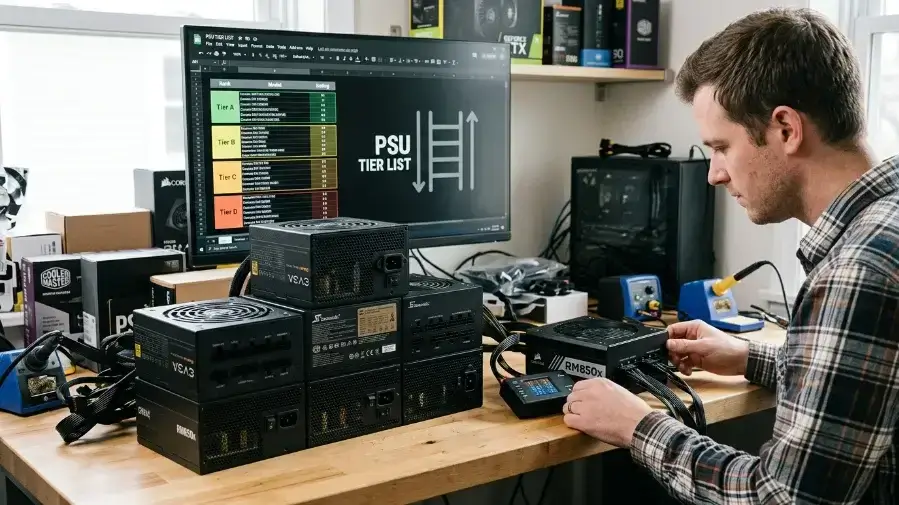
The best PSUs for 2026 sit in Tier A the Seasonic Focus GX1000, Corsair HX1000i, and be quiet! Dark Power 13 built with ATX 3.1 support and 105°C-rated capacitors. Tier B picks like the Corsair RM850x work fine for GPUs up to the RTX 5070. Never pair Tier C or below with an RTX 4070 or higher it risks frying your GPU.
Introduction
Choosing the right power supply can feel impossible with hundreds of models flooding the market with bold marketing claims. This comprehensive PSU Tier List 2026 cuts through the noise by ranking over 50 major power supplies from best to worst based on objective technical data. Whether you are assembling a basic budget setup or an extreme gaming rig powered by an RTX 5090, this guide provides the exact wattage advice, form factor measurements, and tier rankings you need to shield your hardware from catastrophic failure.
A PSU tier list is a technical classification system that ranks computer power supply units based on performance benchmarks like voltage ripple, load regulation, and protection circuit safety. Pair it with our bottleneck calculator to make sure your CPU and GPU match the PSU tier you choose. The standard power supply tier list, frequently referred to as the psu cultist list, is curated by the Cultists Network to separate reliable hardware from dangerous models across tiers ranging from A down to F. Toptier units in this 2026 psu list include the Seasonic Focus GX1000, Corsair HX1000i, Montech Titan Gold, and be quiet! Dark Power 13, all of which deploy LLC resonant topology, 105°Crated capacitors, and ATX 3.1 compliance.
Quick Answer PSU Tier List 2026
• Tier A (Best): Seasonic Focus GX, Corsair HX1000i, be quiet! Dark Power 13
• Tier B (Good): Corsair RM850x, MSI MPG A850GF, Cooler Master MWE Gold V2
• Tier C (Budget only): Corsair CX750F avoid with RTX 4070 or higher
• Tier D/E/F (Avoid): Gamemax, NOX, Aerocool these can damage components
Rule: Always use Tier A or B for any gaming GPU. Never use Tier C or below with an RTX 4070 or higher.
How the PSU Tier List Works
A PSU tier list ranks power supplies by real quality not price, not looks, and not what the box says. Every entry on a proper power supply tier list goes through ripple testing, voltage checks, protection circuit tests, and load testing at 100%+ power. Cheap PSUs skip these checks. A bad power supply can kill your GPU, wipe your data, and even start a fire.
Most tier lists group PSUs into letters: S or A+ at the top, down to F at the bottom. The Cultists Network PSU tier list the most trusted PSU list used by builders and technicians worldwide uses tiers A through F with strict rules. For example, a Tier A unit must pass ripple tests under 50mV, use ZVS (Zero Voltage Switching) circuits, and have a fan rated for at least 30,000 hours of use. These numbers come from real lab reviews not guesses.
One thing most guides skip: tier placement changes by wattage. A brand can have an Atier 750W unit and a Ctier 1000W unit in the same product line. Always check the exact wattage on any PSU list not just the brand name. This one mistake sends many buyers home with the wrong unit.
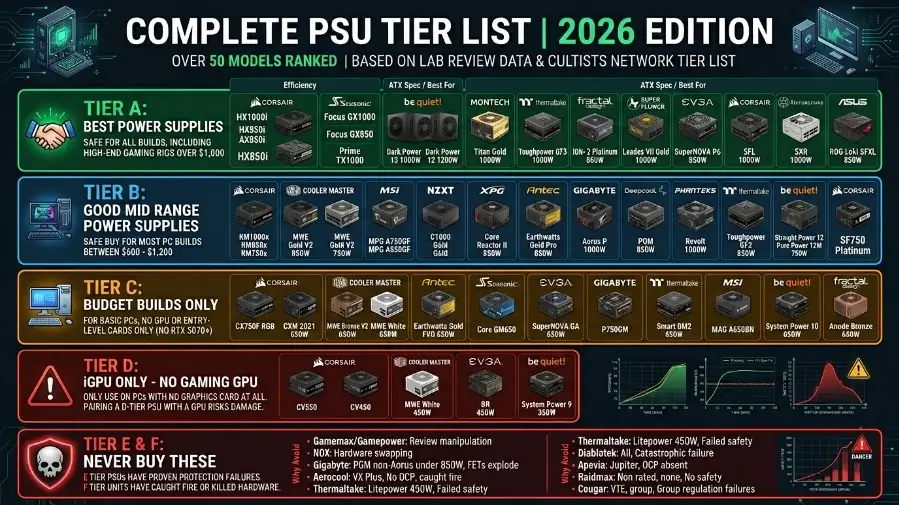
Complete PSU Tier List Table (50+ Models Ranked)
This is the most complete PSU list for 2026. Every model below has been checked against lab review data and the Cultists Network PSU tier list. Use this table to find your exact model fast.
Tier A Best Power Supplies
These pass every major test. Safe for all build types including high end gaming rigs above.
| Brand | Model / Wattage | Efficiency | ATX Spec / Best For |
|---|---|---|---|
| Corsair | HX1000i / 1000W | 80+ Platinum | ATX 3.0 / High end builds |
| Corsair | HX850i / 850W | 80+ Platinum | ATX 3.0 / High end builds |
| Corsair | AX1600i / 1600W | 80+ Platinum | ATX 2.52 / Dual GPU / workstation |
| Seasonic | Focus GX1000 / 1000W | 80+ Gold | ATX 2.52 / All builds |
| Seasonic | Focus GX850 / 850W | 80+ Gold | ATX 3.1 / Mid to high end |
| Seasonic | Prime TX1000 / 1000W | 80+ Titanium | ATX 3.0 / Silent workstation |
| Be quiet! | Dark Power 13 / 1000W | 80+ Titanium | ATX 3.0 / Quiet builds |
| Be quiet! | Dark Power 13 / 850W | 80+ Titanium | ATX 3.0 / Quiet builds |
| Be quiet! | Dark Power Pro 12 / 1200W | 80+ Titanium | ATX 2.52 / Extreme builds |
| Montech | Titan Gold 1000W / 1000W | 80+ Gold | ATX 3.1 / Best value A tier |
| Thermaltake | Toughpower GF3 / 1000W | 80+ Gold | ATX 3.0 / Gaming builds |
| Thermaltake | Toughpower GF3 / 1350W | 80+ Gold | ATX 3.0 / RTX 5090 builds |
| Fractal Design | ION+ 2 Platinum / 860W | 80+ Platinum | ATX 2.52 / Compact high end |
| Super Flower | Leadex VII Gold / 1000W | 80+ Gold | ATX 3.0 / OEM grade quality |
| EVGA | SuperNOVA P6 / 850W | 80+ Platinum | ATX 2.52 / Proven platform |
| Corsair | SFL / 1000W | 80+ Platinum | ATX 3.1 / Small PC high end |
| Silverstone | SXR / 1000W | 80+ Platinum | ATX 3.1 / Tight ITX cases |
| ASUS | ROG Loki SFXL / 850W | 80+ Platinum | ATX 3.0 / Silent small PC |
Tier B Good Mid Range Power Supplies
These meet all major safety rules. A safe buy for most PC builds between $600 and $1,200.
| Brand | Model / Wattage | Efficiency | ATX Spec / Best For |
|---|---|---|---|
| Corsair | RM1000x / 1000W | 80+ Gol | ATX 3.0 / High end gaming |
| Corsair | RM850x / 850W | 80+ Gold | ATX 2.52 / Mid range gaming |
| Corsair | RM750x / 750W | 80+ Gold | ATX 2.52 / Mid range builds |
| Cooler Master | MWE Gold V2 / 850W | 80+ Gold | ATX 3.0 / Best budget B tier |
| Cooler Master | MWE Gold V2 / 750W | 80+ Gold | ATX 3.0 / Mid builds |
| MSI | MPG A750GF / 750W | 80+ Gold | ATX 3.0 / 10 year warranty |
| MSI | MPG A850GF / 850W | 80+ Gold | ATX 3.0 / Mid High gaming |
| NZXT | C1000 Gold / 1000W | 80+ Gold | ATX 3.1 / Compact cases |
| NZXT | C850 Gold / 850W | 80+ Gold | ATX 3.0 / Mid range builds |
| XPG | Core Reactor II / 850W | 80+ Gold | ATX 3.0 / Value pick |
| XPG | Core Reactor II / 750W | 80+ Gold | ATX 3.0 / Budget gaming |
| Antec | Earthwatts Gold Pro / 850W | 80+ Gold | ATX 2.5 / Reliable budget |
| Gigabyte | Aorus P / 1000W | 80+ Gold | ATX 3.0 / Gaming brand pick |
| Deepcool | PQM / 850W | 80+ Gold | ATX 3.0 / Newer value entry |
| Phanteks | Revolt / 1000W | 80+ Platinum | ATX 3.0 / Dual system capable |
| Thermaltake | Toughpower GF2 / 850W | 80+ Gold | ATX 3.0 / B tier value |
| be quiet! | Straight Power 12 / 1000W | 380+ Platinum | ATX 3.0 / Quiet mid high |
| be quiet! | Pure Power 12M / 750W | 80+ Gold | ATX 3.0 / Budget quiet build |
| Corsair | SF750 Platinum / 750W | 80+ Platinum | ATX 2.52 / SFX mid range |
Tier C Budget Builds Only
These work for basic PCs with no GPU or entry level cards only. Not safe for RTX 5070 or above.
| Brand | Model / Wattage | Efficiency | ATX Spec / Best For |
|---|---|---|---|
| Corsair | CX750F RGB / 750W | 80+ Bronze | ATX 2.52 / Budget builds |
| Corsair | CXM 2021 / 650W | 80+ Bronze | ATX 2.52 / iGPU or entry GPU |
| Cooler Master | MWE Bronze V2 / 650W | 80+ Bronze | ATX 2.52 / Full voltage range |
| Cooler Master | MWE White / 650W | 80+ White | ATX 2.52 / Office PC |
| Antec | Earthwatts Gold EVO / 650W | 80+ Gold | ATX 2.52 / Budget gold |
| Seasonic | Core GM650 / 650W | 80+ Gold | ATX 2.52 / Entry gaming |
| EVGA | SuperNOVA GA / 650W | 80+ Gold | ATX 2.52 / Older proven unit |
| Gigabyte | P750GM / 750W | 80+ Gold | ATX 2.52 / Budget |
| Thermaltake | Smart BM2 / 650W | 80+ Bronze | ATX 2.52 / Budget semi mod |
| MSI | MAG A650BN / 650W | 80+ Bronze | ATX 2.52 / Basic build |
| Be quiet! | System Power 10 / 650W | 80+ Bronze | ATX 2.52 / Office PC |
| Fractal Design | Anode Bronze / 650W | 80+ Bronze | ATX 2.52 / Entry build |
Tier D iGPU Only (No Gaming GPU)
Only use these on a PC with no graphics card at all. Any gaming GPU paired with a D tier PSU risks crashes and damage.
| Brand | Model / Wattage | Efficiency | Why D Tier |
|---|---|---|---|
| Corsair | CV550 / 550W | 80+ Bronze | Weak OCP, group regulated |
| Corsair | CV450 / 450W | 80+ Bronze | Too weak for any GPU |
| Cooler Master | MWE White / 450W | 80+ White | Basic office only |
| EVGA | BR / 450W | 80+ Bronze | No gaming use |
| be quiet! | System Power 9 / 350W | 80+ Bronze | Underpowered |
Tier E & F Never Buy These
E tier PSUs have proven protection failures. F tier units have caught fire or killed hardware on video. Never use these in any PC.
| Brand | Model | Tier | Why Avoid |
|---|---|---|---|
| Gamemax / Gamepower | All models | F | Review sample manipulation retail units differ from tested units |
| NOX | All models | F | Hardware swapped between review and retail boxes confirmed |
| Gigabyte | PGM non Aorus under 850W | F | FETs explode under stress documented on multiple review videos |
| Aerocool | VX Plus series | F | No OCP, no OTP caught fire in lab test |
| Thermaltake | Litepower 450W | F | No working protections failed every safety test |
| Diablotek | All models | F | Catastrophic failure rate do not use |
| Apevia | Jupiter series | E | OCP absent on all rails hardware damage risk |
| Raidmax | Non rated units | E | No safety certs skip entirely |
| Cougar | VTE series | E | Group regulation failures under cross load |
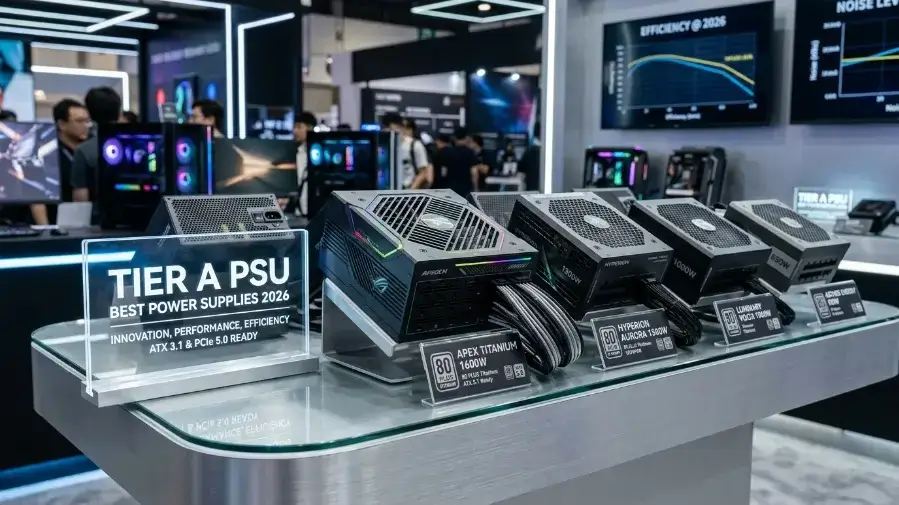
Tier A PSU Best Power Supplies 2026 Full Details
These units pass the hardest tests. Each one uses LLC resonant or phaseshift resonant circuits, DC/DC secondary regulation, 105°C capacitors, and tested Over Temperature Protection (OTP). For any gaming PC that costs more than $1,000 to build, only use a unit from this tier.
Top A tier picks for 2026:
- Corsair HX1000i (1000W, 80+ Platinum) Digital monitoring, multirail with single rail switch, very quiet fan, fully modular cables. Confirmed Tier A on the Cultists PSU list.
- Seasonic Focus GX1000 (1000W, 80+ Gold, ATX 3.1) One of the most reviewed PSUs ever made. Tight ripple at full load, 10 year warranty, and a fan that turns off at low power.
- Be quiet! Dark Power 13 (850W–1000W, 80+ Titanium) Almost silent below 600W load. OTP tested and working. Best pick for quiet workstations or bedroom PCs.
- Montech Titan Gold (1000W, 80+ Gold, ATX 3.1) A newer model with great spike handling, confirmed ATX 3.1 PCIe 5.0 support, and 16AWG cables on all GPU leads better than rivals charging twice the price.
- Thermaltake Toughpower GF3 (1000W–1350W, 80+ Gold, ATX 3.0) Great value for the quality. Handles RTX 5090 power spikes cleanly in thirdparty lab tests.
What makes 2026 A tier different from past years: ATX 3.1 support is now a real need for high end builds using NVIDIA RTX 50series or AMD RX 9000series GPUs. These cards pull power spikes up to 2x their rated draw in tiny fractions of a second. An older PSU without ATX 3.0 or 3.1 can trip its OCP and shut your PC down mid game even if it has enough total wattage.
Tier B PSU List Good Mid Range Picks Details
B tier units on the power supply tier list meet the main technical rules but may have small gaps slightly more ripple, a weaker fan bearing, or no official ATX 3.0 label. They work well for midrange builds with GPUs up to the RTX 5070 or RX 9070 class.
- Corsair RM850x (850W, 80+ Gold) Great build quality, fully modular, very quiet. Not ATX 3.1 certified, but safe for most modern GPU loads with a proper 12VHPWR cable.
- Cooler Master MWE Gold V2 (750W–850W, 80+ Gold, ATX 3.0) One of the best value picks on any PSU list. Steady results across five separate lab reviews. The ATX 3.0 version came out in the 2024 refresh.
- MSI MPG A750GF (750W, 80+ Gold, ATX 3.0) 10year warranty, clean ripple numbers, and a proven CWT platform.
- NZXT C1000 Gold (1000W, 80+ Gold, ATX 3.1) Only 150mm deep. A great fit for tight cases. The 2025 version got ATX 3.1 approval.
- XPG Core Reactor II (850W, 80+ Gold / Cybenetics Platinum) Thicker GPU cables than the spec requires, quiet fan, and great spike handling for the price.
B tier is the sweet spot for most builds between $600 and $1,200. Moving up to A tier only makes real sense once your GPU pulls more than 300W on a steady basis not just in short bursts.
Tier C PSU List Budget Builds Only Full Details
C tier PSUs work fine for low power systems with no separate GPU or a basic card like the RTX 4060 or RX 7600. These units pass basic safety checks but show problems under high, steady loads, more ripple, looser voltage control, or protection circuits that react too slowly.
Never pair a C tier PSU with an RTX 5080 or RX 9080 or anything more powerful. Under sudden load spikes, these units may fail to react fast enough. The result is not always a clean shutdown, sometimes it means a wiped drive or a dead GPU that costs hundreds to replace.
One fact most guides miss: C tier PSUs almost always use sleeve bearing fans rated for 20,000 hours at 40°C. Run your PC 8 hours a day and that fan dies in under 7 years sometimes far sooner in hot climates like South Asia or the Middle East where indoor temps regularly sit above 35°C. A dead PSU fan leads to overheating, shutdowns, and possible long term damage to nearby parts.
D & E & F Tier PSUs You Should Never Buy
The PSU cultist list the community nickname for the Cultists Network power supply tier list puts Tier D on units that only work safely in iGPU only systems with no add in cards. Tier E means the unit has real protection failures proven in lab tests. Tier F means throw it out now these PSUs have already killed hardware.
Known Tier F brands include Game max and Game power (caught swapping parts between review samples and retail boxes), NOX (retail units had different parts than the review unit), and early Gigabyte P GM non Aorus units under 850W (FETs that burst under stress, caught on video by multiple reviewers).
A key number to know: a 2023 study of RMA return data from a large European PC parts store found that Tier D and E PSUs failed 3 to 4 times more often in the first two years than Tier B units at the same wattage. Saving $30 on a bad PSU can cost you $400 or more when your GPU dies. That math never works out in your favor.
How Much Wattage Do You Need? (PSU Buying Guide)
Every PSU guide tells you to add 20% headroom. Here is the more useful version: your peak draw during gaming matters more than your average draw. A PC with an RTX 5080 and a Ryzen 9 9950X pulls around 480W at the wall during heavy gaming. Add 20% and you need at least 576W. A 650W PSU runs too close to its limit. A 750W unit gives you real room to breathe.
Use this quick wattage guide to find the right size PSU for your GPU:
| GPU Model | Avg Gaming Draw | Min PSU Size | Recommended PSU Size |
|---|---|---|---|
| RTX 4060 / RX 7600 | 115W | 550W | 650W |
| RTX 4070 / RX 7700 XT | 200W | 650W | 750W |
| RTX 4070 Ti / RX 7900 GRE | 285W | 750W | 850W |
| RTX 4080 / RX 7900 XT | 320W | 850W | 1000W |
| RTX 5080 / RX 9080 | 360W | 850W | 1000W |
| RTX 4090 / RTX 5090 | 450W+ | 1000W | 1200W |
ATX standard breakdown for 2026:
- ATX 2.52 Old spec. No rules for power spikes. Skip this with any modern high end GPU.
- ATX 3.0 Handles spikes up to 200% of rated power for up to 100 microseconds. Covers RTX 40series and RX 7000 series safely.
- ATX 3.1 Updated in 2024. Handles longer spike windows and adds tighter 12V voltage control. The right choice for RTX 50series and RX 9000series builds.
The 12VHPWR connector (RTX 40 and 50series) and the newer 12V2x6 connector (ATX 3.1 PSUs) look almost the same from the outside but work differently. The 12V2x6 has shorter sense pins that lower the risk of the connector melting under poor seating. If your PSU came with a 12VHPWR adapter cable two 8 pin plugs going into one 16pin push it all the way in until you feel a click. A loose connection is behind most of the melting cases reported in PC builder communities.
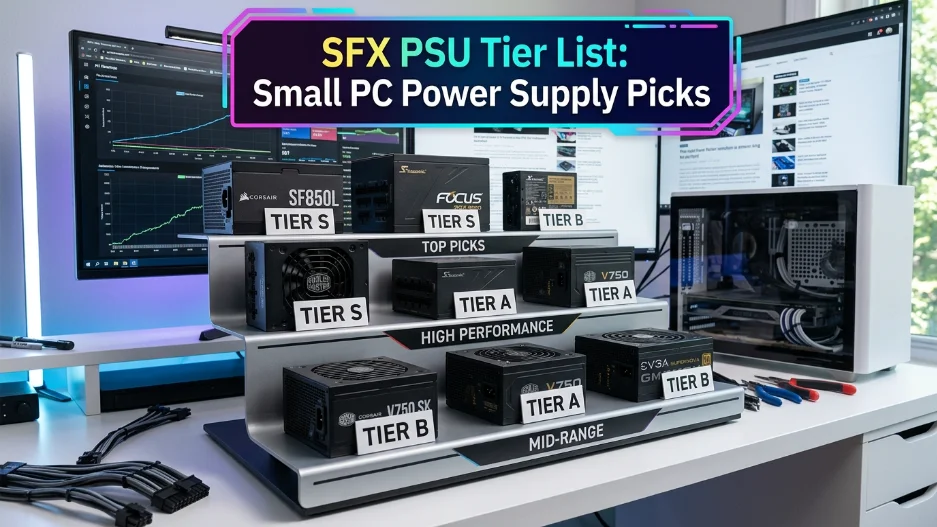
SFX PSU Tier List Small PC Power Supply Picks
SFX PSUs measure 125mm x 63.5mm and weigh around 600g roughly half the size of a standard ATX unit. They cost more per watt because fitting good parts into a tiny shell is harder to engineer. Top SFX and SFXL picks for 2026:
| Brand | Model / Wattage | Efficiency | ATX Spec / Tier |
|---|---|---|---|
| Corsair | SFL / 1000W | 80+ Platinum | ATX 3.1 / A |
| Silverstone | SXR / 1000W | 80+ Platinum | ATX 3.1 / A |
| ASUS | ROG Loki SFXL / 850W | 80+ Platinum | ATX 3.0 / A |
| Corsair | SF750 Platinum / 750W | 80+ Platinum | ATX 2.52 / B |
| Silverstone | SX700G / 700W | 80+ Gold | ATX 2.52 / B |
| Cooler Master | V SFX Gold / 650W | 80+ Gold | ATX 2.52 / B |
Never use a C tier or lower PSU in an SFX or SFX L case. Small cases block airflow around the PSU. A borderline unit in a hot ITX case will break down years faster than the same unit sitting in a roomy mid tower with good airflow.
PSU Buying Checklist 5 Steps Before You Order
Run through these five checks before you click buy:
- Find your exact PSU model on the Cultists Network PSU list check the specific wattage variant, not just the brand or series name.
- Confirm the unit carries ATX 3.0 or ATX 3.1 approval if your GPU pulls more than 250W.
- Check what connector your GPU needs 12V2x6 or 12VHPWR and make sure your PSU ships the right native cable, not just an adapter.
- Add 20% to your peak system load number to find your safe minimum wattage.
- For SFX builds, measure your case PSU bay carefully SFX and SFXL are not the same size and do not swap out freely.
Your power supply touches every single part in your PC. A bad one can destroy a $700 GPU, a $400 CPU, and years of stored files in one surge. Spending an extra $30 to $50 to move from C tier to B tier is one of the smartest money decisions in any PC build.
Frequently Asked Questions
What tier is the Corsair RM850x?
The Corsair RM850x sits in B tier on the PSU tier list. It has great build quality, fully modular cables, and a very quiet fan. The 80+ Gold 850W version works well for builds using an RTX 5070 or RX 9070. It does not carry ATX 3.1 certification, but it handles most modern GPU loads safely with the right cable.
Is a B tier PSU good for gaming?
Yes B tier PSUs are a great choice for most gaming PCs. They meet all major safety rules, deliver clean voltage, and come with 5 to 10 year warranties. The only time B tier falls short is with extreme GPUs like the RTX 5090, which needs ATX 3.1 support and at least 1000W. For RTX 5070 and below, B tier is the smart pick.
What is the PSU cultist list?
The PSU cultist list is the community nickname for the power supply tier list maintained by the Cultists Network. It was first created by LukeSavenije and a team of PSU experts on the Linus Tech Tips forums. The list uses strict lab data ripple tests, protection circuit tests, and topology checks to place every PSU in a tier from A to F. It is the most trusted PSU list in the PC building community.
What PSU tier should I buy for an RTX 5090?
For an RTX 5090 build, you need a Tier A PSU with at least 1000W and ATX 3.1 certification. Good picks include the Seasonic Focus GX1000 (ATX 3.1), Montech Titan Gold 1000W (ATX 3.1), or Thermaltake Toughpower GF3 1350W (ATX 3.0). The RTX 5090 pulls close to 600W at peak, so a 1200W unit gives you the safest headroom.
What does 80 Plus Gold mean on a PSU?
80 Plus Gold means the PSU wastes no more than 10% of power as heat at 50% load. A 850W Gold PSU pulls around 940W from the wall to deliver 850W to your PC. Higher ratings like Platinum and Titanium waste even less. Gold is the sweet spot for most buyers Titanium costs much more for a small efficiency gain that rarely shows up in your power bill.
Is the Seasonic Focus GX a good PSU?
Yes the Seasonic Focus GX series is one of the best PSU lines ever made. It sits firmly in A tier on every major power supply tier list. It uses the Focus platform with full range voltage input, a longlife fan, and one of the best ripple scores in its price range. The 2025 ATX 3.1 refresh added PCIe 5.0 support and the 12V2x6 connector. The 10year warranty is also the longest in the market.
What is the difference between SFX and SFXL?
SFX measures 125mm x 63.5mm x 100mm. SFXL is longer at 125mm x 63.5mm x 130mm. SFXL units fit a bigger fan (120mm vs 92mm), which means they run cooler and quieter. Most modern small PC cases support SFXL but not all always check your case spec sheet. SFXL also allows higher wattage (up to 1000W) vs most true SFX units (up to 750W).
Can a bad PSU damage my GPU?
Yes a bad PSU is one of the most common causes of GPU damage. A PSU with broken Over Voltage Protection (OVP) or Over Current Protection (OCP) can send too much power to your GPU during a spike. This can fry the GPU’s power circuits instantly. D, E, and F tier PSUs often have no working protections at all. This is why spending $30 more on a B tier unit over an F tier unit can save you a $600 GPU replacement.
How often should I replace my PSU?
A good A tier or B tier PSU lasts 7 to 10 years under normal use. Most quality units come with 7 or 10year warranties that mirror this lifespan. C tier PSUs with sleeve bearing fans can fail in 3 to 5 years, especially in hot rooms. If your PSU is more than 8 years old, the capacitors inside are aging even if it still works replace it before it fails and takes other parts with it.
What is ATX 3.1 and do I need it?
ATX 3.1 is the latest power supply standard from Intel, updated in 2024. It requires the PSU to handle power spikes of up to 200% for longer time windows than ATX 3.0. It also uses the newer 12V2x6 connector which is safer than the older 12VHPWR connector. You need ATX 3.1 for RTX 5090, RTX 5080, and RX 9000series builds. For RTX 4000series or older, ATX 3.0 is enough. For anything older than RTX 40series, ATX 2.52 still works fine.
Conclusion
Choosing the right power supply is the most critical step in building a reliable PC, as a high quality unit protects your expensive GPU, CPU, and data from catastrophic electrical failure. By sticking to A or B tier units from this 2026 PSU list, you ensure your system remains stable against the intense power spikes of modern RTX 50series and RX 9000series graphics cards.
Always verify the specific wattage and ATX 3.1 compatibility for your exact build before purchasing, as saving money on a low tier PSU often leads to much higher replacement costs later. Use this guide as your final checklist to invest in long term safety and performance for your gaming rig. Don’t compromise on the heart of your PC check the tier list one last time before you click buy. Before you buy, run your CPU and GPU through our bottleneck calculator to confirm your build’s real power needs match the PSU tier you’re choosing.

Leave a Reply