

Quick Answer: On October 23, 2026, tech critic Ed Zitron accused NVIDIA of fueling the gaming GPU crisis by pushing its chip supply toward AI hardware that big tech companies cannot even power yet, citing a Business Insider report on Amazon’s unused server racks. These are accusations, not proven facts. If you are a gamer, the smart move right now is to buy a 16GB mid-range card only if you genuinely need one, and skip the overpriced flagships.
Introduction
The Nvidia gaming GPU crisis took a dramatic turn on October 23, 2026. A new wave of reporting, led by tech critic Ed Zitron and picked up by outlets including GameByte and RespawnFirst, accuses NVIDIA of manufacturing the shortage that has kept graphics card prices painfully high for months.
The claim is blunt: NVIDIA allegedly diverted its TSMC chip supply away from GeForce gaming cards and toward enterprise AI chips like the H100, B200, and GB300, then encouraged hyperscalers such as Amazon, Google, Microsoft, and Meta to order those chips far ahead of when they could actually use them. The result, critics say, is millions of expensive chips sitting idle in warehouses while gamers pay record prices for gaming GPUs.
Is it true? That is the hard part. These are accusations and analysis, not established facts, and NVIDIA has its own explanation. This article does not ask you to pick a side. Instead, it does something more useful: it explains what the story means for your next build. Which GPU tiers still make sense in October 2026, how to pair a CPU when the GPU is the fixed expensive part, whether the used market is worth the risk, and how to decide between buying now or waiting.
For a recap of how the 2026 shortage built up in the first place, our GPU Shortage 2026 buying guide covers the early timeline and the first wave of price spikes in two minutes. This article picks up the story where that guide leaves off, with this week’s accusations and what they change for buyers.
What Happened This Week The Accusation Against NVIDIA
Ed Zitron’s Clai
Ed Zitron is a tech industry critic known for long, detailed analyses of Big Tech. His argument, published in his newsletter and summarized across tech press this week, goes like this.
First, NVIDIA is allegedly sending most of its TSMC wafer supply to data center chips (the H100, B200, and GB300) instead of GeForce gaming cards. Since gaming GPUs and AI chips are built on the same advanced TSMC manufacturing nodes, every wafer that becomes a data center chip is a wafer that cannot become a gaming card.
Second, NVIDIA allegedly encouraged its biggest customers, Amazon, Google, Microsoft, and Meta, to take delivery of AI hardware far ahead of when their data centers could power it. Zitron argues this “channel stuffing” keeps NVIDIA’s revenue figures looking strong while buyers absorb the storage, power, and depreciation costs of hardware they cannot use.
The punchline: if companies cannot install the chips, Zitron asks, what is actually creating the scarcity? His answer is that NVIDIA itself demanded partners order early, which kept gaming GPU supply tight and prices high.
What Business Insider Reported
Much of the concrete reporting comes from Business Insider, which cited internal Amazon emails from August 2026. According to that report, Amazon set up a program called “Early Rack Receipt,” taking delivery of around $5 billion worth of NVIDIA GB300 server racks before its data centers had the power to run them. Amazon reportedly expected to take on roughly $3 billion more per month after that.
The report says several AWS sites have floor space for the racks but lack the utility power capacity to switch them on. So finished racks sit in warehouses and staging areas. Business Insider calls these “dark GPUs.” Amazon responded that staging hardware near the sites ahead of energization is normal business practice.
Zitron’s analysis also points to Microsoft CEO Satya Nadella publicly admitting he had chips “sitting in inventory” that he could not plug in. Taken together, the reports paint a picture of AI hardware being bought faster than it can be powered.
Practical takeaway: whether or not you believe the accusations, the verified core is that serious money is flowing into AI hardware that is not yet online. That money and manufacturing capacity is real, and it competes directly with gaming GPU supply.
The Dark GPU Problem Chips Sitting Unused in Warehouses

The phrase “dark GPUs” deserves a plain explanation, because it is the most striking image in this story.
A “dark GPU” is a graphics processor or AI accelerator that has been manufactured, shipped, and paid for, but is sitting powered off in a warehouse instead of doing work. Think of it like a brand new car locked in a storage garage while people at the dealership pay double for used cars.
Why does this happen? Data centers do not just need racks. They need enormous amounts of electricity, and local power grids cannot always deliver it on the schedule that chip orders follow. A hyperscaler can have the building, the cooling, and the servers ready, but if the utility company has not upgraded the grid connection, the racks stay dark.
For gamers, the painful part is simple. The same TSMC factories, the same advanced packaging lines, and the same GDDR memory that feed those idle AI racks are the factories that make the RTX 5070 you want for your build. When a large share of that capacity is reserved for hardware that sits dark, fewer gaming cards get made, and prices climb.
This matters even if you never read a tech newsletter. Every dark GPU represents manufacturing capacity that did not become a graphics card on a store shelf. In Japan, retailer Sofmap Gaming recently posted a photo of nearly empty shelves and publicly asked customers to “please sell your gaming PC” back to the store, offering strong buyback prices because new stock is so scarce. When shelves are empty from Tokyo to Texas, the connection between wafer allocation and your build budget is no longer abstract.
What NVIDIA Is Accused Of
TSMC Wafers Diverted From GeForce to AI Chips
Critics make three connected claims:
- 1. Wafer diversion. Most of NVIDIA’s TSMC wafer supply is allegedly routed to high-margin data center chips (H100, B200, GB300) at the expense of GeForce cards. Gaming simply pays less per wafer, so it gets fewer wafers.
- 2. Early-delivery pressure. NVIDIA allegedly encouraged Amazon, Google, Microsoft, and Meta to take delivery of AI hardware before their sites could power it, boosting NVIDIA’s reported revenue while the buyers carry the cost of idle hardware.
- 3. The RTX 5090 freeze. This connects to earlier unconfirmed reports that NVIDIA paused RTX 5090 production to redirect its GB202 chips toward RTX PRO professional cards for AI and workstation customers. The RTX 5090 has effectively vanished from US retail, with listings reaching $5,000 to $9,000 against a $1,999 MSRP, and NVIDIA removed the card from its own GPU marketplace. For the full backstory on the 5090 situation, we covered NVIDIA’s denial and what the $9,000 street prices actually tell you here.
Memory Shortages and Demand, Beyond NVIDIA’s Control
Fairness requires the other side. NVIDIA’s own explanation, given by Ida Keita, the company’s vice president of developer relations, at an event in Seoul in mid-October, is that consumer shortages come from the broader semiconductor supply chain, not from NVIDIA’s allocation choices.
“This is not something Nvidia can control,” Keita said, pointing to memory supplies. GDDR7 and DRAM are genuinely scarce and expensive right now, and that shortage hits every card maker, not just NVIDIA. AMD’s RX 9070 XT launched at $599 and is selling well above that figure too. Rising memory costs are also pushing up DDR5 RAM prices, which is why a YouTube channel’s Patch Report noted this week that the same gaming PC now costs about $1,000 more than it did not long ago on US parts trackers.
It is also true that AI demand itself is real and massive, whether or not anyone stuffed the channel. Even without the dark GPU story, data centers are buying enormous quantities of silicon, packaging capacity, and memory. That alone puts upward pressure on gaming cards.
Practical takeaway: the truth is probably a mix. AI demand is real, memory is genuinely scarce, and NVIDIA prioritizes its highest-margin customers, as any company would. The new accusations add a sharper question: how much of the pain was truly unavoidable, and how much was a choice? For your wallet, though, the cause matters less than the strategy. Prices are high either way, so the next sections focus on what to actually do.
Why This Matters to Gamers
Here is where the news becomes a bottleneck question, which is what this site is about.
In a normal market, you pick your GPU for your target resolution and frame rate, then choose a CPU strong enough to keep up. The GPU is the star, and everything else orbits it. In the 2026 crisis market, that logic flips. The GPU is no longer a free choice. It is the fixed, expensive part. You buy whatever tier you can afford or find in stock, and the CPU becomes the part you tune around it.
This flip changes three things about pairing strategy:
First, bottlenecks get worse when you overspend on the CPU. If all you could find at a sane price is an RTX 5060 Ti or an RX 9060 XT, pairing it with a $400 flagship CPU is wasted money. At 1440p, a mid-range CPU will keep up with a mid-range GPU just fine. Save the CPU budget for the GPU fund, or for the RAM that also got expensive this year.
Second, VRAM is now a bottleneck decision, not just a spec. Several reviewers and analysts now treat 12GB as the practical minimum for new AAA games at 1440p, with 16GB as the safe buy. In a shortage, the 8GB cards that look cheap are often the worst value, because you will hit a VRAM wall before you hit a GPU performance wall. Buying 16GB once beats buying cheap now and re-entering this painful queue in a year.
Third, resolution changes the bottleneck math. If you are stuck with a weaker GPU than you wanted, dropping from 1440p to 1080p shifts more of the load back onto the CPU, which can expose a CPU bottleneck you did not have before. Our guide on how to find a PC bottleneck walks through spotting exactly this kind of imbalance before you spend money.
Practical takeaway: in this market, buy the best GPU tier you can justify, then buy the cheapest CPU that will not bottleneck it at your resolution. Not the other way around.
What GPU Tiers Still Make Sense to Buy
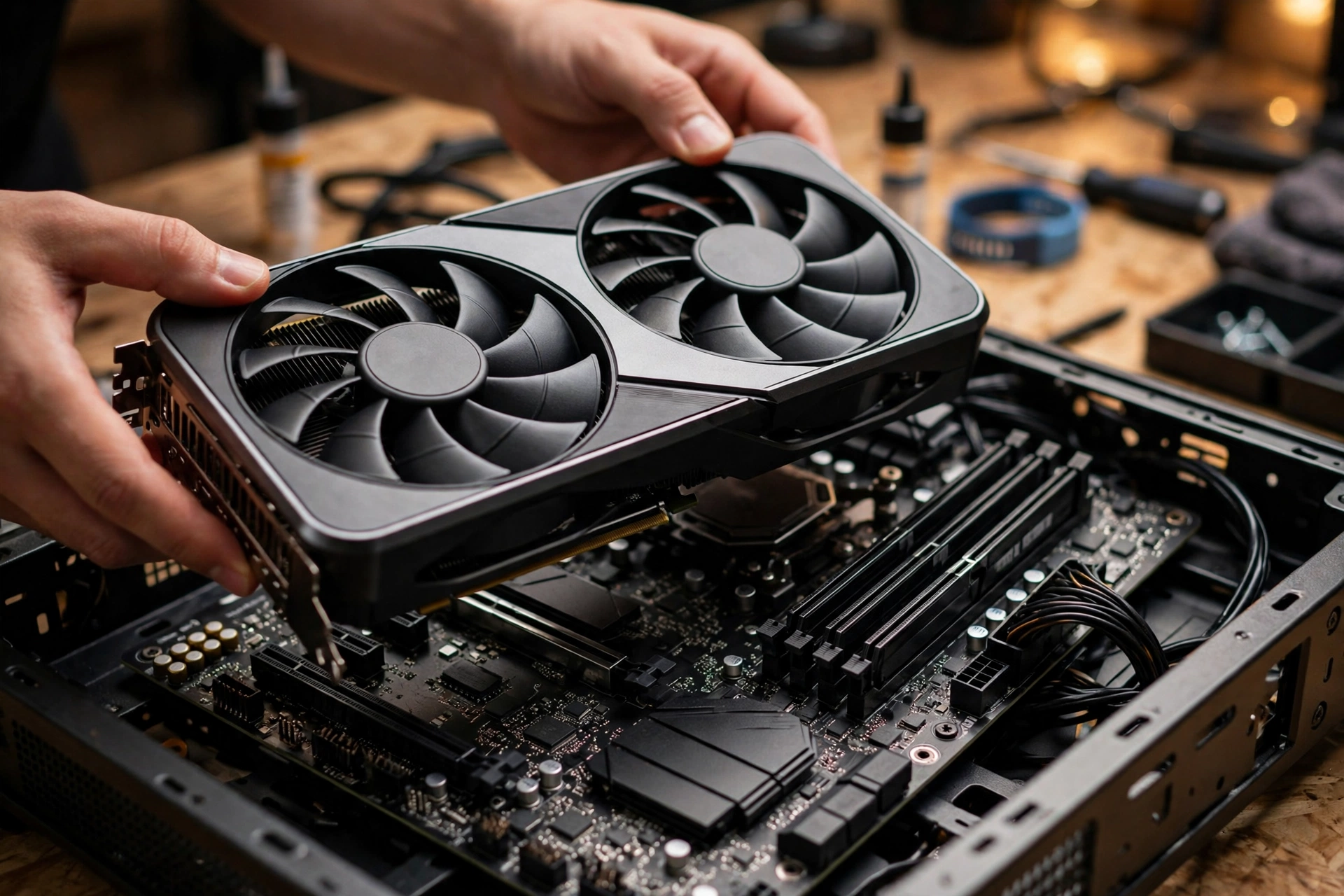
Prices move daily, so treat every figure below as a reported recent US street price, not a live quote. Sources are recent market tracking from mid-October 2026. The pattern matters more than any single number: the higher you climb, the worse the price-to-performance gets.
| Card | Launch MSRP | Reported Oct 2026 US street price | Verdict for gamers |
|---|---|---|---|
| Radeon RX 9060 XT 16GB | Not verified | Around $543 | Sensible 1080p/1440p pick. 16GB at this price is rare in this market. |
| RTX 5060 Ti 16GB | Not verified | Around $771 | Expensive for its class, but the 16GB model is the only one worth considering. Skip the 8GB version. |
| RTX 5070 | $549 | Mid-$600s and up | Solid 1440p card if you find one near the lower end of the range. Open-box deals near $745 are worth a look. |
| Radeon RX 9070 XT 16GB | $599 | Around $800 to $830 | The least painful high-mid option. Roughly $300 cheaper in practice than the 5070 Ti, with close raster performance. |
| RTX 5070 Ti | $749 | Well above MSRP | Only worth it if DLSS, ray tracing, or CUDA work is worth the premium to you. |
| RTX 5080 | Not verified | Over $1,500 | Very hard to justify on pure gaming value right now. |
| RTX 5090 | $1,999 | $5,000 to $9,000 | Do not buy. Effectively unavailable at anything near a sane price. |
A few honest notes on this table. First, AMD is not immune. The RX 9070 XT costs far more than its $599 launch price, because memory and fab pressure hit every manufacturer. Second, the 16GB models consistently hold their value better than 8GB models, which confirms the VRAM guidance above. Third, the RTX 5090 row is there as a warning, not an option. At five to nine thousand dollars, it is a collector’s item, not a gaming purchase.
If you want a deeper tier-by-tier breakdown for high-resolution gaming specifically, our best graphics card for 4K gaming guide ranks the current options by resolution. The prices in that guide were written before this week’s news, so read it for the tier logic and use this article for the current market reality.
Practical takeaway: the value sweet spot in October 2026 is the 16GB mid-range: RX 9060 XT 16GB on a budget, RX 9070 XT 16GB if you can stretch. Everything above the 5070 Ti is paying a crisis tax.
CPU Pairing Strategy When the GPU Is the Fixed Expensive Part
Once you have locked in whatever GPU the market allowed you to buy, the CPU question becomes simple: what is the cheapest CPU that will not bottleneck this card at my resolution?
Here is the practical framework:
Step 1: Start from your GPU and resolution, not from a CPU wishlist. A RTX 5060 Ti or RX 9060 XT at 1080p or 1440p pairs comfortably with a mid-range 6-core CPU. An RX 9070 XT or RTX 5070 at 1440p wants a solid modern 6 to 8 core chip, but it does not need a flagship. Flagship CPUs only start earning their price with flagship GPUs at high refresh rates, and flagship GPUs are exactly what this market will not sell you at sane prices.
Step 2: Check the platform cost, not just the chip. This matters more than usual in 2026 because DDR5 RAM prices have spiked alongside GPU prices. A cheaper CPU on a platform that needs expensive DDR5 can cost more overall than a slightly pricier CPU on a DDR4 platform you already own. We covered the RAM side of this squeeze in our CPU price hike and gaming PC cost breakdown. Always price the CPU, motherboard, and RAM together.
Step 3: Verify with a bottleneck check before you buy. Run your planned pairing through a bottleneck calculator at your exact resolution and target games. If the calculator shows the CPU holding back the GPU by more than a few percent at your settings, step the CPU up one tier. If it shows the GPU as the limit, which is the healthy state, stop spending on the CPU.
Common mistake to avoid: buying a previous-generation flagship CPU “for future upgrades” when your GPU is mid-range. In this market, the future upgrade is the GPU you could not afford today. A balanced mid-range CPU now leaves you money for that GPU later, when supply normalizes.
Practical takeaway: let the scarce GPU set the budget ceiling, then buy the minimum CPU that clears the bottleneck check. Bank the difference.
The Used Market What Japan’s Empty Shelves Tell You
The Sofmap story from Japan is the clearest signal of how tight things have gotten. Sofmap Gaming, a major electronics retailer, posted a photo of nearly empty shelves on its official X account and asked customers to sell their gaming PCs back to the store, saying used systems were genuinely out of stock and offering strong buyback prices. Reporting from Akihabara, Tokyo’s biggest electronics district, added that new graphics card stock sells out almost immediately when it arrives.
When retailers are begging for used PCs, the used market flips in two ways. Your old card is worth more, which is good news if you are selling. But the card you want to buy used is also worth more, because every seller has read the same headlines you have. The discount you expect from buying used shrinks exactly when you need it most.
If you do go used, protect yourself with this checklist:
- Buy from sellers with real return policies. Local marketplaces with no buyer protection are a minefield during shortages. A card that was mis-sold or is failing will cost you more than the savings.
- Ask about the card’s history. A card that ran heavy rendering or mining workloads for years looks identical in photos to one from a gaming PC. Ask directly, and be skeptical of vague answers.
- Test before you commit when possible. If you can meet the seller, run a demanding game or benchmark for at least 20 to 30 minutes. Watch for crashes, artifacting, or fans that rattle.
- Check the power requirements. Older high-end cards like the RTX 3090 are 350W cards with sharp power spikes. Make sure your power supply can handle it, because buying a new PSU wipes out the used discount.
- Compare against new 16GB options. A used card only makes sense if it is clearly cheaper per year of useful life than a new RX 9060 XT 16GB or RTX 5060 Ti 16GB. Do the math before the nostalgia kicks in.
Practical takeaway: the used market is a valid escape hatch, but the shortage tax applies there too. Only buy used when the price clearly beats new 16GB options after factoring in warranty risk.
Wait or Buy? A Simple Framework
This is the question every gamer is asking, and the honest answer depends on your situation. Here is a simple framework.
Buy now if:
- Your current card cannot run the games you actually play. Call of Duty Modern Warfare 4 launched today, October 23, and it is the biggest PC release of the fall. If your hardware cannot run the games on your list, waiting means months of not playing.
- You found a card at or near the lower end of its current street range. An open-box RTX 5070 near $745, or an RX 9070 XT near $800, is a defensible buy in this market.
- You are buying 16GB. A 16GB card bought today stays useful for years, which is the best hedge against a market that keeps punishing short-term thinking.
Wait if:
- Your current card still plays your games at settings you accept. As one analyst put it this week, the most valuable upgrade in 2026 is the one you do not make. Every month you wait is a month closer to supply normalization.
- You are chasing a flagship. The RTX 5080 and 5090 are priced as luxury goods right now. Waiting costs you nothing if the alternative is paying double.
- You are hoping for Black Friday deals. Multiple outlets, including TechRadar, are advising against this specifically for GPUs this year. Rising memory costs and tight supply mean the traditional late-year discounts are unlikely to appear for graphics cards.
The middle path: buy a sensible 16GB mid-range card now to cover the next two to three years, and plan the big upgrade for when the market normalizes. This avoids both the pain of waiting with unplayable hardware and the pain of overpaying for a flagship.
One more timing factor: new game launches drive demand spikes. With Modern Warfare 4 launching today and the holiday season ahead, short-term demand is more likely to rise than fall. If you have decided to buy, sooner in the season is generally better than later.
Practical takeaway: need it now means buy now, at 16GB, near the low end of the street range. Do not wait for Black Friday GPU miracles that the current supply picture does not support.
Could Prices Fall in 2027? What We Honestly Know
Nobody honest will promise you a date when prices return to normal. Here is what can be said with confidence.
Market analysis from recent weeks suggests that if you do not need a card now, the second half of 2027 has the clearest chance of paying off for patient buyers. That is not a prediction of cheap GPUs. It is an assessment that new fab capacity and easing memory supply are unlikely to arrive meaningfully before then.
Several forces could move prices in either direction:
- Downward: if hyperscaler AI orders slow when cloud providers hit capital spending limits, wafer and memory capacity could free up for gaming products. Some analysts warn of an oversupply correction similar to what followed the crypto mining bust.
- Upward: memory manufacturers continue shifting production toward high-bandwidth memory for AI chips, which keeps GDDR and DDR5 supply tight. NVIDIA itself has warned that supply constraints would remain a headwind for gaming beyond early fiscal 2027.
The uncomfortable truth is that waiting has been a losing bet through most of 2026. Buyers who held off over the summer are now paying more for the same cards. Waiting only works as a strategy if you can genuinely afford to wait, meaning your current hardware still does the job.
Practical takeaway: hope for relief in the second half of 2027, plan for elevated prices until then, and never make a buying decision based on a promised crash that has not happened yet.
Frequently Asked Questions
Buy an open box 5070 now or wait until Black Friday?
This is a real question from a US gamer on Reddit, quoted in recent TechRadar coverage: “Buy an open box 5070 now or wait until Black Friday? I see a few open box deals for $745. What do people think about snagging this now at such an inflated price, or waiting until Black Friday to try and snag under $700?”
Our answer: buy it now if $745 fits your budget. The $549 launch MSRP is not coming back this year, under-$700 Black Friday pricing for a 5070 looks unlikely given memory costs and tight supply, and an open-box card from a retailer with a return policy is one of the safer ways to buy in this market. Check that the box includes all accessories and that the return window is real before you pay.
Should I buy a GPU now or wait?
If your current card still runs your games, wait. The most valuable upgrade is the one you skip. If you are building anyway or your card cannot keep up, buy a 16GB card once, at the low end of its current street range, instead of buying cheap now and re-entering this market in a year. Waiting without a working card is just paying in lost gaming time.
Is 8GB of VRAM enough in 2026?
For older games and esports titles at 1080p, yes. For new AAA releases at 1440p, no. 12GB is the practical minimum for new games, and 16GB is the safe buy. This matters more than usual right now because 16GB cards are the ones holding their value, while 8GB cards risk hitting a memory wall long before their GPU cores run out of speed.
RX 9070 XT or RTX 5070 Ti?
On raw gaming performance the two are close. On actual October 2026 street prices they are not: the 9070 XT has been selling roughly $300 cheaper in practice. Pick the 5070 Ti only if DLSS upscaling, better ray tracing, or CUDA for work tasks is worth that gap to you. For pure raster gaming at 1440p, the 9070 XT is the better value in this market.
Why are graphics cards so expensive in 2026?
Three overlapping causes. First, AI data center demand is consuming enormous amounts of advanced silicon, packaging capacity, and memory. Second, GDDR7 and DRAM are genuinely scarce, which raises costs for every card maker including AMD. Third, critics allege NVIDIA prioritized high-margin AI chips and encouraged early hyperscaler orders, tightening gaming supply further. That third claim is unproven, but the first two are widely reported and enough to explain the prices on their own.
Is NVIDIA really abandoning PC gamers?
That is the fear behind this week’s headlines, and it is worth separating fact from feeling. Fact: the RTX 5090 has effectively disappeared from retail and from NVIDIA’s own marketplace, and no new GeForce cards are expected soon. Feeling: that this means GeForce is over. The honest answer is that gaming is still a real business for NVIDIA, just a much smaller one next to data center revenue. Gamers are being deprioritized in allocation, which is not the same as being abandoned, but it feels similar at checkout.
Key Takeaways
- The October 23 accusations claim NVIDIA fueled the gaming GPU crisis by diverting chips to AI hardware that sits unused in warehouses (“dark GPUs”). These are accusations, not proven facts, and NVIDIA blames memory shortages beyond its control.
- Either way, prices are high and supply is tight, so your strategy matters more than the blame debate.
- The value sweet spot in October 2026 is 16GB mid-range: RX 9060 XT 16GB on a budget, RX 9070 XT 16GB if you can stretch.
- When the GPU is the fixed expensive part, buy the cheapest CPU that will not bottleneck it at your resolution, and price the CPU, motherboard, and RAM together.
- Buy now only if you need a card now, at 16GB, near the low end of street prices. Do not wait for Black Friday GPU deals that the supply picture does not support.
- Realistic relief is not expected before the second half of 2027. Plan accordingly.
Conclusion
The dark GPU story is genuinely shocking: billions of dollars of chips sitting in warehouses while gamers pay record prices. Whether that happened because of deliberate channel stuffing, unavoidable power grid delays, or a mix of both is something only time and more reporting will settle.
What you can control is your buying strategy. Buy 16GB, buy at the low end of the street range, pair a sensible CPU to whatever GPU the market gives you, and verify the pairing with a bottleneck check before you spend. The crisis will eventually pass. The goal is to come out of it with a balanced build, not a receipt you regret.
If you are still weighing the broader shortage, start with our GPU Shortage 2026 buying guide for the full timeline, then use this article’s framework to make your decision. And if you are unsure about any pairing, run it through a bottleneck check first. In a market this expensive, ten minutes of checking beats months of regret.

Leave a Reply