

Quick answer: NVIDIA plans to replace the 16GB RTX 5080 with a 24GB GDDR7 model in Q1 2027, using denser 3GB memory chips on the same 256-bit bus. Nothing is confirmed, and board partners reportedly have no development documents yet. If it happens, 4K gamers get meaningful VRAM headroom, but raw frame rates may barely change.
If you have been shopping for a high-end GPU in 2026, you already know the market feels broken. Prices keep climbing, the RTX 5090 is reportedly vanishing from production, and now the loudest rumor in graphics says an rtx 5080 24gb refresh will take over as NVIDIA’s top gaming card in the first quarter of 2027. This is not an official announcement. It is a report from the Taiwanese publication Benchlife, picked up by VideoCardz, Notebookcheck, and Wccftech between October 10 and October 13, and every detail below should be read with that warning attached.
Still, the rumor matters even if it never ships exactly as described. It tells you where NVIDIA’s lineup is heading, it changes the math on whether to buy a 16GB RTX 5080 today, and it answers the single biggest complaint gamers have had about the card since launch: 16GB of VRAM on a thousand-dollar flagship. This guide breaks down what the rumor actually says, how NVIDIA would reach 24GB without redesigning the card, what the extra memory changes for 4K gaming, which CPUs will keep up with a 24GB flagship, what power supply you should plan for, and whether you should buy now or wait for Q1 2027.
What the Latest Rumor Actually Says
Here is the report, stripped down to what sources actually claim versus what they are guessing. Benchlife, a Taiwanese tech publication with a long track record of board-partner leaks, reports that NVIDIA plans to launch a GeForce RTX 5080 with 24GB of GDDR7 memory in the first quarter of 2027, and that this card will replace the existing 16GB RTX 5080 rather than sit alongside it. VideoCardz, Notebookcheck, and Wccftech all carried the story within a day of each other, and all three tag it explicitly as a rumor.
Three details in the reporting deserve your attention because they tell you how solid this is. First, Benchlife says NVIDIA’s board partners have not received any development documentation for the 24GB model. They have reportedly only been told verbally that the materials are coming soon. That is unusual for a card supposedly launching within one or two quarters, and it means the Q1 2027 window could easily slip. Second, nobody has confirmed whether this card will be called the RTX 5080 SUPER or keep the plain RTX 5080 name. Earlier rumors described a 24GB RTX 5080 SUPER with the same 10,752 CUDA cores as the current card, and VideoCardz reported back in July 2026 that at least one board partner had received SUPER hardware before NVIDIA put the launch on hold over the high cost of 3GB GDDR7 chips. The new 24GB card may simply be that shelved SUPER project under a different name, or it may be a fresh product. Nobody outside NVIDIA knows yet. Third, no pricing, clock speeds, or power figures have leaked. Any article giving you a price for this card is guessing.
The sources for this story are worth naming so you can judge them yourself: VideoCardz’s report is the most detailed English write-up, Notebookcheck’s coverage adds useful context on the RTX 5090 situation, and Wccftech’s article collects the earlier leaker claims in one place. All three agree on the core claim and all three say NVIDIA has confirmed nothing.
The Reported RTX 5090 Production Halt
The 24GB RTX 5080 rumor does not exist in a vacuum. Days earlier, leakers MEGAsizeGPU and hongxing2020 reported that NVIDIA had halted RTX 5090 production and was redirecting its GB202 chips toward the far more profitable RTX PRO workstation cards, a claim Benchlife has since corroborated while stressing it should not be read as a formal end-of-life. We covered that story in detail, including what 5090 owners and prospective buyers should do, in our earlier article: RTX 5090 reportedly discontinued: what gamers should do next. The short version is that existing RTX 5090 stock is getting more expensive as it drains, and nothing NVIDIA has said contradicts the production-halt reports.
If both reports are accurate, the picture for 2027 is stark: the RTX 5090 leaves the shelves, the 16GB RTX 5080 gets replaced, and a 24GB RTX 5080 becomes the most powerful GeForce card a gamer can actually buy new. That context is what makes this rumor worth a full guide instead of a two-paragraph news blurb.
How NVIDIA Gets to 24GB on the Same 256-bit Bus

This is the part of the rumor that is actually elegant engineering, and it is worth understanding because it explains both what the card can do and what it cannot do. The current RTX 5080 uses NVIDIA’s GB203 GPU with 10,752 CUDA cores and a 256-bit memory interface. A 256-bit bus divided into 32-bit channels means the card carries exactly eight memory chips. Today those are 2GB (16Gb) GDDR7 modules, which gives you 8 x 2GB = 16GB. The rumored refresh swaps in denser 3GB (24Gb) GDDR7 modules from Samsung and Micron: 8 x 3GB = 24GB. Same GPU, same board layout, same bus width, 50 percent more capacity. No redesign required, which is exactly why this kind of refresh is cheap for NVIDIA to execute.
Here is the catch that most coverage glosses over: more capacity does not mean more bandwidth. Memory bandwidth is determined by bus width multiplied by memory speed, not by how much data the chips can hold. Think of it as a parking lot: adding spaces (capacity) does not add lanes to the road in (bandwidth) unless you also raise the speed limit. If NVIDIA keeps the current 30 Gbps GDDR7 speed, the 24GB card keeps the same 960 GB/s of bandwidth as the 16GB model, just with far more room for textures, geometry data, and AI model weights. The older RTX 5080 SUPER rumors pointed to faster 32 Gbps memory that would have pushed bandwidth to 1,024 GB/s, but the current Benchlife report says nothing about memory speed, so treat any bandwidth increase as unconfirmed.
The 3GB GDDR7 modules themselves are the reason this card may or may not appear on schedule. These denser chips are scarce and expensive right now. Industry reporting via PC Guide cites UDN’s claim that 3GB GDDR7 chips cost board partners somewhere around $60 to $70 each, versus roughly $20 for a standard 2GB chip. That means the memory alone on a 24GB card could cost about three times what it costs on the 16GB model, which is reportedly why NVIDIA shelved the SUPER refresh in the first place. If memory prices stay where they are, either the card launches late or it launches expensive. There is no version of this story where 50 percent more VRAM comes free.
24GB vs 16GB What Changes for Gamers
Let us be precise about what a 24GB RTX 5080 would and would not do for you, because the VRAM number on the box causes more confusion than almost any other spec. The table below compares the current card against the rumored refresh. Every value in the 24GB column is unconfirmed and labeled as such.
| Specification | RTX 5080 16GB (current, confirmed) | RTX 5080 24GB (rumored, unconfirmed) |
|---|---|---|
| GPU | GB203 | GB203 (reported, same chip) |
| CUDA cores | 10,752 | 10,752 (reported, unchanged) |
| VRAM capacity | 16GB GDDR7 | 24GB GDDR7 (reported) |
| Memory modules | 8x 2GB chips | 8x 3GB chips (reported) |
| Memory bus | 256-bit | 256-bit (reported, unchanged) |
| Memory bandwidth | 960 GB/s | 960 GB/s (likely unchanged; faster memory unconfirmed) |
| Board power | 360W TGP | Not reported; earlier SUPER rumors suggested higher |
| Launch MSRP | $999 | Not announced |
| Availability | On shelves now | Rumored Q1 2027; partners lack development docs |
The single most important row in that table is the CUDA core count. If the 24GB card keeps the same 10,752 cores as reported, its raw rendering speed will be nearly identical to the 16GB model in any game that fits comfortably in 16GB of VRAM. You are not buying a faster GPU. You are buying a GPU with a bigger memory pool, and that distinction decides whether this card is worth your money.
So when does the bigger pool actually matter? Three gaming scenarios benefit clearly. First, 4K with maximum texture settings plus ray tracing or full path tracing is where 16GB cards start to strain. When a card runs out of VRAM, the driver starts shuffling data to system RAM across the PCIe bus, and the result is not a small FPS dip but ugly stuttering and collapsed 1% lows. Our best graphics cards for 4K gaming guide covers which current cards handle that workload, and a 24GB 5080 would slot into it comfortably. Second, heavily modded games with 4K and 8K texture packs can blow past 16GB without breaking a sweat. Third, anyone who also runs local AI models, 3D rendering, or heavy video work gets a card that finally stops being embarrassing next to the 24GB RTX 4090 for memory-bound tasks.
What 24GB will not do is raise your frame rate in the games you already play smoothly. It will not fix a CPU bottleneck, it will not make DLSS unnecessary, and it will not turn the 5080 into a 5090. The RTX 5090’s advantage was never just its 32GB of memory; it was a far larger GB202 chip with dramatically more cores and a 512-bit bus. A 24GB 5080 closes the memory gap while the compute gap stays wide open. Keep that in mind every time someone tells you this card “replaces” the 5090. It replaces it on the shelf, not in performance.
The 4K Flagship Gap the 24GB Model Would Fill
Step back and look at the market this card would launch into, because the timing explains the product. The RTX 5090 launched at $1,999 and, according to 3DCenter’s October 2026 pricing report on the German market, its street price has since climbed roughly 132 percent in twelve months. The RTX 50 series as a whole is up about 66 percent on average over the same period, and even if you exclude the 5090, the average increase is still near 57 percent. AMD’s RX 9000 series rose a comparatively modest 46 to 48 percent, and Intel’s Arc cards about 38 percent. We broke down what those rising component prices mean for gaming PC budgets separately, but the takeaway here is simple: flagship-class GPUs have never been more expensive relative to launch, and the card that used to anchor the top of the stack is reportedly leaving.
That leaves a hole. With the RTX 60 series reportedly delayed until 2028, Blackwell has to carry NVIDIA’s gaming lineup for much longer than originally planned, and a memory refresh is one of the cheapest ways to keep a two-year-old architecture feeling current. A 24GB RTX 5080 would not match the 5090, but it would give NVIDIA a defensible “most powerful GeForce you can actually buy” story, and it would finally answer AMD’s 24GB cards on memory capacity. Remember the Tom’s Hardware forum user who said they wanted the 5080 but felt NVIDIA “decided to cheap out on RAM, again,” and was cross-shopping the 24GB RX 7900 XTX? That buyer is exactly who this refresh is for. The 7900 XTX comparison is instructive: a two-year-old AMD card with 24GB of slower GDDR6 has been winning the capacity argument against the 5080 since day one, and NVIDIA clearly noticed.
There is a second, quieter reason for the timing. CES 2027 in January is the natural announcement venue for a Q1 product, and several outlets have already pointed at it. But announcements need finished hardware behind them, and right now the reporting says board partners are still waiting on development materials. A CES reveal followed by a March launch is plausible. A delay into mid-2027 is equally plausible. Do not plan a build around a date that NVIDIA has not confirmed.
Which CPUs Will Not Bottleneck a 24GB RTX 5080 at 4K
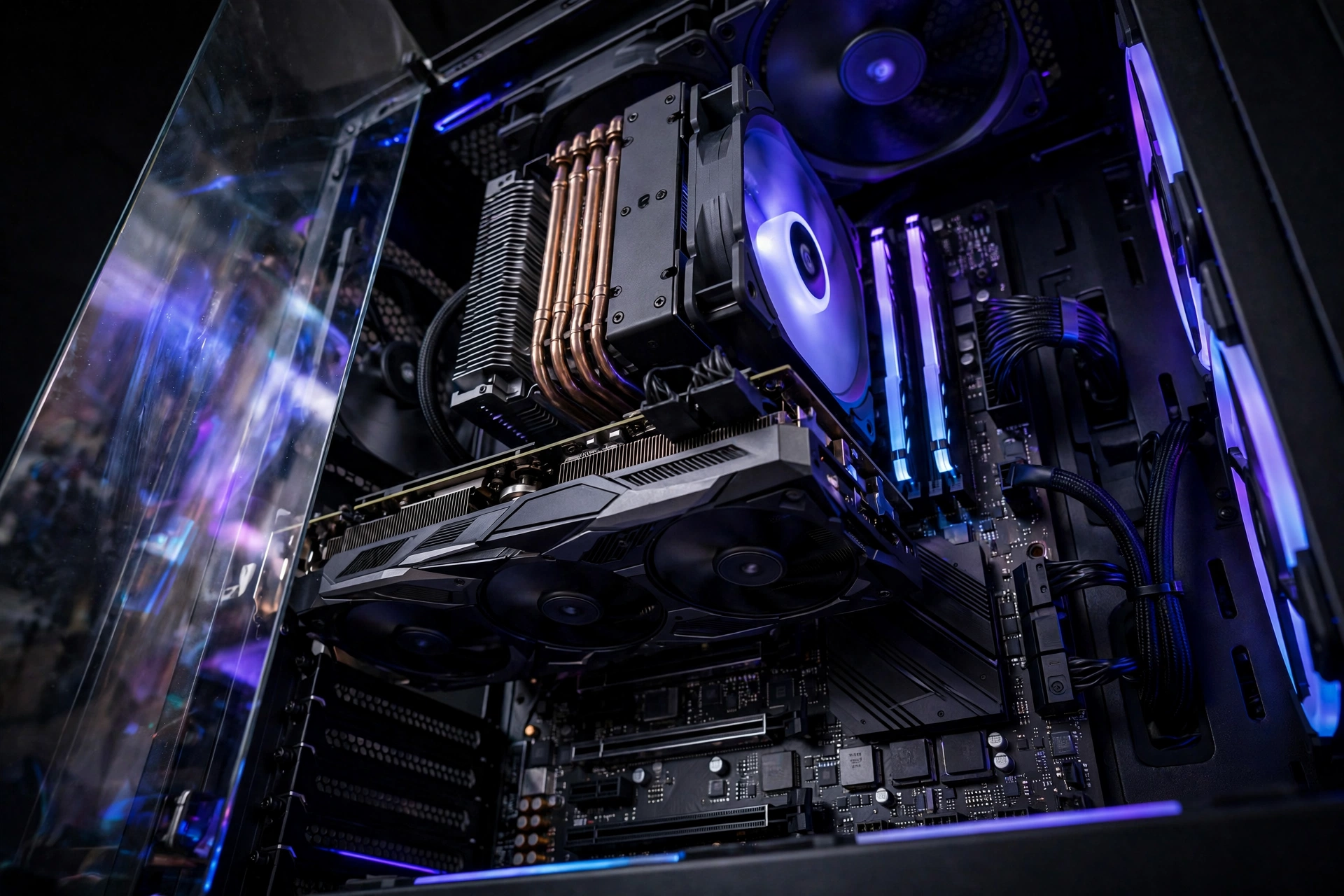
Here is the good news for your wallet: at 4K, a 24GB RTX 5080 is overwhelmingly GPU-bound, which means the CPU matters less than the GPU marketing would have you believe. In graphically demanding AAA titles at 3840×2160, the card will be the limiting factor in the vast majority of scenes, and any modern mid-range or better CPU will feed it fast enough to keep average frame rates where they belong. The CPU starts to matter in three situations: competitive esports titles at very high refresh rates, where the CPU sets the frame-rate ceiling; 1% lows and frame-time consistency, where a weak CPU causes stutter even when averages look fine; and 1440p gaming, where the GPU finishes frames faster and the CPU has to keep up.
One misconception to clear up before the recommendations: extra VRAM does not change what the CPU has to do. The 24GB card asks exactly the same of your processor as the 16GB card, because the CPU still issues the same draw calls and the game logic still runs on the same cores. VRAM is local storage on the graphics card, not a second processor. If your CPU is fine with a 16GB 5080, it is fine with a 24GB one. If it is holding the 16GB card back, 24GB of memory will not save it. For a refresher on how the two limits interact, see our explainer on CPU bottlenecks versus GPU bottlenecks.
With that understood, here is how CPUs stack up for a 24GB RTX 5080 build, assuming 4K gaming as the primary workload:
| CPU tier | Example CPUs | Verdict with a 24GB RTX 5080 at 4K |
|---|---|---|
| No-compromise | Ryzen 7 9800X3D, Ryzen 7 7800X3D | No meaningful bottleneck at 4K or 1440p; best 1% lows available |
| Excellent | Core i7-13700K, Core i5-14600K, Ryzen 7 7700X | GPU-bound in nearly all 4K titles; great high-refresh 1440p performance |
| Solid value | Ryzen 5 7600 / 7600X, Core i5-13400F and newer | Fine for 4K 60-120Hz gaming; may trail slightly at 240Hz esports settings |
| Caution | Older 6-core / 4-core chips, laptop-class CPUs | Likely to limit 1% lows; upgrade the CPU before buying a flagship GPU |
The i7-13700K pairing deserves a specific mention because we have tested the logic in depth: our i7-13700K and RTX 5080 pairing guide found it a well-balanced combination, and that conclusion carries over unchanged to the 24GB model since the CPU load is identical. On the AMD side, the 3D V-Cache chips remain the safest pick if you also play CPU-heavy competitive games. And if your main goal is high-refresh esports rather than 4K eye candy, read our breakdown of what CPU you actually need for 240Hz before spending flagship-GPU money, because at 1080p and 1440p low settings the CPU does far more of the work.
One more practical note: DLSS 4 with multi frame generation changes the bottleneck picture in an interesting way. Frame generation raises displayed frame rates without asking more of the CPU, which can make a mid-range CPU feel faster than it is, but it does not reduce the CPU’s actual workload per real frame. Our article on whether DLSS reduces CPU bottlenecks digs into that distinction. With a 24GB card, DLSS Quality mode at 4K plus frame generation is likely to be the sweet spot that keeps both the GPU’s memory and your CPU comfortably in their lanes.
PSU and Power Notes for a Flagship-Class RTX 5080
The current 16GB RTX 5080 is a 360W TGP card, and NVIDIA’s official guidance pairs it with a quality 850W power supply. The rumored 24GB model has no confirmed power figure. The older RTX 5080 SUPER rumors pointed to a higher board power around 415W, but the current Benchlife report says nothing about power at all, so treat that number as history, not fact. Denser memory chips can draw slightly more power than the ones they replace, but the difference is small next to the GPU itself, and board partners may simply keep the same 360W envelope.
Here is the practical guidance. If you are building around a 24GB RTX 5080 when it launches, an 850W high-quality ATX 3.1 power supply with a native 12V-2×6 cable remains the sensible baseline, exactly as it is for the 16GB card. Step up to 1000W if you are pairing it with a power-hungry flagship CPU, planning heavy overclocking, or you simply want headroom for transient spikes, which Blackwell cards are known for. Do not reuse an ancient 750W unit with adapter cables on a card in this class; the connector and the transient behavior both assume a modern supply. Our PSU tier list and power supply ranking will help you pick a specific model.
A quick word on the 12V-2×6 connector, since it still worries builders: seat it fully until the latch clicks, leave the cable with a gentle bend rather than a sharp one at the plug, and check it once after the first week of use. Most of the melted-connector stories from the last two generations trace back to partially seated plugs, not to the connector design itself.
Buy an RTX 5080 Now or Wait for Q1 2027?
This is the question the rumor forces on everyone shopping today, so here is a decision framework instead of a one-size answer.
Buy the 16GB RTX 5080 now if you need the card in the next few months, you primarily play at 4K without maxed-out path tracing, and you found one at a price you can live with. The 16GB card is a real product with real drivers and real warranty support today, and the 24GB card is a rumor with no price, no firm date, and no guarantee it keeps the same MSRP. Waiting for a product that might slip to mid-2027 while your current GPU struggles is a bad trade.
Wait for the 24GB model if you keep graphics cards for four or more years, you play with ultra textures and path tracing at 4K, you run local AI models or 3D work on the side, and your current card is still doing its job. VRAM requirements only move in one direction over a card’s lifetime, and 50 percent more headroom is genuinely meaningful on a four-year horizon. Just go in expecting to pay more: the memory cost data all points one way.
Consider the used market either way. Two dynamics are worth watching. First, if the 16GB model is really being discontinued, remaining new stock could get more expensive, not cheaper, as supply drains, which is exactly what the RTX 5090 reports describe. Second, used RTX 4090 cards remain the wildcard alternative: the 4090 was discontinued back in October 2024, so you are shopping the used market, but you get 24GB of VRAM and flagship-class raster performance today instead of a rumor tomorrow. Verify the seller, check the card’s history, and make sure your PSU can handle a 450W card before going that route.
One more scenario: NVIDIA could surprise everyone and keep the 16GB model in production at a lower price while the 24GB card sits above it. The reporting says replacement, not coexistence, but product plans change, and a cheaper 16GB 5080 would instantly become the value pick of the high end. Keep an eye on street prices through the holidays; they will tell you which way NVIDIA is leaning before any official announcement does.
What Could Still Change
A responsible guide has to list what could kill this story, because several things already have once. The RTX 50 SUPER refresh was reportedly shelved over 3GB GDDR7 costs as recently as mid-2026, and the same cost problem exists today. Samsung has announced DRAM price increases for the second half of the year, and those costs land directly on graphics cards. If memory stays scarce and expensive, NVIDIA can delay the card, raise its price beyond what gamers will pay, or quietly cancel it again.
The missing development documents are the second red flag. Board partners design coolers, PCBs, and packaging around NVIDIA’s specs, and they reportedly have none of that yet for a card supposedly launching in Q1 2027. Either the timeline is aspirational or the product is further along internally than partners have been told. Both have happened before. The naming is the third unknown: RTX 5080 SUPER versus a straight RTX 5080 replacement changes how the card is marketed and possibly how it is priced, and nobody has confirmed either.
None of this means the rumor is wrong. Benchlife’s sourcing on board-partner matters is generally solid, and the business logic is coherent: the 5090 is reportedly exiting, the 60 series is reportedly delayed to 2028, and GPU prices are up about 66 percent year over year.
But business logic is not a product launch. Treat Q1 2027 as the current best guess, not a date, and do not make irreversible purchase decisions on it.
Frequently Asked Questions
Is there an RTX 5080 with 24GB of VRAM yet?
No. As of October 2026, the only RTX 5080 on sale is the 16GB model that launched in early 2025. The 24GB version exists only in reports from Benchlife, VideoCardz, Notebookcheck, and Wccftech, which point to a Q1 2027 launch that NVIDIA has not confirmed. If you see a listing for a 24GB or 32GB RTX 5080 today, it is either a mislabeled RTX 5090, a scam, or confusion with system RAM. This question comes up constantly in buyer forums, and the answer is the same everywhere: the card does not exist yet.
Is 16GB of VRAM enough for gaming in 2026?
For most gaming, yes. The vast majority of current titles at 4K with high settings stay comfortably inside 16GB, and at 1440p you are nowhere near the limit. The edge cases are 4K with ultra-quality texture packs, full path tracing, and heavy modding, where 16GB cards can start paging to system RAM and stuttering. That is precisely the complaint behind this whole rumor: on a thousand-dollar-plus card, buyers expect headroom, not edge cases. If your library is mostly competitive shooters and well-optimized AAA games, 16GB remains fine. If you max out every setting in every cinematic single-player game, the 24GB model is aimed at you.
Do current RTX 5080 cards really run out of VRAM with path tracing?
There are credible user reports saying so. In the discussion thread under Wccftech’s coverage of this rumor, at least one RTX 5080 owner reported their card running out of VRAM in 007: First Light with path tracing enabled, and similar complaints have surfaced around other path-traced titles. Treat these as anecdotal rather than benchmarked, but they point in a consistent direction: path tracing allocates large buffers for ray data and denoising, and it is the single most VRAM-hungry setting in modern games. If path-traced 4K is your thing, this is the strongest practical argument for waiting on 24GB.
I am upgrading from an RTX 3080 Ti and eyeing the RTX 5080. Should I wait for the 24GB model?
This exact question came up on the Tom’s Hardware forums from a 3080 Ti owner, and the answer depends on your patience and your settings. A 16GB RTX 5080 is a massive upgrade from a 3080 Ti in every metric: raster performance, ray tracing, DLSS 4, power efficiency, and VRAM capacity (16GB versus 12GB). If you buy today, you get that upgrade today. If you wait for a rumored Q1 2027 card, you get 50 percent more VRAM on paper but you also wait months for a product with no confirmed price in a market where prices keep rising. Our read: if your 3080 Ti is still serving you, waiting costs nothing and the 24GB card is the better long-term buy. If you are already turning settings down and unhappy, buy the 16GB card now rather than suffering for a rumor.
Should I buy an RX 7900 XTX or wait for the RTX 5080 24GB?
Another real question from the Tom’s Hardware forums, and it is a good one. The RX 7900 XTX gives you 24GB of VRAM today, strong raster performance, and usually a lower street price than the RTX 5080, but it trails badly in ray tracing and lacks DLSS, relying on FSR instead. The rumored 24GB RTX 5080 would erase the VRAM advantage while keeping NVIDIA’s lead in ray tracing, upscaling, and features. If ray tracing and DLSS matter to you, waiting for the 24GB 5080 makes sense. If you play mostly raster-heavy games and found a good 7900 XTX price, it remains a legitimate buy right now. Just note that AMD’s RX 9000 prices have also been climbing, up roughly 46 to 48 percent over the last year in the German market per 3DCenter, so the “AMD is the value pick” gap is narrower than it used to be.
Do I need a new power supply for the RTX 5080?
If your current PSU is a quality 850W or larger unit from the last few years, you are almost certainly fine for the 16GB model, and very likely fine for the rumored 24GB model too, since no power increase has been reported. Ideally it should be an ATX 3.1 unit with a native 12V-2×6 cable rather than adapters. If you are still on a 650W or 750W supply, or your unit is more than about seven years old, budget for a replacement alongside the GPU. Check our PSU tier list for specific models that handle Blackwell transient spikes well.
Will the 24GB RTX 5080 cost more than the 16GB model?
Nobody has announced pricing, so any number is speculation. The directional evidence says yes, it will cost more. The 3GB GDDR7 modules it needs are reportedly far more expensive than the 2GB modules they replace, with industry reporting putting 3GB chips at roughly three times the cost per chip. Add the broader market trend, RTX 50 series prices up about 66 percent in a year in Germany per 3DCenter, and a launch at the old $999 MSRP looks unlikely. How much more is the open question, and it is the single biggest thing to watch as Q1 2027 approaches.
Will 24GB of VRAM reduce CPU bottlenecks?
No. VRAM capacity has no effect on CPU bottlenecks. A CPU bottleneck happens when the processor cannot prepare frames fast enough for the GPU, and that relationship is identical whether the card has 16GB or 24GB of memory. What extra VRAM does fix is VRAM exhaustion stutter, which feels similar (hitching, uneven frame times) but has a completely different cause and solution. If you are unsure which one you are seeing, our guide to the signs your CPU is bottlenecking your GPU will help you tell them apart, and our GPU bottleneck fixes cover the settings that actually relieve a struggling graphics card.
Key Takeaways
- The 24GB RTX 5080 is an unconfirmed rumor from Benchlife (via VideoCardz, Notebookcheck, and Wccftech) pointing at Q1 2027, with board partners reportedly still waiting on development documents.
- The upgrade would come from denser 3GB GDDR7 chips on the same 256-bit bus: 50 percent more capacity, likely the same bandwidth, and probably the same 10,752 CUDA cores.
- More VRAM helps 4K ultra textures, path tracing, mods, and creator/AI workloads. It will not meaningfully raise FPS in games that already fit in 16GB, and it is not a 5090 replacement in performance.
- The rumor makes business sense: the RTX 5090 is reportedly exiting production, the RTX 60 series is reportedly delayed to 2028, and GPU prices are up about 66 percent year over year.
- At 4K, a 24GB 5080 stays GPU-bound with any modern mid-range or better CPU; VRAM size does not change CPU requirements.
- An 850W ATX 3.1 PSU with a native 12V-2×6 cable remains the sensible baseline until NVIDIA confirms power figures.
- Buy the 16GB card now if you need it now; wait if your current GPU still works and you keep cards for years. Watch memory costs and holiday street prices for early signals.
The Bottom Line
The rumored RTX 5080 24GB is the card the original 5080 should have been: same fast Blackwell GPU, finally with a memory pool that matches its price class. If it launches in Q1 2027 as reported, it becomes the default high-end buy for 4K gamers by simple elimination, with the RTX 5090 reportedly gone and nothing else waiting in the wings. But it is still a rumor, the timeline rests on board partners receiving documents they do not have yet, and the memory market could still delay it or price it out of reach.
So here is the practical play. If you are building or upgrading in the next few months, evaluate the 16GB RTX 5080 on its own merits at the price in front of you, pair it with a CPU that will not hold it back, and do not feel bad about the purchase. If you can wait comfortably, waiting for 24GB is the better long-term bet, especially for path-traced 4K and multi-year ownership. Either way, keep watching this space: we will update this guide the moment NVIDIA confirms, denies, or slips the date, and our RTX 5090 production-halt coverage has the other half of the story.

Leave a Reply