

Quick answer: rtx 5080 vs rtx 4090 is not a clean generational win. In 2026, a new RTX 5080 beats most used RTX 4090 deals because you get a warranty, 90W less power draw, DLSS 4 multi frame generation, and the best power efficiency of any flagship. Buy the RTX 5080 if you mainly game. Buy a used RTX 4090 only if you need 24GB of VRAM for AI, 3D rendering, or video editing.
If you are building or upgrading a high-end PC in late 2026, you are probably staring at two options: an RTX 5080, NVIDIA’s current-generation Blackwell card at around $999 MSRP, or a used RTX 4090, the last-generation Ada flagship that still haunts the second-hand market. Both are absurdly fast. Both handle 4K gaming without breaking a sweat. And both have serious trade-offs that most comparison articles gloss over.
The GPU market is strange right now. Memory shortages have pushed prices up across the board, stock is scarce, and features like DLSS matter more than raw specs. We are going to break this down the way we would for a friend: real numbers, real trade-offs, and a clear recommendation at the end. Reports from mid-October 2026 said NVIDIA stopped shipping the big GB202 chips used in the RTX 5090 to board partners, with remaining 5090 stock reportedly sitting between $4,000 and $5,000. NVIDIA denied on October 16, 2026 that the RTX 5090 has been discontinued, saying it will keep shipping, though supply is tight.
This guide settles it. We will compare real benchmark numbers, VRAM, power draw, street prices, and which CPUs pair best with each card, so you can see at a glance where your money goes.
Who Should Buy Which The Short Answer
- Buy the RTX 5080 if you want a new card with a warranty, better efficiency, DLSS 4, and a card that will stay supported longer.
- Buy a used RTX 4090 if you do AI/ML work, 3D rendering, or video editing that benefits from 24GB of VRAM.
- For pure 4K gaming, the 5080 is typically the better value in 2026, assuming you can find one near its street price.
- Avoid both if you are gaming at 1440p or below, you are paying for headroom you will never use.
RTX 5080 vs RTX 4090 Specs Head to Head
On paper, this looks like a mismatch. The 4090 has more of almost everything more CUDA cores, more VRAM, a wider memory bus. But architecture matters more than raw counts here: the 5080’s Blackwell SMs do more work per clock, and its GDDR7 memory delivers far more bandwidth per pin than the 4090’s GDDR6X.
| Specification | RTX 5080 | RTX 4090 |
|---|---|---|
| Architecture | Blackwell (GB203) | Ada Lovelace (AD102) |
| CUDA Cores | 10,752 | 16,384 |
| VRAM | 16GB GDDR7 | 24GB GDDR6X |
| Memory Bus | 256-bit | 384-bit |
| Memory Bandwidth | ~960 GB/s | ~1,008 GB/s |
| Boost Clock | ~2,617 MHz | ~2,520 MHz |
| TGP | 360W | 450W |
| DLSS Support | DLSS 4 (multi frame gen) | DLSS 3 (frame gen) |
| Launch MSRP | $999 | $1,599 |
Takeaway: the 4090 is the bigger chip with more VRAM; the 5080 is the newer, more efficient chip with better features and a warranty.
Gaming Benchmarks How Big Is the Real Gap
Across the review press, the picture is consistent: at 4K native rasterization, the RTX 4090 is roughly 5-15% faster than the RTX 5080 depending on the title. The gap is widest in games that hammer memory bandwidth and narrowest in lighter or shader-heavy titles where Blackwell’s architectural gains shine.
At 1440p, the gap shrinks further, often to single digits, because both cards are so fast that the CPU becomes a bottleneck.
Ray tracing
With full ray tracing enabled, the gap stays similar in raw RT performance, but the 5080 pulls ahead in perceived smoothness thanks to DLSS 4 multi frame generation, which the 4090 cannot use. In Cyberpunk 2077 with path tracing at 4K, a 5080 with DLSS 4 delivers frame rates the 4090 simply cannot match with DLSS 3, even though the 4090 renders more native frames.
DLSS 4 vs DLSS 3
This is the 5080’s trump card. DLSS 4’s multi frame generation can insert up to three AI-generated frames per rendered frame, multiplying frame rates by 3-4x in supported titles. The 4090 is stuck with DLSS 3’s single generated frame. If you play a lot of DLSS-supported single-player games, this alone can flip the comparison. DLSS 5 is now real as well: NVIDIA driver 621.14, released November 4, 2026, adds DLSS 5 with 3D-Guided Neural Rendering to Hogwarts Legacy and War Thunder, for RTX 50-series hardware.
1% lows and smoothness
Average FPS only tells half the story. In testing, the 5080 tends to show slightly better frame-time consistency in newer titles thanks to its newer memory subsystem, while the 4090’s raw throughput gives it an edge in the most demanding scenes. Both are smooth enough that you will not notice a difference without an overlay running.
The VRAM Question 16GB GDDR7 vs 24GB GDDR6X
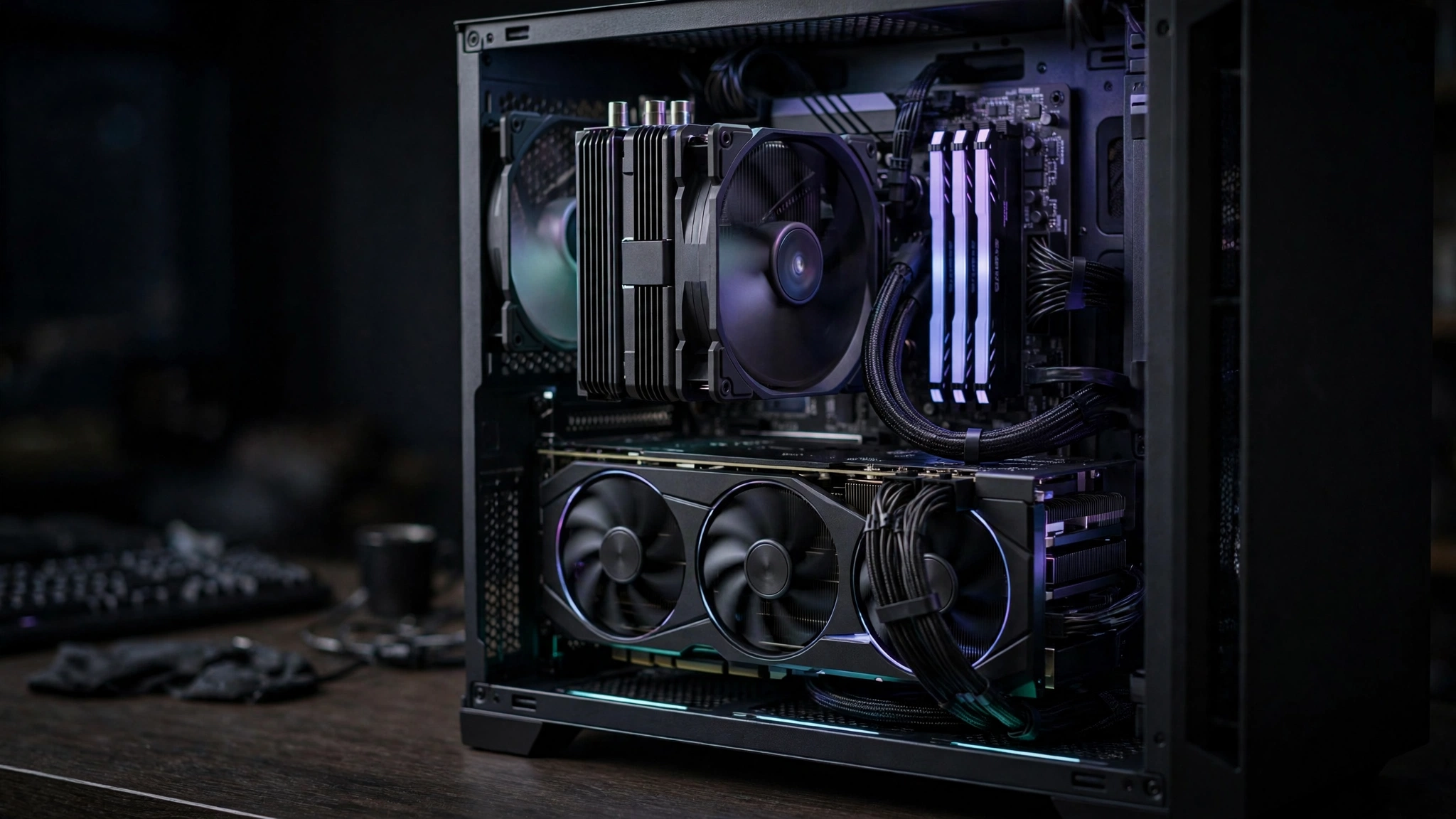
This is the single most important section for many buyers. 16GB is enough for 4K gaming today, even the heaviest current titles rarely exceed 13-14GB at 4K max settings. But the trend line is clear: texture packs, mods, and next-gen engines keep pushing VRAM usage up.
For gaming only, 16GB GDDR7 is fine for the next few years, and its enormous bandwidth means it is rarely the bottleneck. For AI/ML work, 3D rendering, or heavy DaVinci/Premiere timelines, 24GB is not a luxury, it is the difference between a model fitting in memory or not. Local LLMs, Stable Diffusion at high resolutions, and large Blender scenes all love VRAM.
Bottom line: if your workload says “VRAM” anywhere in the requirements, the 4090’s 24GB wins outright. If you only game, stop worrying about 16GB.
Power, Heat, and PSU: 360W vs 450W
The 4090’s 450W TGP is no joke. It needs a beefy PSU (850W minimum, 1000W recommended), dumps serious heat into your room, and its transient power spikes are legendary, early units famously needed ATX 3.0 PSUs to avoid shutdowns. The 5080 at 360W is meaningfully easier to live with: a quality 750-850W PSU suffices, and your room stays cooler.
Over a few years of heavy use, the power difference also shows up on your electricity bill. It won’t decide the purchase alone, but it is a real cost of 4090 ownership that used-market listings never mention.
Street Prices in Late 2026: The Shortage Tax
MSRP is fiction in the current market. Memory shortages have inflated GPU prices across the board, and both cards routinely sell above their launch prices when in stock. As a rough guide for late 2026:
A new RTX 5080 now starts at $2,199.99 for the cheapest in-stock card, and the cheapest new listing tracked was $2,881.52, about 188 percent above the $999 MSRP. A used RTX 4090 typically goes for $3,300 to $3,497 on eBay, with new listings near $5,199.99.
The math that matters: a used 4090 currently costs more than a new 5080, which is historically backwards. You are paying extra to lose your warranty. The 4090 only makes sense used when you need the 24GB of VRAM.
Buying a Used RTX 4090 Without Regrets
The used 4090 market is a minefield. These cards were the go-to for AI hobbyists and miners during their prime, and a card that ran at 100% load for two years is not the same as one that played Cyberpunk on weekends. That said, most 4090s were undervolted by knowledgeable owners, the risk is real but manageable if you check carefully.
- Ask for proof of purchase and usage history. Gaming-only cards from original owners are the safest bet.
- Check the 12VHPWR connector for melting or discoloration, the infamous connector issue affected early units.
- Stress-test before you pay if buying locally: run FurMark or a demanding game for 20+ minutes and watch temperatures and clock stability.
- Verify the warranty transfers. Some AIB warranties follow the card, others don’t. No warranty should mean a lower price.
- Compare against new 5080 pricing first. If the gap is under $150, buy new, the warranty alone is worth it.
Meet sellers in person where possible, use platforms with buyer protection, and never pay by irreversible methods.
CPU Pairings Which Chip Lets Each Card Breathe

At 4K, the GPU does most of the work, but the wrong CPU still costs you frames, especially in 1% lows.
Best CPUs for the RTX 5080
| CPU | Why it works | Best for |
|---|---|---|
| Ryzen 7 9800X3D | 3D V-Cache king, unbeatable gaming lows | Pure gaming builds |
| Ryzen 9 9950X3D | 16 cores + X3D cache, no compromises | Gaming + streaming/work |
| Core i7-14700K / 15700K-class | Strong all-rounder, often cheaper platform | Budget-conscious high-end |
Best CPUs for the RTX 4090
| CPU | Why it works | Best for |
|---|---|---|
| Ryzen 9 9950X3D | Feeds the 4090 fully, great for creators | AI/rendering + gaming |
| Ryzen 7 9800X3D | Still the gaming sweet spot | 4K high-refresh gaming |
| Core i9-14900K-class | Maximum multithread for workstations | Productivity-first builds |
Run your exact combo through our bottleneck calculator before buying at 4K both pairings are usually GPU-bound (which is what you want), but at 1440p high-refresh the CPU choice matters more.
The Rumor Mill Should You Wait for a 24GB RTX 5080
Rumors of a 24GB RTX 5080 variant (sometimes called 5080 SUPER or Ti) have circulated for a while. If it materializes, it would erase the 4090’s biggest advantage while keeping Blackwell’s efficiency and DLSS 4. But rumors are not products: there is no confirmed release date, and memory shortages make a VRAM-doubled variant expensive to produce.
Our advice: don’t wait on rumors. If you need a GPU now, buy based on what’s on shelves today, not on a card that may never arrive.
Verdict: The 2026 Decision Framework
Run through this in order:
1. Do you need 24GB VRAM? AI, 3D rendering, heavy video work, used RTX 4090 (or wait for a 24GB 5080).
2. Can you find an RTX 5080 near MSRP? Yes, buy the 5080. New card, warranty, DLSS 4.
3. Is a used 4090 at least $150-200 cheaper than a new 5080? Yes, the 4090 is a legitimate option.
4. Are you gaming below 4K? Then neither, put the savings toward a better CPU, monitor, or SSD.
Key Takeaways
- The RTX 4090 is 5-15% faster in native 4K rasterization, but the 5080 counters with DLSS 4 multi frame generation.
- 24GB VRAM makes the 4090 the clear winner for AI, rendering, and creative work.
- The 5080 wins on efficiency (360W vs 450W), warranty, and new-card peace of mind.
- A used 4090 only makes sense when meaningfully cheaper than a new 5080, and after careful inspection.
- Pair either card with a Ryzen 7 9800X3D or 9950X3D for the best 4K gaming experience.
Frequently Asked Questions
Is the RTX 5080 faster than the RTX 4090?
In native rasterization, no, the 4090 is typically 5-15% faster at 4K. But with DLSS 4 multi frame generation, the 5080 often feels smoother.
Is 16GB VRAM enough for 4K gaming in 2026?
Yes, for now. Current 4K titles rarely exceed 13-14GB even at max settings. It may become a limitation in a few years.
Should I buy a used RTX 4090 for gaming?
Only if it is significantly cheaper than a new RTX 5080 and passes inspection (connector check, stress test, proof of purchase).
Which uses more power, 5080 or 4090?
The RTX 4090, by a wide margin: 450W TGP versus 360W for the 5080. Budget for a 1000W PSU with the 4090.
Will there be a 24GB RTX 5080?
Rumors persist but nothing is confirmed. Don’t base a purchase decision on unannounced products.
Conclusion
The rtx 5080 vs rtx 4090 debate has no universal winner, but most gamers in 2026 should buy the new RTX 5080. It is the safer, saner, more efficient choice, and DLSS 4 makes it feel faster in supported titles.

Leave a Reply